Category Archives: Book Review

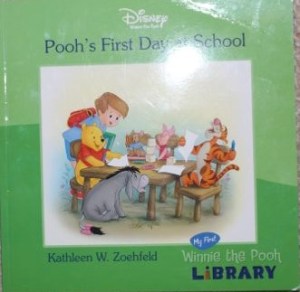
Pooh’s First Day at School by Kathleen W. Zoehfeld

Standard

IMG_8113Pooh’s First Day at School by Kathleen W. Zoehfeld and illustrated by the Disney Storybook Artists, paperback picture book, 32 pages, published by Funtastic Ltd in 2007.

Christopher Robin is starting school tomorrow, but the school is outside the 100-acre-wood, and only Christopher Robin gets to go. Roo and Tigger want to go too, but Piglet and Eyeore aren’t so keen. Since they can’t come with him, Christopher Robin sets up a classroom just for his friends, with singing, drawing, building, counting and even a snack of honey. He tells his friends all about school, and shows them it will be lots of fun.

This is a nicely illustrated picture book featuring the familiar characters from the 100-acre-wood. My kids love Winnie the Pooh and this book is no exception. They liked seeing some of their favourite characters enjoying a day at school. Even though Piglet was a little scared to go to school, and Pooh didn’t think he was smart enough to go, they both enjoyed the experience, as Christopher Robin shows them that school can be fun for everyone.

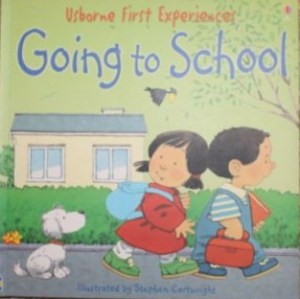
Usborne First Experiences: Going to School by Anne Civardi

Standard

IMG_8110Usborne First Experiences: Going to School by Anne Civardi and illustrated by Stephen Cartwright, paperback picture book, published by Usborne Publishing Ltd in 2005.

This book is part of the Usborne First Experiences series which is designed to introduce young children to new things, taking some of the anxiety out of these new situations. Going to School follows twins Percy and Polly Peach on their first day at school.

Getting ready for the day, going to school, meeting the teacher and the other children can all be a little daunting. Polly is a bit shy, but that’s okay because her mum can stay for a while to help her settle in, and there are lots of fun things to do at school, like painting, craft, music and playing in the playground. The day goes quickly and soon it is time to go home, going to school was pretty good after all.

This is a simple story showing that school can be a fun and safe place where children can make lots of friends. While reading this book, children can try to find the little yellow duck that is hiding on each page too. This adds an extra element of engagement for young children when reading this book. Another good book to read to children just about to start preschool or school.


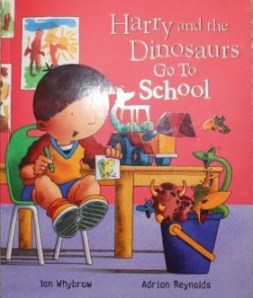
Harry and the Dinosaurs go to School by Ian Whybrow and Adrian Reynolds

Standard

IMG_8109Harry and the Dinosaurs go to School by Ian Whybrow and  illustrated by Adrian Reynolds, paperback picture book, published by Koala Books in 2006.

We have been a fan of Harry and his Bucketful of Dinosaurs for some time now, dinosaurs always attract my kids! This Harry installation is a lovely picture book that tells the story of Harry’s first day at school.

Harry is excited to be starting at school, but Stegosaurus isn’t so keen. He meets his new teacher, but the poor dinosaurs are left out in the hall with the coats. School doesn’t seem so much fun without his dinosaurs, but there is a boy that is much sadder than Harry. With the help of his dinosaurs, Harry befriends the boy and helps to make his first day better.

My kids love this book, and my preschooler often asks for it at bedtime. The story is simple, and the kids can relate to it. I also really like the illustrations. Starting school can be a bit scary, but making new friends makes going to school heaps of fun. This is a great book to help ease some of the nervousness of children who are about to start school for the first time.

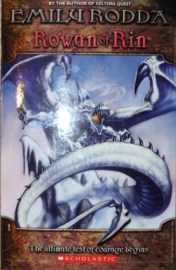
Rowan of Rin by Emily Rodda

Standard

IMG_8107Rowan of Rin by Emily Rodda, paperback, 138 pages, first published in 1993, this edition was published by Omnibus Books (part of the Scholastic Group) in 2005.

Rowan is a young boy, living in the little village of Rin with his mother, Jiller and his younger sister, Annad. Rowan is a caring, quiet, and shy boy, different to the other children of Rin. He is thought of as a weakling by many of the other villagers, who do not understand him. His job is to tend to the Bukshah, the gentle beasts that provide milk and wool to the people of Rin.

When the stream from the mountain that supplies the drinking water for the bukshah ceases to flow, the villagers are concerned, their lives depend on the bukshah. They must climb the mountain to discover the cause of the interrupted flow. Unexpectedly, Rowan must join the party of villagers chosen to embark upon this quest. They have a map to guide them, but it is full of riddles, and the path is full of dangers. And at the top of the mountain there is rumoured to be a dragon. Rowan and his companions have a frightening and arduous journey ahead, but they all must be brave and continue on regardless of any possible obstacles in order to restore the flow of water down the mountain. Rowan doubts he is up to the task at hand, but he sets out on the adventure of his life to save the bukshah and the village of Rin.

While this book is aimed at middle primary school children, I still love this story as an adult. It’s got adventure, fantasy, anticipation, riddles, and a dragon! I read this with my second grader, and she also loved the story. Each riddle gave us a great opportunity to discuss what it meant, and talk about what we thought might happen next in the story, and how it might affect the characters. It is very well written, and it is easy to bring Rowan and his traveling companions to life. I highly recommend this book for any child looking for a good adventure story.


Rowan of Rin won The Children’s Book Council of Australia Book of the Year in the Younger Readers category in 1994.

The Princess Diaries Series by Meg Cabot

Standard

The Princess Diaries are written in first person as Mia writing entries into her journal. The language used is appropriately teenager-ish with lots of “Why me?” and “I am not even kidding”, an extremely annoying phrase, as well as plenty of obsessive comments about boys, kissing, breasts and other teenage behaviours. For this reason, I think it would be unsuitable for children below upper primary or early high school to read.

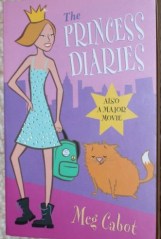
IMG_4928The Princess Diaries by Meg Cabot, paperback, 230 pages, published by Macmillan Children’s Books in 2001.

Mia Thermopolis thinks she is just a normal high school student with normal teenager problems, like flunking algebra, and lack of breast development. She thinks she is unattractive, unpopular, and flat-chested, and is sometimes bullied by the popular jocks and cheerleaders at school. Her best friend, Lilly, is a genius with tendencies towards being a bit domineering and superior, and Mia finds her brother, Michael, very attractive, but she can’t tell Lilly that. Mia lives in New York City with her artist mother and their extremely overweight cat, Fat Louie. Also her mum is dating her algebra teacher, the one subject she is currently failing. Her father lives in Europe in a small country called Genovia, and for her first fourteen years, Mia has thought he was a rich politician there, but then she discovers that her father is actually the reigning monarch of Genovia, and in turn Mia is the Princess of Genovia. That is when her life is turned upside down, and she has to face reporters, her Grandmere’s princess lessons, and having a bodyguard tag along on her every move, even around school. She records her adventures in the journal her mother gave her in the hopes that she might express her feelings somewhere at least, even if she won’t tell her.

I actually really enjoyed this book. It was entertaining and funny, and I came to like Mia. Of course, I could hardly see Mia as an average teenager though, even before it is revealed that she is a princess. After all, her mother is a well-known artist, and she spends summers and Christmases with her father at her Grandmere’s chateau in France. She attends what appears to be an expensive private school and mingles with geniuses on a daily basis. Her best friend, Lilly, has her own public access show, which Mia helps to film, and Michael publishes his own webzine.  That is hardly the life of an average teenager. And did it really come as such a surprise that her father was royalty? Where did Mia think all of that money came from, why does her Grandmere have before and after hour privileges to the shops in Genovia, why does her Grandmere’s chateau require a private airstrip, why doesn’t she spend her holidays at her father’s home? And why hasn’t she asked her father any of these questions? If you can just accept the premise that Mia believes herself to be a normal teenager, and that she really hadn’t asked herself any of those questions about her father, the story is quite enjoyable.


IMG_4927The Princess Diaries: Take Two by Meg Cabot, paperback, 213 pages, published by Macmillan Children’s books in 2001.

In the second book of the Princess Diaries, Mia has new problems to deal with. Her mum is getting married to her algebra teacher, whom she still refers to as Mr G, despite the impending certainty that he will soon be her stepfather. And her Grandmere has taken it upon herself to organise a most grandiose affair for the wedding, which Helen (Mia’s mother) will never agree to. Part of that included inviting Helen’s parents, whom she doesn’t get along with particularly well, all the way from Indiana, along with Mia’s cousin Hank. And if that isn’t bad enough, she has to cope with press interviews, and a secret admirer that she hopes is Michael, about which she still can’t talk to Lilly about it. Another enjoyable story about an unlikely teenage princess moving through the hazardous world of family, friends and high school.


Wings & Co: Operation Bunny by Sally Gardner

Standard

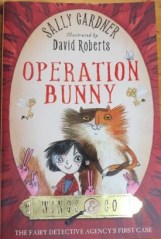
IMG_3647Wings & Co: Operation Bunny by Sally Gardner and illustrated by David Roberts, paperback, 185 pages, published by Orion Children’s Books in 2012.

Emily Vole was abandoned in a hatbox as a baby, and she is adopted by the very rich Ronald and Daisy Dashwood. Daisy is very vain and rather stupid, and when she falls pregnant with triplets, she turns Emily from adopted daughter into a Cinderella like slave. Emily works from sun-up to sun-down cleaning, washing, and caring for the triplets. She is not allowed to go to school and has to sleep in the laundry. One day by chance Emily meets her wonderful and elderly neighbour Miss String, and her man-sized talking cat, Fidget. They help and teach Emily, and open her to the world of magic and fairies. When the evil witch, Harpella, comes wreaking vengeance, Emily and Fidget set off on the run. They team up with the grumpy and rather self-important Buster who is a fairy detective, and together they try to destroy the evil Harpella.

I really enjoyed this story, and am looking forward to the next instalment to see what Emily, Fidget and Buster get up to. It was well written with some funky black and white illustrations to enhance the story. I found it to be an entertaining read that I wanted to keep reading to the end. I will be encouraging my first grader to read this, as I think it is suitable for school aged children. Emily is a quirky character with independence and smarts, and I liked her. Fidget was also a good character, with many cat and fish related phrases, and a rather sardonic sense of humour. I will enjoy reading this again to my pre-schooler.

The Snake Who Came To Stay by Julia Donaldson

Standard

IMG_3649The Snake Who Came To Stay by Julia Donaldson and illustrated by Hannah Snow, paperback, 77 pages, published by Scholastic in 2013.

This is a chapter book written by the author of one of our favourite books, The Gruffalo. The summer holidays are coming up and Polly has advertised her home as a holiday place for pets. After she has accepted responsibility for Bill and Ben the guinea pigs, Charlie the Mynah bird, Doris the snake and a pondful of fish next door, Polly’s mum says that is enough. The guinea pigs make lots of noise, Charlie keeps loudly imitating everything, and Doris hisses quietly in her tank in the kitchen. It’s a rather noisy holiday home for pets, but everything is going well until Polly leaves Doris’ tank lid open. Her mum is not impressed, but surely Doris will turn up somewhere soon.

This is an easy chapter book with black and white illustrations throughout. It was a nice story with likeable characters and some funny bits. Suitable for lower primary school children, I read this to my preschooler, and she enjoyed it. My first grader read this and it was an easy read for her, but she liked the story.

Change the Locks by Simon French

Standard

IMG_3406Change the Locks by Simon French, paperback, 103 pages, published by Ashton Scholastic Pty Limited in 1991.

Steven, an eleven year old boy living with his Mum and baby brother, Dylan, doesn’t remember much about his early life, and any questions he asks are deflected by his mother. Her life is in tatters, as she tries to cope with her abusive ex, no job and living out of town without a car. There isn’t much left over for Steven and Dylan, and most of Dylan’s care is left to Steven, a big responsibility for a boy. When Steven’s teacher starts a pen pal program with a class from another school, Steven’s pen pal’s name sparks a memory. He is sure that he has heard that name before, but he can’t quite place it. He is puzzling over this when he and his best friend, Patrick, discover an old newspaper under the flooring while they are helping his parents with some renovations. The newspaper has an article that just might be about Steven and his Mum, but it leads to more questions than answers for Steven, and he really wants to find out the truth. He feels that he is old enough now to know how and where his life began, and why he’s never been told about it before, but his mother may not be ready to tell her story.

This book is fairly short for a novel, but it is still a good read. Steven has to cope with things that many kids will have no exposure to, such as not knowing his father or grandparents, caring for his younger brother, even during the night, which makes him very tired, and being scared of his mum’s ex-boyfriend. These things make Steven different to other kids, and children can often be mean to those that are different, making his school life harder, just as his home life is also difficult. These are great burdens for a boy of that age. The subject matter is handled well, and the story is compelling. I remember reading this for the first time in about year four, and handling it well, though we also discussed it in class, which allowed for more understanding of the themes and issues presented in the story. This is especially important for younger readers so that they get the most out of the book. It’s probably best for middle and upper primary age children.

The 39-Storey Treehouse by Andy Griffiths and Terry Denton

Standard

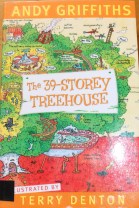
IMG_3581The 39-Storey Treehouse by Andy Griffiths and Terry Denton, paperback, 344 pages, published by Pan Macmillan in 2013.

Following on from The 26-Storey Treehouse, Andy and Terry have added another 13 storeys to their amazing treehouse. There is a bowling alley, a tank of man-eating sharks and an active non-erupting volcano, but the 39th level is still under construction.  The boys are writing their next book when they get a call on their 3D telephone from Mr. Big Nose, who imposes a ridiculous deadline of the following afternoon for the new book. How can Andy and Terry write and illustrate a long book in such a short time, as long books take longer to write than short books, which take a shorter time to write than long books…. Well, Terry has the answer, on the 39th level his new invention will do the writing and illustrating for them. But when the machine thinks it can do a better job at writing books than Andy and Terry, things get out of hand. They have to regain control of their treehouse and their book, and what better way to do that than invite Professor Stupido, the greatest un-inventor ever to live, to un-invent Terry’s machine, but what if Professor Stupido doesn’t want to stop there?

This book is a crazy ride of the imagination, where anything and everything is possible, and will probably happen! A very amusing book for lower to middle primary aged students and above, it really does have laugh out loud moments, and my first grader thought it was hilarious. She read it several times over the weekend, as it is a pretty easy read, despite its length. The text is simple, large and heavily interspersed with amusing black and white illustrations. I think this would be a good book for a reluctant reader.


Ella and Olivia Series by Yvette Poshoglian

Standard

We’ve been reading some of the books from the Ella and Olivia chapter book series. They have simple storylines, with large text and black and white illustrations, making them a great start to reading chapter books for lower primary school children. I’ve read these books to my pre-schooler and she loved them, wants me to keep reading so she can find out what happens. I don’t mind reading them to her either, which is something I can’t say about every book she picks out! When she is ready for chapter books, I would be happy for her to read these books on her own. I think she particularly related to Ella and Olivia because she saw herself as being like Olivia, with an older sister that she idolises, and a baby brother who drools a lot 🙂 These could be stories about her and her sister, so it’s easy for her to picture the story unfolding. We are going to see if there are some more Ella and Olivia books available from the library for us to read together.

Update August 2015: Now in kindergarten, my daughter still loves these books, but now she can read them herself. We have collected the entire set now, and each time a new one is released, she asks for it straight away. I will try to review the rest of the series in the coming months.
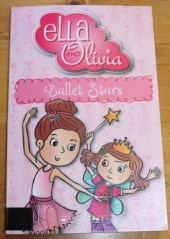
IMG_3536Ella and Olivia: Ballet Stars by Yvette Poshoglian and illustrated by Danielle McDonald, paperback, 63 pages, published by Scholastic Australia in 2012.

This is book number three in the series. Olivia wants to be just like her big sister, Ella. In Ballet Stars, Ella is taking ballet lessons, and Olivia wants to learn to dance too. Ella’s ballet school is putting on a production of Cinderella, and Ella wants to be the star and dance a solo. Olivia wants to be in the show as well. Ella practices and practices, teaching Olivia along the way, even if Olivia only has her swimmers and sandals to dance in instead of a leotard! Will the girls get want they want?
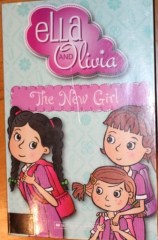
 

IMG_3644Ella and Olivia: The New Girl by Yvette Poshoglian and illustrated by Danielle McDonald, paperback, 63 pages, published by Scholastic Australia in 2012.

This is the fourth book in the series. In The New Girl, it is Olivia’s first day at big school, and Ella is starting year two. There is a new girl in her class, Millie, and she is a bit mean. She is rude to Ella, and Ella starts to dislike her. When Millie is mean to Olivia and won’t let her play with them, Ella stands up to Millie on Olivia’s behalf. Maybe Millie isn’t really mean, maybe she is just feeling lonely in unfamiliar surroundings. Will Ella give her a chance?


IMG_3580Ella and Olivia: Puppy Trouble by Yvette Poshoglian and illustrated by Danielle McDonald, paperback, 63 pages, published by Scholastic Australia in 2013.

This is book number five in the series. In Puppy Trouble, Ella and Olivia are finally allowed to have a puppy. They pick out a cute little fellow from the pet shop and take him home. They soon discover that there is much more to keeping a puppy than just playing with it all the time. This story gentle reminds readers that pet ownership comes with responsibility, including cleaning up after your pet, even when you just want to play with them.


IMG_3631Ella and Olivia: The Big Sleepover by Yvette Poshoglian and illustrated by Danielle McDonald, paperback, 63 pages, published by Scholastic Australia in 2013.

This is book number six in the series. In The Big Sleepover, Ella is allowed to have her very first sleepover with her best friend Zoe. Ella is very excited. When Zoe arrives for the sleepover, her dad suggests that Ella might like to come riding with Zoe the following day. The girls have fun, but when it’s time for bed they don’t want to go to sleep. A midnight snack, giggling and waking Olivia makes for a late night. And there are consequences come morning.
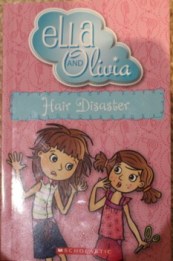
 

IMG_4950Ella and Olivia: Hair Disaster by Yvette Poshoglian and illustrated by Danielle McDonald, paperback, 63 pages, published by Scholastic Australia in 2015.

This is the fifteenth book in the series. Ella is preparing to play Sleeping Beauty in her ballet recital. She has been practicing with Olivia everyday. Ella and Olivia decide to try out some hair styles in the bathroom the day before the show. Olivia brushes Ella’s hair over and over, and then Olivia reaches for the scissors. What will Ella’s hair look like for the ballet concert?