Tag Archives: investigations

Rising Colours

Standard
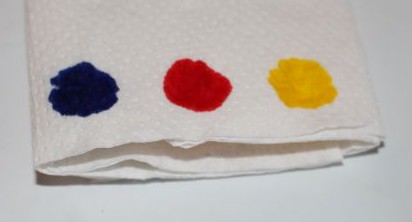
Primary colours on paper towel.

Primary colours on paper towel.

We were talking about primary colours yesterday, and I thought we could try a little experiment with paper towel.

A and I made some coloured spots with markers on paper towel and placed it in water to see what would happen. As the paper towel sucked up the water, it took the colours with it, making them rise up the paper towel. A was amazed and excited by this.
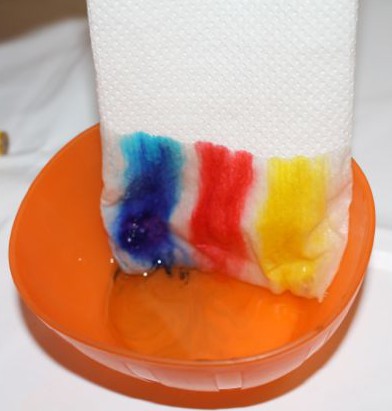
Colours rising up the paper towel.
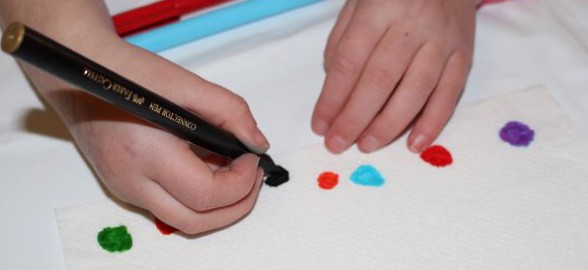
Colours rising up the paper towel.

A colouring in her spots.

A colouring in her spots.

A used markers to make more coloured spots on another piece of paper towel and placed it in some water on a plate. She let the paper towel lay flat, rather than upright. The colours spread out on the paper towel as the water was absorbed.

The colours spreading out.

The colours spreading out.

We also tried drawing the primary colours on top of each other before placing the paper towel in the water. The yellow rose up into the red, then both of them into the blue. Up went the water, and up went the colours, mixing together to make some orange, and purple and brown.

The colours stacked on top of each other.

The colours stacked on top of each other.

The colours rising into each other.

The colours rising into each other.

This was fun and easy, and I loved watching A’s eyes light up when she saw what was happening.
Celery Experiment

Standard

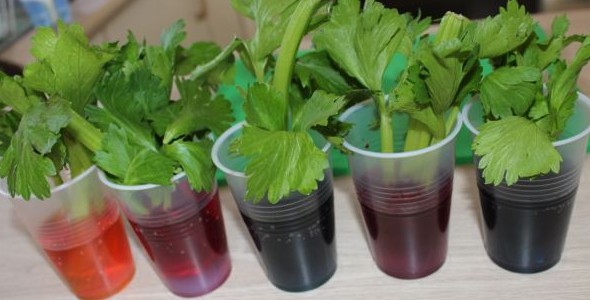
The kids don’t really like to eat celery (though I do), but they weren’t averse to using it for an experiment. What happens when we place celery tops into cups of coloured water?

At the start.

At the start.

We chose five food colours, red, pink, green, yellow and blue. We placed some of each colour into five separate plastic cups and then filled the cups up to about half way with water. Each cup got its own celery top. I asked the kids what they thought would happen if we left them like that, they both thought the celery would suck up the water. We also talked about what would happen to the colours, and would we see a difference between the colours. I was predicting that blue and red would produce the most dramatic change, and L predicted that yellow and green wouldn’t do anything.

We left the celery for about an hour. By this time, we could see some colour rising up the stalks, and travelling through the leaves. The pink and blue ones had the most obvious change in colour.

Pink, blue and red (l-r) after an hour.

Pink, blue and red (l-r) after an hour.

After an hour.

After an hour.


After about 24 hours, much more of the colour had been transferred from the cups into the leaves, producing a mottled effect on the leaves. We could also see the colour in the stalks. The red, pink and blue showed a major change in the colour, while the yellow and green ones were much harder to see. Looking closely at the green one, we could see the colour where some of the leaves were a little damaged, and around the edges of the leaves. The yellow one’s leaves appeared somewhat brighter than before the experiment, and we could see the yellow around the top of the stalk, but compared to the other colours, it was very difficult to see what had happened.

After 24 hours, the red, blue and pink (l-r) had a dramatic change.

After 24 hours, the red, blue and pink (l-r) had a dramatic change.

This little experiment demonstrates the way plants suck up water throughout their stem and leaf systems. It is another example of capillary action at work. L was quite interested in it, but A mostly just liked the pretty colours the celery had turned 🙂

Magnifying Glasses

Standard
Looking at the tree leaves.

Looking at the tree leaves.

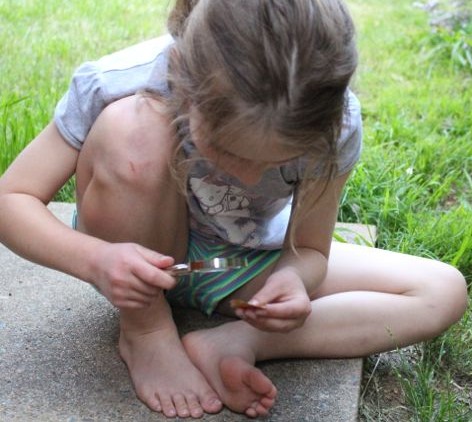
Big L brought home a magnifying glass in a sample bag last week. He gave this to L and found our kids magnifying glass for A. The kids took them into the yard to explore. They looked at leaves, grass, bugs, feathers, flowers, the concrete path, pegs, and many other things, including their own hands and feet. This gave the kids a different perspective on the outside things that they see every day. They really enjoyed using the magnifying glasses, and have asked to explore with them again soon.

Investigating a leaf.

Investigating a leaf.

Investigating a curled up leaf.

Investigating some bark.