Tag Archives: kids non-fiction

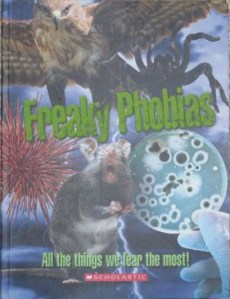
Freaky Phobias by Joel Levy

Standard

IMG_2519Freaky Phobias by Joel Levy, paperback non-fiction, 80 pages, published by Scholastic Australia in 2011.

This book is a fascinating insight into a range of phobias. It covers the most common ones, such as arachnophobia and claustrophobia, alongside some extremely unusual phobias. I never knew there was a word for the fear of otters or knees or kissing, but there is! And there are many other phobias that I had never considered, but discovered in Freaky Phobias.

Freaky Phobias is an informative and interesting book for primary aged children. I learnt quite a lot whilst reading Freaky Phobias, as did my second grader. It had a good depth of information for children, and plenty of fun facts to engage the reader. The photography depicted all of the terrors contained within the book with such clarity that my second grader wanted to skip some of the pages because she felt anxious.

Freaky Phobias contains an A-Z of Phobias, providing the names and descriptions of quite a few phobias. I think this glossary could have been enhanced by including the phonetic spelling of the names, as some of them are quite long and complicated words, which I had difficulty pronouncing.

This is quite a good non-fiction title for young learners (and big ones too!)


Big Book of Aussie Dinosaurs by Kel Richards and Glen Singleton

Standard

IMG_1489Big Book of Aussie Dinosaurs by Kel Richards and illustrated by Glen Singleton, hardback non-fiction, 25 pages, published by Scholastic Australia in 2014.

Over the years we have read many dinosaur books, but I think this is the first one exclusively about Australian dinosaurs. It is a clear and simple introduction to this topic, suitable for preschoolers and lower primary school children. It contains facts about each dinosaur, with quirky illustrations on every page. My preschooler liked the carnivores running around with knives and forks. Her favourite dinosaur is Minmi, and she liked that a carnivore’s knife and fork were drawn crumpled from trying to penetrate her hard bony plates.

There is a glossary of Australian dinosaurs at the back of the book with a picture, the full name, phonetic pronunciation and the meaning of the dinosaur’s name. We tried saying all of the names aloud, some of them were quite difficult!

Prefect for all small dinosaur lovers, Big Book of Aussie Dinosaurs deserves a place in any dinosaur book collection!


Jeremy by Chris Faille and Danny Snell

Standard

IMG_1357Jeremy by Chris Faille and illustrated by Danny Snell, published by Working Title Press in 2013.

Jeremy is a baby kookaburra that has fallen out of his nest. The family cat brings him home when he is just a wrinkly little pink ball with closed eyes. The nest is too high to return the bird to, so the family look after him, keeping him warm and feeding him. Jeremy grows feathers, and gets bigger and stronger. All too soon he is ready to face the world on his own.

Jeremy is a heart warming tale of survival, that also serves to introduce the reader to the basics of how a kookaburra develops. The story itself is a simple narrative following Jeremy’s progress from ugly newborn to young adulthood, when he is ready to fend for himself.

Inside the front and back covers, lots of facts about kookaburras are presented, considerably increasing the depth of knowledge gained from this book. The illustrations in Jeremy are an asset to this book, as they are wonderfully life-like, and so detailed. They bring Jeremy to life as he grows and changes.

Several times as a child I found a poor baby bird that had fallen or been pushed from its nest, and tried to save it. None of mine were as lucky as Jeremy though. I was pleased that Jeremy grew into a healthy young kookaburra that could be released back into the wild, despite his shaky start. My preschooler was surprised, having never seen a newly hatched bird,  that baby birds have no feathers and are completely defenceless. She enjoyed the extra facts about kookaburras, and I’m pretty sure she learnt some things!  As this book is mostly non-fiction disguised as a picture book, I think it would be an excellent tool to help encourage children into reading more non-fiction. Good for curious kids in primary school and preschool, I enjoyed sharing Jeremy with my daughter very much.


* Jeremy was the winner of the 2014 Children’s Book Council of Australia Book of the Year in the Eve Pownall Award for Information Books category.

My Body by Bloomsbury Discovery

Standard

IMG_1196My Body by Bloomsbury Discovery and illustrated by Joelle Dreidemy, large format non-fiction boardbook with flaps, published by Bloomsbury Publishing Plc in 2014.

Most children love lift-the-flap books, and this one has dozens of flaps that open to reveal lots of fun facts and information about the body. A wonderfully engaging book for preschoolers and children in lower primary, My Body covers human evolution and the various body systems in a detail appropriate for this age group. The main illustrations were plentiful, detailed and clear, showing a good life-like representation of the human body. There were also lots of other illustrations on every page with more facts, and these had more of a cartoon quality about them.

The flaps were a big attraction for my preschooler, but once we started reading, she really got into the information too. She asked a lot of questions while we were reading, she came back to the book later to look through it again herself, and asked me to re-read a few sections to her. We ended up reading the whole book in one sitting as she was enjoying it so much. The information contained within this book was detailed enough that my second grader also found it useful and enlightening. I have heard my preschooler repeat several facts she learnt from My Body, especially that people shouldn’t eat snot because it contains germs!


Ears, Eyes, Nose by Rebecca Bondor

Standard

IMG_1191Ears, Eyes, Nose by Rebecca Bondor, a Rookie Toddler boardbook, published by Children’s Press (Scholastic) in 2014.

This boardbook introduces young children to some of their body parts. It contains clear photographs of children pointing to their own ears, eyes, and other parts. Seeing children just like them can help toddlers and young children to engage in learning new things. And with only one large print word per photo, and a sturdy board construction, this is a great book to start learning body parts with babies and toddlers.

Ten Tiny Toes by Caroline Jayne Church

Standard

IMG_1195Ten Tiny Toes by Caroline Jayne Church, boardbook, published by Cartwheel Books in 2014.

A simple and engaging book for toddlers celebrating their bodies. As I read through Ten Tiny Toes with my son (15 months old), I encouraged him to point to each part of his body and do the actions in the book. He liked looking through the book and pointing to the pictures, and especially grabbing his toes when we read ‘and ten tiny toes!’ He did laugh and giggle when we touched his tummy too. The text was large with rhyming language, and the illustrations were simple, yet nice. This story helped us to focus on learning parts of the body in a fun way that many toddlers will enjoy.

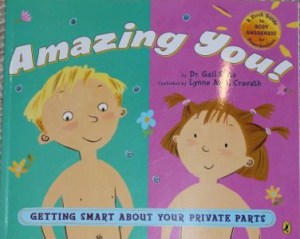
Amazing You! by Dr. Gail Saltz and Lynne Avril Cravath

Standard

IMG_1170Amazing You! by Dr. Gail Saltz and illustrated by Lynne Avril Cravath, paperback non-fiction, first published by Dutton Children’s Books in 2005, this edition published by Puffin Books in 2008.

Amazing You! is a basic look at the reproductive systems for young children. Aimed at preschoolers, this book provides information on body awareness and answers questions about ‘private parts’. It is a good first journey into what can be an awkward topic for many parents.

The text and illustrations are clear and simple, using anatomical names and easy to understand language. There is also a helpful section at the back of the book for parents on talking about sexual curiosity and where babies come from with their children. When it comes to describe how babies are made, it does not go into extensive detail, but sticks to the basics of egg and sperm, all a preschooler really needs to know. The book mentions that sexual curiosity is natural and normal, including masturbation and asking questions. It also reminds us that our bodies and our sexual organs should not be a source of embarrassment or shame, because they are all part of us, and we are amazing!

Mummy Laid an Egg! by Babette Cole

Standard

IMG_1174Mummy Laid an Egg! by Babette Cole, non-fiction paperback, first published by Jonathan Cape in 1993, this edition published by Red Fox in 1995.

Dad and Mum have decided to tell their kids where babies come from. They tell the kids that sometimes dinosaurs deliver babies, or they can be grown from seeds, made from gingerbread, or they can even be found under rocks! And in this case, the kids exploded from a huge egg that Mum laid on the couch. The kids think this is hilarious. They quickly begin on a journey to set their parents straight, including lots of drawings explaining just how babies are made.

A light-hearted look at reproduction, this book is perfect for younger children from preschool up. The drawings are humorous, educational, and appropriate for the intended audience. The language is easy to understand for children, and the subject matter is treated without any of the seriousness that sometimes surrounds this often delicate topic. I think this book would be especially good for parents who are a little nervous about having “the talk” with their kids, it is a great way to lighten the mood.

Both my preschooler and second grader love this book. I think that it is the best introduction to the sensitive subject of conception and reproduction that I have come across. It is honest, frank and amusing. I particularly like the pages that show how mummies and daddies fit together, some truly awkward and hilarious positions! My kids laughed at the ridiculous stories that the Mum and Dad tell their kids, as well as at many of the drawings throughout the book. It covered the basics, and my kids were happy with the content, re-reading it several times, asking questions and discussing it. A really nice book, I am very glad I purchased Mummy Laid an Egg!


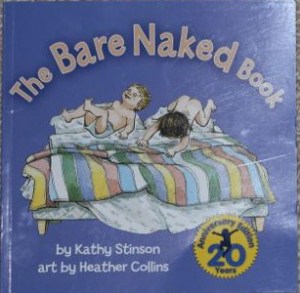
The Bare Naked Book by Kathy Stinson and Heather Collins

Standard

IMG_1167The Bare Naked Book by Kathy Stinson with art by Heather Collins, paperback non-fiction, first published in 1986, this edition published in 2006 by Annick Press.

This is a simple look at our bodies, and the different parts that make them up. With basic language and clear illustrations, this is a nice book for toddlers and preschoolers. It introduces each part of the body, with some illustrated examples of each, such as pushing arms, hairy nipples and stamping feet. At the end of each page, it asks the child to locate that body part on themselves, which is a great prompt for learning body parts and for body awareness.

My preschooler liked the pictures, and had fun locating all her body parts as suggested by the book. She enjoyed perusing this book on her own too, looking at the pictures, and pointing out what the different parts of the body were doing.

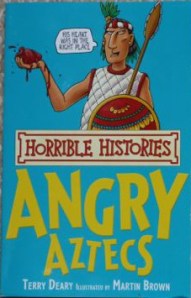
Horrible Histories: Angry Aztecs by Terry Deary and Martin Brown

Standard

IMG_0855Horrible Histories: Angry Aztecs by Terry Deary and illustrated by Martin Brown, paperback non-fiction novel, 138 pages, first published by Scholastic Ltd. in 1997, this edition published in 2008.

This is a book that tackles the perception of history being boring, and re-invigorates it in a format perfect for children thirsty for knowledge. I thoroughly enjoyed this informative look at the Aztecs, how they lived and how they died, including all the nasty bits, such as human sacrifices, violent ball games and dogs for dinner. There was information on the Aztecs’ neighbours, enemies and the Spanish Conquistadors, their diets, priests and marriages.

Angry Aztecs is full of historical facts that were easy to understand, and presented alongside amusing black and white drawings. As well as allowing easier visualisation of parts of the Aztecs’ history, the illustrations included some comics to help elucidate various points being made in the text. There were also engaging quizzes that assisted in consolidating the knowledge acquired throughout the book

A very definitely not boring insight into the peoples of this interesting empire of the Americas, this is a good read for middle and upper primary school children, especially those interested in history or other cultures. It is on my second-grader’s ‘to read’ list, along with many other titles from his fantastic series. Everyone needs some Horrible Histories in their lives!