Category Archives: Animals

Sleep Tight, Ginger Kitten by Adèle Geras and Catherine Walters

Standard

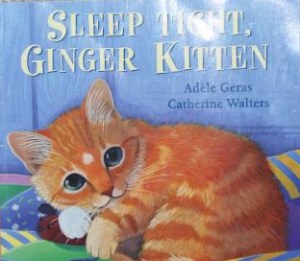
IMG_2447Sleep Tight, Ginger Kitten by Adèle Geras and illustrated by Catherine Walters, paperback picture book, first published by Little Tiger Press in 2001, this edition published by Ice Water Press in 2001.

The sleepy little ginger kitten is looking for a place to nap. He gets disturbed in the bathroom, and on the bed, the box is too small and the shoes too lumpy, will he ever find a cozy and comfy place to sleep?

This picture book is suitable for preschool and lower primary school children, and is just perfect for kitten and cat lovers. The ginger kitten is extremely cute, and the book is beautifully illustrated throughout. I can remember my cats acting just like this when they were only kittens. Kittens are beautiful and funny creatures, and this story reflects their behaviour well. It reminds me of how lovely it is to have a sleepy kitten curled up on my lap purring. Sleep Tight, Ginger Kitten has been a favourite for both my kitten loving daughters from about three years old.

The Great Reindeer Rebellion by Lisa Trumbauer and Jannie Ho

Standard

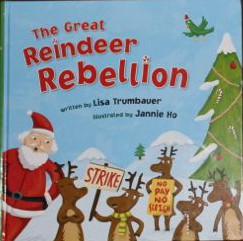
IMG_2445The Great Reindeer Rebellion by Lisa Trumbauer and illustrated by Jannie Ho, hardback picture book, first published by Sterling Publishing Co., Inc. in 2009, this edition published by Koala Books in 2010.

The reindeer have demands, so they decide to go on strike. They will not pull Santa’s sleigh until their conditions change. There’s only days until Christmas, and Santa needs someone to pull his sleigh, so he advertises for a sleigh team. He tries out cats and dogs, kangaroos and flamingos, will he find the right helpers in time to deliver all the presents?

This is probably our favourite Christmas book. It gets read all year round, with more frequent readings leading up to Christmas. My kids think it is hilarious. The illustrations are just as funny as the rhyming text, and I really enjoy reading this with my kids. I love the sleigh team trials, and the reasons that each animal isn’t up to par.

The Great Reindeer Rebellion is a fantastic Christmas book for preschool and primary school aged children. Be prepared to read this one again and again!

Where is the Green Sheep? by Mem Fox and Judy Horacek

Standard

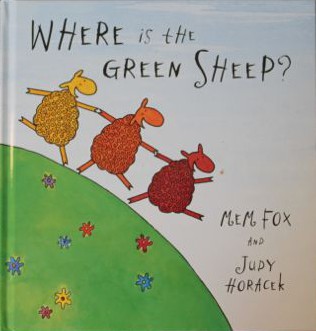
IMG_1566Where is the Green Sheep? by Mem Fox and illustrated by Judy Horacek, hardback picture book, published by Penguin Books (Australia) in 2004.

There are blue sheep and star sheep, up sheep and car sheep, but where is the green sheep? Find out as you turn the pages, discovering many different sheep along the way.

A brilliant early childhood book, Where is the Green Sheep? is perfect for every child. We discovered it by chance at the library when my first child was a toddler. We borrowed it so often over the following months we finally went out and bought our own copy. It has been read many many times, to the point where the kids could repeat it verbatim without even opening the book. Despite this, I never tire of reading this book to my kids, it really brings them (and me) so much joy. Where is the Green Sheep? is a wonderful book to share with toddlers and preschoolers, and older children will also enjoy the lyrical text and cute pictures.

It is a fun rhyming search through the flock to find the elusive green sheep. The story and illustrations are simple, yet extremely engaging for young children. The text is large and easy to read. The language is suitable for children just learning to read as well. We like to read Where is the Green Sheep? aloud, building up the rhythm of the text, and the kids always join in for “But where is the green sheep?”. The sheep are very distinctive, and the kids enjoy discovering what type of sheep are on each page, as if they have never read it before.

No children’s library would be really complete without this magnificent picture book from one of Australia’s favourite authors, Mem Fox. Now don’t be a slow sheep, go out and find the green sheep! (from all good book sellers).


* Where is the Green Sheep? was the winner for the 2004 Children’s Book Council of Australia Book of the Year in the Early Childhood category.

Banjo and Ruby Red by Libby Gleeson and Freya Blackwood

Standard

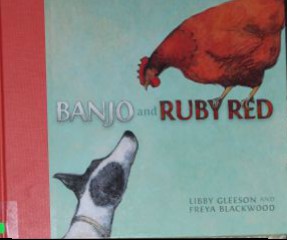
IMG_1486Banjo and Ruby Red by Libby Gleeson and illustrated by Freya Blackwood, hardback picture book, published by Little Hare Books in 2013.

Banjo is a chook dog. It is his job to round up the chooks and get them into their pen to be shut in for the night. He barks and chickens come from all over, except Ruby Red, who sits on the wood heap and ignores Banjo. When Ruby Red falls ill, Banjo finds her and cares for her during her recovery.

Gorgeously illustrated, this story of a wayward and head strong chook and her diligent round-up dog, is both moving and funny. I liked the barking and the squarking, with chooks flying everywhere, it reminded me of the chook yard my grandparents had when I was a child. My preschooler liked that Ruby Red ignores Banjo until he topples the wood pile, this made her laugh. I think she saw herself in Ruby Red, stubborn and resistant til the last! My second grader liked Banjo, and how he cared for Ruby Red when she was sick, even though she had antagonised him in the past. Friendship and love can conquer all.

Banjo and Ruby Red is a lovely book for sharing with preschoolers and lower primary school children, and a must have for primary school libraries!


* Banjo and Ruby Red was an honour book for the 2014 Children’s Book Council of Australia Book of the Year in the Early Childhood category.

Cardboard Roll Sheep

Standard

A loves sheep, and spends a lot of time playing with her sheep figurines. She also likes to draw and make sheep. This sheep was made with a cardboard roll and some cotton balls.

IMG_1500

Matchstick legs.

Matchstick legs.

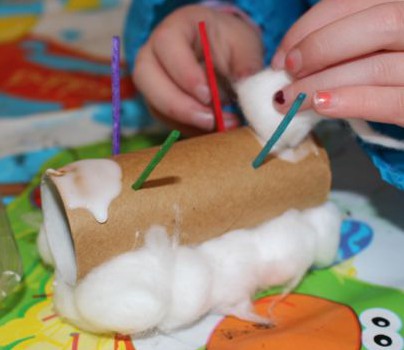
We added legs to the cardboard roll first. I made some small holes and A poked a coloured matchstick into each one. Then she got to gluing on the wool, which was lots of cotton balls. She added so many cotton balls that the sheep became a little heavy for its legs! Next time I think we might need to use popsticks or something else a little sturdier for legs. Either that, or we make the sheep less woolly.

Adding wool.

Adding wool.

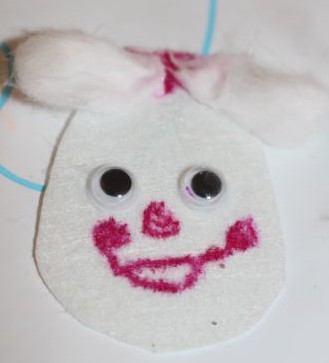
For the face, we used a piece of white felt. A decorated it with a mouth and nose and some googly eyes. She used a little bit of the cotton wool to make two droopy ears, and glued them to the top of the the head. Then she used some craft glue to stick the face to the body, and she had her sheep.

The sheep's head.

The sheep’s head.

A insisted it was just a baby lamb, but I think it looked more like a sheep that hadn’t been shorn for about three years!

A very woolly sheep.

A very woolly sheep.

Baby Bedtime by Mem Fox and Emma Quay

Standard

IMG_1479Baby Bedtime by Mem Fox and illustrated by Emma Quay, hardback picture book, published by the Penguin Group in 2013.

A mummy elephant gets her baby ready for bed with a beautiful bedtime lullaby. She tells her baby all the things she could do, such as nibbling on his ears, and gazing at him all night, but then the time for sleep has come.

Baby Bedtime is a lovely lullaby of love from a mother for her baby. The sentiment would be shared by many parents, and I definitely feel this way about my own children. The illustrations are just gorgeous, and gently rendered, making me feel relaxed and calm. Helpful for lulling little ones into sleep, this is perfect for reading to toddlers and preschoolers before bed. My second grader liked this story, but she thought she was a bit old for it.

Jeremy by Chris Faille and Danny Snell

Standard

IMG_1357Jeremy by Chris Faille and illustrated by Danny Snell, published by Working Title Press in 2013.

Jeremy is a baby kookaburra that has fallen out of his nest. The family cat brings him home when he is just a wrinkly little pink ball with closed eyes. The nest is too high to return the bird to, so the family look after him, keeping him warm and feeding him. Jeremy grows feathers, and gets bigger and stronger. All too soon he is ready to face the world on his own.

Jeremy is a heart warming tale of survival, that also serves to introduce the reader to the basics of how a kookaburra develops. The story itself is a simple narrative following Jeremy’s progress from ugly newborn to young adulthood, when he is ready to fend for himself.

Inside the front and back covers, lots of facts about kookaburras are presented, considerably increasing the depth of knowledge gained from this book. The illustrations in Jeremy are an asset to this book, as they are wonderfully life-like, and so detailed. They bring Jeremy to life as he grows and changes.

Several times as a child I found a poor baby bird that had fallen or been pushed from its nest, and tried to save it. None of mine were as lucky as Jeremy though. I was pleased that Jeremy grew into a healthy young kookaburra that could be released back into the wild, despite his shaky start. My preschooler was surprised, having never seen a newly hatched bird,  that baby birds have no feathers and are completely defenceless. She enjoyed the extra facts about kookaburras, and I’m pretty sure she learnt some things!  As this book is mostly non-fiction disguised as a picture book, I think it would be an excellent tool to help encourage children into reading more non-fiction. Good for curious kids in primary school and preschool, I enjoyed sharing Jeremy with my daughter very much.


* Jeremy was the winner of the 2014 Children’s Book Council of Australia Book of the Year in the Eve Pownall Award for Information Books category.

The Swap by Jan Ormerod and Andrew Joyner

Standard

IMG_1358The Swap by Jan Ormerod and illustrated by Andrew Joyner, hardback picture book, published by Littler Hare Books in 2013.

Caroline Crocodile is very jealous of her baby brother. Mama Crocodile is always saying how wonderful he is, and giving him big smoochy kisses. Caroline thinks her brother is just a big smelly and drooly mess, and she really wants Mama Crocodile to herself. So when Mama Crocodile asks Caroline to look after her brother while she pops into the hat shop, Caroline decides to trade her brother for a new baby  at The Baby Shop. She tries a baby panda, twin tiger cubs and an elephant, but none of them are quite right. Perhaps her baby brother really is the best brother to have after all?

A beautiful picture book about the love of a sister for her brother, this story touched my heart. My preschooler chose this book to read before bed last night, and it was lovely to share it with her. She has a baby brother of her own, who she thinks is often smelly and dribbly just like Caroline’s little brother. I’m pretty sure my preschooler has considered swapping her brother on occasion (when he threw her toothbrush in the toilet, bit her tummy hard enough to draw blood, emptied a water bottle into her bed…), yet she loves him dearly, and knows that he is her perfect little brother. Baby brothers or sisters often get a lot of attention, but this doesn’t diminish an older sibling’s love or importance, it’s just that babies are so messy and dependent! It can take a while for an older sibling to realise this, just like Caroline. And just like Caroline, sometimes older siblings might be jealous of a baby in their family. My preschooler really related to Caroline Crocodile and laughed a lot when Caroline tried to trade her brother in. She also thought that the antics of the substitute brothers were hilarious. I liked the twin tigers that were “too tiring”, as they quickly destroyed a toy shop and menaced the other children, while my preschooler liked the baby elephant sitting in the fountain. The illustrations in The Swap are colourful and entertaining. There were plenty of things for my preschooler to spot, especially in the town scenes. We enjoyed looking carefully at all the pictures. Caroline Crocodile’s facial expressions are wonderfully realistic and it was easy to see how she was feeling.

Especially good to read to big brothers and sisters, The Swap is a great story for all preschoolers and lower primary school children.


* The Swap was the winner of the 2014 Children’s Book Council of Australia Book of the Year in the Early Childhood category.


Upside Down in the Jungle by Helen Phillips

Standard

IMG_1309Upside Down in the Jungle by Helen Phillips, paperback novel, 333 pages, first published under the title Here Where the Sunbeams are Green by Delacorte Press in 2012, this edition published by The Chicken House in 2013.

Mad and Roo have a famous ornithologist for a father, Dr Wade, also known as The Bird Guy. He travels to find rare and important birds regularly, but when he is asked to track and catalogue rare birds in the jungle by an exclusive resort at the base of a volcano, he doesn’t return. His family begin to worry, and then they receive the Very Strange and Incredibly Creepy Letter that appears to be nonsense, but Roo is convinced it’s a coded message. Their mother, Sylvia, thinks that they are being watched, and a colleague of The Bird Guy has started hanging around the family constantly. The whole situation is very odd, and eventually the family flies to the jungle to find Dr Wade, where things only become stranger. With the help of Kyle, the grandson of the owners of the lodge where the family are staying, Mad and Roo are determined to uncover the truth about their father and just what he is doing in the jungle and why he hasn’t come home yet.

Adventure, mystery, first romance and an incredibly rare bird, believed to be extinct in the jungles of South America, are found in this exciting novel for middle to upper primary and lower high school students. Told from the perspective of Mad, a twelve-almost-thirteen year old, who finds herself unwillingly unravelling the mystery of her father’s reluctance to return from the jungle or to communicate with his family, spurred on by her younger sister Roo. They team up with the charming, yet cheeky, Kyle, who is supposed to be teaching them Spanish, but is much more concerned with locating the rare volcano bird that he knows to exist, though it had previously been reported to be extinct. This novel was fast paced and intriguing, with beautiful imagery. I enjoyed reading it, and had difficultly putting it down. I became involved in the fortunes of the characters, and hoped that they would find the bird and solve the mystery. It was very well written, the characters were well developed, and it was easy to conjure their images in my mind. A fantastic book. I look forward to reading more by Helen Phillips in the future.
Wombat Stew by Marcia K Vaughan and Pamela Lofts

Standard

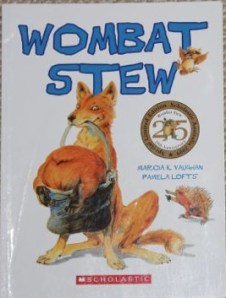
Photos - 14870Wombat Stew by Marcia K Vaughan and illustrated by Pamela Lofts, paperback picture book, first published by Scholastic Australia in 1984, this edition published in 2009.

This classic Australian picture book was a favourite of mine as a child, and now it is a favourite of my own children.

When a very clever dingo catches a wombat and decides to make wombat stew, the other bush animals help him to make the crunchiest and chewiest stew imaginable. They suggest adding mud, flies, feathers and even gumnuts to the billy, but Dingo must taste it before he adds the final ingredient, that lovely fat wombat!

This is a wonderful book to share with preschoolers and primary school children. The story is well told, and funny, with realistic illustrations. My kids particularly like Dingo’s song about his wombat stew as he dances around the billy. They laugh when each new ingredient is added to the billy, and they love it when Dingo tries the stew. A valuable addition to every home library, Wombat Stew is a book that will be read and enjoyed many times!