Tag Archives: chapter book

Lulu Bell and the Birthday Unicorn by Belinda Murrell and Serena Geddes

Standard

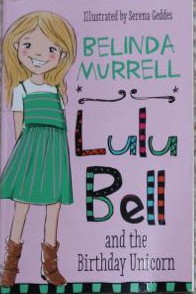
IMG_3813Lulu Bell and the Birthday Unicorn by Belinda Murrell and illustrated by Serena Geddes, paperback chapter book, 86 pages, published by Random House Australia in 2013.

Meet Lulu Bell, a great big sister to Rosie and Gus, best friend to Molly and daughter of the local vet. During the preparations for Rosie’s mermaid themed birthday party, their Dad is called out to capture an escaped pony before it can get hurt. Until its owners can be found, the pony is placed in Lulu’s backyard, where the party is soon to be held. Unfortunately the pony gets up to some mischief, upsetting Rosie. Luckily Lulu has an idea that will help to make Rosie’s party the best ever.

A simple story of family, friends and fun, this chapter book captivated my kindergartner. She enjoyed the storyline, and identified with the family, which were very realistic. She liked the way Gus spoke, and called himself “Bug Boy” and the way that Rosie and Lulu interacted as sisters. The idea of a mermaid party was quite appealing to her also!

For self reading, Lulu Bell and the Birthday Unicorn, would suit a slightly more confident reader than one just starting chapter books. While the chapters were reasonably short, and the black and white illustrations frequent, there is more depth to this story than is usually seen in a first chapter book. The language was very suitable for lower primary school children, and the story easy enough to follow. I read this one to my kindergartner as she’s not yet onto chapter books, and she has already asked for more Lulu Bell!
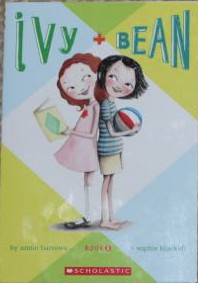


Ivy + Bean by Annie Barrows and Sophie Blackall

Standard

IMG_36851Ivy + Bean by Annie Barrows and illustrated by Sophie Blackall, paperback chapter book, 113 pages, published by Scholastic in 2007.

Bean is a mischievous seven year old with a love of annoying her older sister, Nancy. She’s a bit of a tomboy, who loves playing outside and getting dirty. Ivy lives in a house across the road from Bean, and is quite prim in comparison, favouring quiet reading and wearing pretty dresses. They couldn’t be more dissimilar, but when Bean finds herself in a bind, Ivy offers to help, and they discover that they have more in common than they initially thought.

This is the first book in the Ivy + Bean series, and the only one we’ve read so far. It contained easy to read language and text with a simple format, black and white illustrations and reasonably short chapters.

Ivy + Bean is most suitable for lower primary school children, who are gaining confidence in their reading. I read this book to my kindergartener, she loved it and has asked for more Ivy + Bean adventures. We read it in just a couple of sessions, as she wanted to “read just one more chapter, mum, pleeeeeease”.  My third grader also read this book, and while she found it extremely easy as a text, she quite enjoyed the story. Ivy and Bean make an odd couple, but they are good characters, making us laugh, and sometimes groan, and who will encourage kids to read about their adventures.


The Adventures of The Bailey School Kids: Santa Claus Doesn’t Mop Floors by Debbie Dadey and Marcia Thornton Jones

Standard

IMG_3287The Adventures of The Bailey School Kids: Santa Claus Doesn’t Mop Floors by Debbie Dadey and Marcia Thornton Jones and illustrated by John Steven Gurney, paperback chapter book, 71 pages, first published by Scholastic Inc. in 1991, this edition published in 2007.

After having to clean up another mess made by the third grade class at Bailey Elementary School, the school janitor quits. In his place, starts Mr Jolly, who looks rather like Santa Claus, and is always turning the heat down to chilly. Messes are no match for Mr Jolly who can have the school sparkling again in no time. And he’s been watching the 3rd grade gang and writing in his little notebook, as if he’s taking notes about the kids. Could he really be Santa?

Santa Claus Doesn’t Mop Floors is a chapter book containing short chapters and a shallow story-line, suitable for children in lower to middle primary school.

It is an easy read, but I greatly disliked the main gang of characters. They were rude, destructive and disrespectful, especially Eddie, who often bullied and coerced his fellow gang members into naughty behaviour. Spreading peanut butter and whipped cream through the school may seem funny to some, but it is still vandalism. I don’t condone these behaviours and I don’t want my children thinking that it is okay to play these sorts of “pranks”. Basically the kids were horrible, and fell well short of the decent role models I have come to expect from good kids books. Even if the writing and plot had been better, I still could not have stepped past the poor behaviour and lack of any meaningful consequences for the gang.

The main theme of the story seemed to be to restore Eddie’s Christmas spirit, through kindness and the presence of magic. However, the plot wasn’t deep enough to really examine the causes for his lack of belief in Christmas. It also didn’t explore why he thought the solution to his sadness and trouble was to be a jerk to everyone else. I would have preferred a bit more moralising.

I did think that I might have been placing too much of my adult (and rule abiding) self forwards whilst reading Santa Claus Doesn’t Mop Floors, so I sought the opinion of my second grader. She also disliked the children in the book, (she too is quite rule abiding and often complains about disruptive kids ruining for classroom learning experience). She thought it was average and not worthy of another read. For a child that devours books of all varieties, often re-reading books I think aren’t great, several times in close succession, I was surprised by her strong disappointment in this Christmas themed book. We will not be seeking any further books in this series, which appears to contain around fifty titles.

Book Advent Calendar

Standard

Each December as we count down to Christmas, the kids like to have an advent calendar to mark the days. There are many types of advent calendars available for purchase, but this year I was vaguely thinking about making one. Before I had decided on what I was going to make, I saw a picture of an advent calendar that someone had made up with books (I don’t know where the photo originated). I thought this was brilliant, as L and A love books. The picture I’d seen was using Christmas themed books, but I ended up just using books that I thought the kids would like.

Some of the books ready to be wrapped.

Some of the books ready to be wrapped.

A lot of the books came from my favourite secondhand bookshop (Canty’s Bookshop in Canberra), and some I bought from the Scholastic Book Club at the kids’ school. A few of the books were mine when I was a child, and I am now giving them to my kids. There is a mix of fiction and non-fiction, with a couple of Christmas themed books. I think L and A will enjoy these books, and they will form part of their Christmas presents.


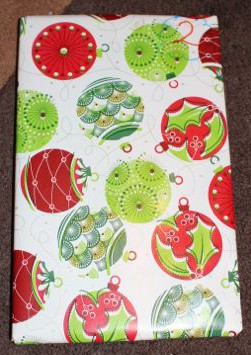
All wrapped up.

All wrapped up.

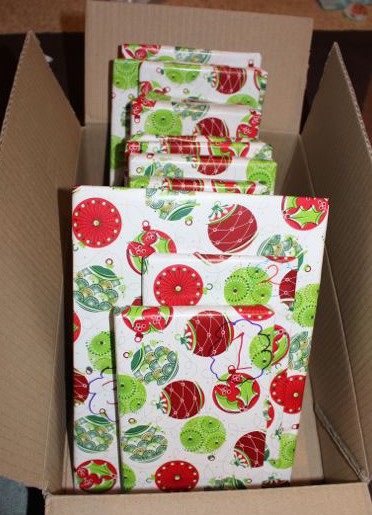
I took 24 books and wrapped them in Christmas wrapping paper. Then I randomly sorted them and numbered them from one to twenty-four. I placed them all into a cardboard box with the numbers facing forwards. On the first of December, L will open the parcel numbered ‘1’, with one parcel for each day leading up to Christmas.

This is an advent calendar that you can really customise to your own child, by choosing books to their reading level and interests. It would be a lovely present for an adult too. Library books could be a good alternative to buying the books, especially if you want to use picture books or Christmas books, but don’t forget to return them!

Ready to be opened.

Ready to be opened.

Airy Fairy: Magic Mess! by Margaret Ryan

Standard

IMG_2455Airy Fairy: Magic Mess! by Margaret Ryan and illustrated by Teresa Murfin, paperback chapter book, 77 pages, published by Scholastic Ltd in 2004.

Airy Fairy is the worst fairy at spells and just about everything else in Fairy Gropplethorpe’s Academy for Good Fairies, but she does try hard. It is Fairy Gropplethorpe’s Rainbow Birthday, and all the little fairies are asked to make her a present. They have also been asked to paint their rooms. Both tasks require creative spell-work, something that Airy Fairy is not very good at. Her attempts are not helped by the meanest and naughtiest fairy at the academy, Scary Fairy, who likes to play rotten tricks on Airy Fairy. Such a small fairy, and such a large mess!

This was an easy read chapter book suitable for lower primary school children. I read it to my preschooler and she really enjoyed it. My second grader liked the story too, but the book was very easy for her. There were black and white drawings scattered through the book. They were a little peculiar, with the characters having quite angled features, but my preschooler liked them. We all laughed when Airy Fairy’s spells went wrong, and scowled when the fault lay with Scary Fairy! It was a fun read that encourages independent reading. There are a few other titles in the Airy Fairy series that we haven’t yet read, but I will be trying to find.

Violet Mackerel’s Possible Friend by Anna Branford and Sarah Davis

Standard

IMG_1445Violet Mackerel’s Possible Friend by Anna Branford and illustrated by Sarah Davis, hardback chapter book, 109 pages, published by Walker Books Australia Pty Ltd in 2013.

Violet’s family has just moved into a new house. Violet is busy exploring the backyard when she discovers a knot in the fence, and accidentally turns it into a hole. She worries that the neighbours might be angry about the hole, so she writes a little apology note and leaves it, along with a small present in the hole. A reply arrives in the hole from Rose, a young girl that lives next door. Is Rose Violet’s possible friend, or maybe she could be a very good friend?

This is the story of a young girl making a new friend and all the uncertainty that comes with it. The story is well written and enjoyable. Violet reminds me of some children I know, and all her worrying and planning gave me a chuckle. While this is not the first book in the Violet Mackerel series, it is the first one we have read. It will not be the last. My preschooler is taken with Violet. She really enjoyed the story and I think she identified with Violet, they have some things in common, such as their collection of small items. She’s keen to read more Violet books.

There are very nice black and white illustrations throughout the book. My preschooler was particularly impressed with how Violet was depicted in the illustrations, just like she imagined her to be (apparently)! The notes that are passed between Violet and Rose are actually drawn as notes in the book too, with writing that even looks like the writing of a young girl. I thought these were a lovely addition.

Violet Mackerel’s Possible Friend is a chapter book that is suitable for lower to middle primary school children. My second grader read the whole book before school one morning, finding it an entertaining story, but a very easy read. I think it would be a good book to help build reading confidence in young children.


Clementine Rose and the Surprise Visitor by Jacqueline Harvey
Standard

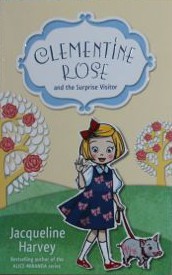
IMG_1399Clementine Rose and the Surprise Visitor by Jacqueline Harvey, paperback, 133 pages, published by Random House Australia in 2012.

Clementine Rose is a sweet little girl of five living in an oversized estate house in disrepair, which her mother, Lady Clarissa Appleby, runs as a country guest house. Also living in Penberthy House, is the very old butler, Digby Pertwhistle, affectionately known as Uncle Digby. Along with her pet tea-cup pig Lavender, Clementine Rose lives a wonderfully happy life. However, all that is threatened when Lade Clarissa’s Aunt Violet appears, moves into the best room in the house with her extremely ugly sphynx, Pharaoh, and grumps and sneers at everyone and everything. Clementine Rose has never met anyone as rude and mean as Aunt Violet. How will they cope with Aunt Violet in the house, and when is she going to leave?

Clementine Rose and the Surprise Visitor is the first book in the Clementine Rose series from Jacqueline Harvey. It is a great introduction to Clementine, who is such a sweet and innocent character. And Aunt Violet is the epitome of sour old lady with her scary cat, and contemptuous sneering and sniping. All the characters are very well written, and the story is engaging and entertaining. The moment Clementine accidentally tosses a guest’s toupee into the fire is just hilarious, and her safari adventure in the library with her friends has prompted my kids to ask for a similar camp-out (though we don’t have fire to toast marshmallows over!). A fun read suitable for kids in lower and middle primary school, Clementine Rose and the Surprise Visitor will make them laugh, and will probably make them want a cute little tea-cup pig just like Lavender!

My second grader enjoys Clementine Rose stories, though she finds them a little easy going now  she will still listen when I read them to her sister. My preschooler just loves the Clementine Rose series, and wants me to keep reading and reading until the book ends! And then she wants to start another straight away. I really like sharing these books with her as well, I enjoy reading about Clementine’s adventures almost as much as she does!

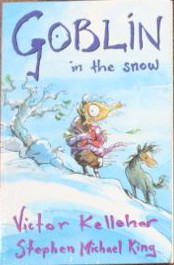
Goblin in the Snow by Victor Kelleher and Stephen Michael King

Standard

IMG_1310Goblin in the Snow by Victor Kelleher and illustrated by Stephen Michael King, paperback chapter book, 73 pages, published by Random House Australia in 2005.

Gibblewort is an horrible Irish goblin who loves annoying his fellow goblins with pranks and tricks. When they get sick of him, they decide he needs a holiday and suggest he visits the snowy peaks of Austria. Once Gibblewort is inside the post bag they change the address so he goes to Australia, a place he hates with a passion! Here he encounters a dragon, snowboarders and adoring fans, but he’d much rather go home.

This is a very simple story of a grumpy goblin and the adventures he has in the snow of the Australian mountains. It is part of a series of chapter books for lower primary school students, great for children ready to move beyond first readers. The chapters are short with easy language and black and white illustrations on most pages. My second grader really liked Gibblewort, despite his foul demeanour, and is keen to read more of his adventures. As an advanced reader, this was much too easy for her, but she enjoyed the story, and thought it very funny when Gibblewort was mistaken for talking moss.

I liked the idea of a story about a bad-tempered goblin, but this tale didn’t really fulfill my expectations. Gibblewort seemed more unlucky than mean, as he accidentally tumbles down the mountain, accidentally falls in the lake, accidentally gets eaten by a fish. I really thought he would be causing more hilarious havoc! Despite falling short of my expectations of calamitous mischief, the story itself wasn’t bad, and it appealed to my kids, which is what really matters to me.

Just Tricking by Andy Griffiths and Terry Denton

Standard

IMG_0830Just Tricking by Andy Griffiths and illustrated by Terry Denton, paperback, 137 pages, first published by Reed Books Australia in 1997, this edition published by Pan Macmillan Australia Pty Ltd in 1999 (printed in 2004).

A collection of ten short stories by the wildly popular pair, Andy Griffiths and Terry Denton, this book is aimed at making kids laugh. It is no literary masterpiece, but boy did it make my second grader cry with mirth! And she has read it and re-read it, with no less enjoyment each time. We have had parts of this book related to us, through giggles and guffaws, so finally I decided I needed to read this book for myself.

The book is set out like an easy novel, with each chapter containing a separate story about mischief and jokester behaviour. Some of the stories were funny, but a few were just gross, like the slug milkshake. Just Tricking is great for kids who want some comedy in their reading adventures, and especially for those with a penchant for practical jokes. The short story format is good for kids just starting to read novels too. They can have the satisfaction of reading a complete story without it being too overwhelming, while working their way through a novel length book.

On every page, surrounding the text, were numerous pencil drawings, diagrams, advice and short anecdotes. I found these to be quite a distraction, and somewhat annoying, rather than funny, as I assume they were meant to be. My second grader said she mostly ignored the illustrations, just looking at them separate to reading the story. If I had left them to the end of each story, I too would have found them less irritating, though still not all that amusing. I think the book would have been more enjoyable with less illustrations and less additional text in the margins.

There were also a couple of times that I thought the content was a tad inappropriate for my seven year old, but these moments passed over her head with little thought put towards them. There were also a few references to things, such as to the game Mortal Kombat, that she didn’t understand, but these did not diminish her experience of this book. My husband says I’m just being prudish! Perhaps he’s right, but I still think this book would be better for slightly older kids, in middle to upper primary school. My daughter has borrowed some of the other books in this series to read, such as Just Shocking and Just Disgusting, enjoying them with equal enthusiasm. These don’t appeal to me much as an adult, but would I like them if I were a child in primary school? Yes, probably, just as much as my daughter has enjoyed them. She loves Just Tricking, and I can see that it will be read many more times, because this book is perfect for reading for fun.


Freak Street: Meet the Zombiesons by Knife & Packer

Standard

IMG_0424Freak Street: Meet the Zombiesons by Knife & Packer, paperback graphic chapter book, 93 pages, first published by Scholastic Australia in 2008, this edition published by Scholastic Australia in 2013.

The Zombiesons live on Freak Street along with some other unusual families. Within their family, there is Mr and Mrs Zombieson, their children Zigi and Zoey and the baby Zee. They also have a three headed dog called Zlobba. They are all bright green with red hair and their brains exposed, they also have an interesting house and yard, including a man-eating hedge that likes mouldy pizza. Granny Zombieson is coming to stay and celebrate her 500 year birthday with her family. She is a whiz in the kitchen at making the most delicious pizzas, such as Haunted Hawaiian, for which she guards the recipes closely.

Zigi plays soccer with the Freak Street School team, and whenever Granny Zombieson comes to watch, the team never loses, so it is important to Zigi that she attend the big final. On the morning of the final the whole family goes to the theme park Danger World for Granny’s birthday. Matters are complicated when Granny has her brain stolen, but by whom and why, and will she still make it to the game to be Zigi’s lucky charm?

This was a funny story filled with amusing colour illustrations. The faces of some of the characters captured their nature extremely well. Granny Zombieson was my favourite character, with her skateboard and attraction to terrifying rides, despite her age. Her friends from the Ridiculously Old Age Zombie Home also made me laugh, especially when Scary’s eyeball fell into the fish bowl. Even though the Zombiesons were zombies, they were mostly just like any other family, though maybe with a few more rather unusual quirks.

My second grader enjoyed Meet the Zombiesons so much that she has asked for more b0ooks from this series, and she is looking forward to meeting more of the Freak Street families. Meet the Zombiesons was a simple yet exciting adventure best for lower and middle primary school students, though I liked it well enough too. It makes zombies seem not very frightening at all, so younger readers shouldn’t be scared to give this book a go, especially with an adult.