Tag Archives: children’s book

Misery Guts by Morris Gleitzman

Standard

Last Import - 1Misery Guts by Morris Gleitzman, paperback novel, 121 pages, first published by Piper in 1991, this edition published by Pan Macmillan Australia in 1996.

Keith and his parents live above their fish and chip shop in London, in a drab building, in a drab street, in a drab city. Keith thinks his parents are a pair of misery guts, depressed and unhappy with life, and all he wants to do is cheer them up. He decides the best thing to do would be to move to Australia, where he believes they will find paradise and happiness. His parents do not want to move to the other side of the world, and they resist Keith’s plan for as long as possible, but finally, after a devastating fire, they agree, and pack up for the long flight to their new home on  the far north coast of Queensland.

A hilarious story of a boy trying his best to make his parents happy, this book made me laugh, both as a child and as an adult. Only a boy could think a smelly, dead rainbow fish would be the perfect cure for depression! But to go all the way to Australia based on nothing more than a fish and a picture takes plenty of courage. Keith works hard to pull it off, including hiding their proximity to the dangerous jellyfish, coconuts and crocodiles that inhabit their new home town. Keith even makes a new friend and ropes her into his plans for his parents’ happiness. Suitable for primary school students, Misery Guts is a heartwarming tale of a boy’s love for his parents, and the lengths he will go to make them happy. Well worth the read.
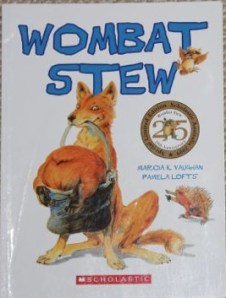
 

Wombat Stew by Marcia K Vaughan and Pamela Lofts

Standard

Photos - 14870Wombat Stew by Marcia K Vaughan and illustrated by Pamela Lofts, paperback picture book, first published by Scholastic Australia in 1984, this edition published in 2009.

This classic Australian picture book was a favourite of mine as a child, and now it is a favourite of my own children.

When a very clever dingo catches a wombat and decides to make wombat stew, the other bush animals help him to make the crunchiest and chewiest stew imaginable. They suggest adding mud, flies, feathers and even gumnuts to the billy, but Dingo must taste it before he adds the final ingredient, that lovely fat wombat!

This is a wonderful book to share with preschoolers and primary school children. The story is well told, and funny, with realistic illustrations. My kids particularly like Dingo’s song about his wombat stew as he dances around the billy. They laugh when each new ingredient is added to the billy, and they love it when Dingo tries the stew. A valuable addition to every home library, Wombat Stew is a book that will be read and enjoyed many times!

I Love You, Nose! I Love You, Toes! by Linda Davick

Standard

Photos - 15525I Love You, Nose! I Love You, Toes! by Linda Davick, hardback picture book, published by Beach Lane Books in 2013.

This is a wonderful rhyming book that celebrates the body and all the parts that make it up. These children love their bodies, no matter the shape, size, colour or even if it’s bruised or scratched. And you can too!

This was a fun book that we shared, bringing our attention to different parts of the body. As we read , my preschooler pointed to each part on her own body, and made some comments, like ‘My hair is red!’ and ‘That girl’s reading a book on the potty!’ My preschooler loved the rhyming cadence and the clear illustrations. She laughed most at the picture of a girl sneezing with lots of green stuff coming out of her nose! The part about not quite being able to hug the back, got my preschooler trying to hug her back like the children in the picture, it was quite funny. I really liked that this book got my preschooler thinking about her body and just how wonderful it really is.

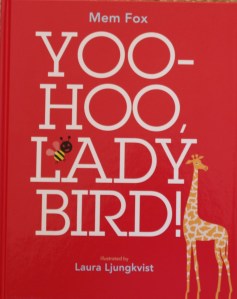
Yoo-Hoo, Ladybird! by Mem Fox and Laura Ljungkvist

Standard

IMG_1189Yoo-Hoo, Ladybird! by Mem Fox and illustrated by Laura Ljungkvist, hardback picture book, published by Penguin Group (Australia) in 2013.

This cute little ladybird just loves to hide. She is hiding somewhere in each picture, can you spot her?

An engaging book for young readers, it involves the child by encouraging them to find the ladybird in each picture. I like that the pages aren’t so packed with items that the ladybird is too hard to find, which makes it perfect for preschoolers. The illustrations are simple, yet unique, with the ladybird hiding among an interesting array of objects. These objects were also fun to spot and name. The story is simple with rhyming text, and my preschooler loved joining in to call ‘Yoo-hoo, Ladybird!’ We really enjoyed this book, and I think it will quickly become a favourite with my preschooler.

My Body by Bloomsbury Discovery

Standard

IMG_1196My Body by Bloomsbury Discovery and illustrated by Joelle Dreidemy, large format non-fiction boardbook with flaps, published by Bloomsbury Publishing Plc in 2014.

Most children love lift-the-flap books, and this one has dozens of flaps that open to reveal lots of fun facts and information about the body. A wonderfully engaging book for preschoolers and children in lower primary, My Body covers human evolution and the various body systems in a detail appropriate for this age group. The main illustrations were plentiful, detailed and clear, showing a good life-like representation of the human body. There were also lots of other illustrations on every page with more facts, and these had more of a cartoon quality about them.

The flaps were a big attraction for my preschooler, but once we started reading, she really got into the information too. She asked a lot of questions while we were reading, she came back to the book later to look through it again herself, and asked me to re-read a few sections to her. We ended up reading the whole book in one sitting as she was enjoying it so much. The information contained within this book was detailed enough that my second grader also found it useful and enlightening. I have heard my preschooler repeat several facts she learnt from My Body, especially that people shouldn’t eat snot because it contains germs!


Ears, Eyes, Nose by Rebecca Bondor

Standard

IMG_1191Ears, Eyes, Nose by Rebecca Bondor, a Rookie Toddler boardbook, published by Children’s Press (Scholastic) in 2014.

This boardbook introduces young children to some of their body parts. It contains clear photographs of children pointing to their own ears, eyes, and other parts. Seeing children just like them can help toddlers and young children to engage in learning new things. And with only one large print word per photo, and a sturdy board construction, this is a great book to start learning body parts with babies and toddlers.

Ten Tiny Toes by Caroline Jayne Church

Standard

IMG_1195Ten Tiny Toes by Caroline Jayne Church, boardbook, published by Cartwheel Books in 2014.

A simple and engaging book for toddlers celebrating their bodies. As I read through Ten Tiny Toes with my son (15 months old), I encouraged him to point to each part of his body and do the actions in the book. He liked looking through the book and pointing to the pictures, and especially grabbing his toes when we read ‘and ten tiny toes!’ He did laugh and giggle when we touched his tummy too. The text was large with rhyming language, and the illustrations were simple, yet nice. This story helped us to focus on learning parts of the body in a fun way that many toddlers will enjoy.

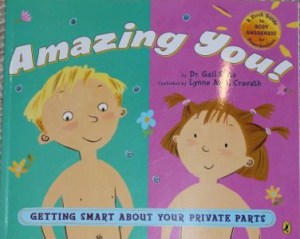
Amazing You! by Dr. Gail Saltz and Lynne Avril Cravath

Standard

IMG_1170Amazing You! by Dr. Gail Saltz and illustrated by Lynne Avril Cravath, paperback non-fiction, first published by Dutton Children’s Books in 2005, this edition published by Puffin Books in 2008.

Amazing You! is a basic look at the reproductive systems for young children. Aimed at preschoolers, this book provides information on body awareness and answers questions about ‘private parts’. It is a good first journey into what can be an awkward topic for many parents.

The text and illustrations are clear and simple, using anatomical names and easy to understand language. There is also a helpful section at the back of the book for parents on talking about sexual curiosity and where babies come from with their children. When it comes to describe how babies are made, it does not go into extensive detail, but sticks to the basics of egg and sperm, all a preschooler really needs to know. The book mentions that sexual curiosity is natural and normal, including masturbation and asking questions. It also reminds us that our bodies and our sexual organs should not be a source of embarrassment or shame, because they are all part of us, and we are amazing!

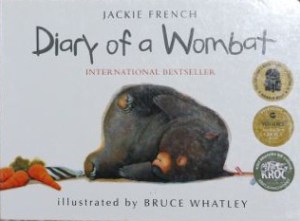
Diary of a Wombat by Jackie French and Bruce Whatley

Standard

IMG_1171Diary of a Wombat by Jackie French and illustrated by Bruce Whatley, boardboard picture book, first published by HarperCollinsPublishers Australia Pty Ltd, this edition published in 2007.

This is a delightful children’s book about the life of a pet wombat. She sleeps, she eats, she digs holes, she sleeps, and she causes all sorts of destruction and mayhem, she sleeps again. Her human family continue to love her, as she digs up the flowers, chews the doormat and demands lots of carrots.

My children love this book, it is definitely a favourite. They love all the trouble that the wombat gets into, they think it is very funny! The story is written in a diary format, with short, yet descriptive entries for each part of each day. The illustrations are very distinctive, perfectly capturing the wombat’s mood. This is a wonderful book to share with preschoolers and lower primary school children, it will entertain them and it will make them laugh. You’ll probably find yourself chuckling too and wondering why you don’t have a pet wombat to liven up your days!

Mummy Laid an Egg! by Babette Cole

Standard

IMG_1174Mummy Laid an Egg! by Babette Cole, non-fiction paperback, first published by Jonathan Cape in 1993, this edition published by Red Fox in 1995.

Dad and Mum have decided to tell their kids where babies come from. They tell the kids that sometimes dinosaurs deliver babies, or they can be grown from seeds, made from gingerbread, or they can even be found under rocks! And in this case, the kids exploded from a huge egg that Mum laid on the couch. The kids think this is hilarious. They quickly begin on a journey to set their parents straight, including lots of drawings explaining just how babies are made.

A light-hearted look at reproduction, this book is perfect for younger children from preschool up. The drawings are humorous, educational, and appropriate for the intended audience. The language is easy to understand for children, and the subject matter is treated without any of the seriousness that sometimes surrounds this often delicate topic. I think this book would be especially good for parents who are a little nervous about having “the talk” with their kids, it is a great way to lighten the mood.

Both my preschooler and second grader love this book. I think that it is the best introduction to the sensitive subject of conception and reproduction that I have come across. It is honest, frank and amusing. I particularly like the pages that show how mummies and daddies fit together, some truly awkward and hilarious positions! My kids laughed at the ridiculous stories that the Mum and Dad tell their kids, as well as at many of the drawings throughout the book. It covered the basics, and my kids were happy with the content, re-reading it several times, asking questions and discussing it. A really nice book, I am very glad I purchased Mummy Laid an Egg!