Tag Archives: children’s book

Esther’s Rainbow by Kim Kane and Sara Acton

Standard

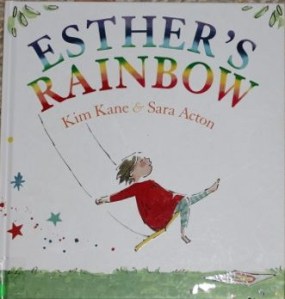
IMG_0757Esther’s Rainbow by Kim Kane and Sara Acton, hardback picture book, published by Allen & Unwin in 2013.

While she is eating lunch one Sunday, Esther sees a rainbow streaming out from under her stool. She touches it, and smells it, but it soon disappears. Throughout the following week she looks for the colours of the rainbow in the world around her. Each day shows her a new colour, as she continues to search for her rainbow.

This is a truly beautiful book about discovering our surrounds, and the joy of everyday items. I felt warm and fuzzy reading this with my preschooler, it is a gorgeous book for sharing with preschoolers and children in lower primary school. My daughter marveled at the things that Esther found the rainbow colours in, and this gave us an opportunity to talk about the colours in our own everyday world. She particularly liked that Esther used all her senses to experience the colours, like smelling green in mint, and tasting yellow pears. Esther’s Rainbow will be read many times in our house, and it will make us feel happy and inspired every time.

Ladybird Baby Touch Rainbow by Fiona Land

Standard

IMG_0761Ladybird Baby Touch Rainbow illustrated by Fiona Land, big boardbook, published by Ladybird Books Ltd in 2013.

This is a big format boardbook that explores the colours of the rainbow from red through to purple. Each page focuses on one colour, with that colour’s name in big writing at the top. There is some rhyming text describing the illustrations, which are simple and easily recognisable for children. The pages are shaped on the edge, and get bigger as the book progresses. There are touchy feely bits on each page too, giving babies and toddlers the opportunity to feel didn’t textures.

The book was too big for Baby T (14 months) to hold, but he was happy to lay it on the floor and turn the pages. He explored the different textures on the pages, and was very taken with the orange cat’s soft tummy. He wanted to keep stroking the cat’s tummy over and over. My preschooler was with us while we were reading this book, and though it was really too young for her, she still enjoyed touching all the different textures and talking about what she could see. She liked the bumpy tortoise and the sparkly boat sail best.

I liked that each colour was represented with multiple illustrations in that colour. I could point them out to Baby T, naming them and repeating the colour’s name to reinforce his colour learning. This was a very good introduction to the basic colours for babies and toddlers.

Princess Evie’s Ponies: Indigo the Magic Rainbow Pony by Sarah KilBride and Sophie Tilley
Standard

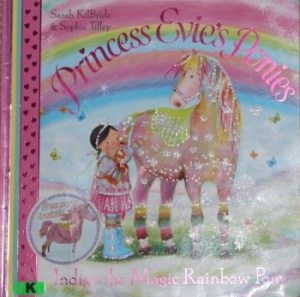
IMG_0754Princess Evie’s Ponies: Indigo the Magic Rainbow Pony by Sarah KilBride and illustrated by Sophie Tilley, paperback picture book, published by Simon and Schuster in 2012.

Princess Evie and her pet cat, Sparkles, have a stable full of magic ponies who take them on adventures. In Indigo the Magic Rainbow Pony, when they ride through the tunnel of trees they emerge into a world of colours. Evie’s clothes have changed to rainbow colours, and so has Indigo’s coat and mane, and there are beautiful butterflies everywhere. Yet, as they ride on they encounter a drab, grey garden, drained of colour. Evie discovers a map that tells her to find the magic girls and collect their coloured stones to return the colours. So Evie, Indigo and Sparkles set out to do just that.

A fun story with magic, adventure, new friendships, sharing and colour. The illustrations are particularly nice, with lots of detail and lovely colours. My preschooler was immediately drawn to this book because it had silver sparkles and a pony on the front cover. She also liked the shiny pink hearts and lettering of the title. The story containing a princess, magic and rainbows were bonuses. My daughter is very pink and princessy and this is the sort of book that she will ask for repeatedly, until I can’t stand reading it any more. And when I have had enough, she will continue to peruse it herself. With two daughters, I’m working on building my tolerance for magic ponies, fairies, princesses, animals…. I prefer a good giggle book to share, but I have to run with what the kids like, though it will be nice when A can read these types of books herself! This is not a bad book however, it just isn’t my cuppa, and my four year old loved it! This book would particularly appeal to girly girls in the preschooler to lower primary age groups.

The Rainbow by Flying Colours

Standard

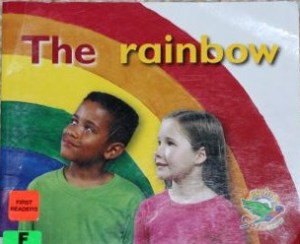
IMG_0758The Rainbow by Flying Colours, paperback first reader, 16 pages, by Cengage Learning Australia, 2004.

This basic Flying Colours reader shows a boy and a girl painting a rainbow. The book is rated at level 1-2, so the language is very easy and repetitive, the text is large and the story extremely simple. The photos were bright and clear. My preschooler had no difficulties reading this book to me, and she seemed to enjoy the progression of painting the rainbow. This early reader is a great way to build reading confidence in young children just starting out on their reading journey.


Amazing Baby: Rainbow Fun by Emily Hawkins

Standard

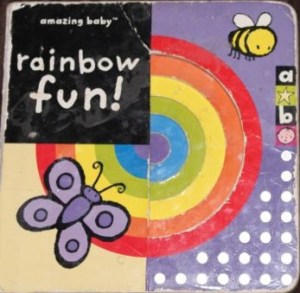
IMG_0755Amazing Baby: Rainbow Fun text by Emily Hawkins with graphics by Mike Jolley and Emma Dodd, boardbook, published by Hardie Grant Egmont in 2008.

This sturdy boardbook introduces babies and toddlers to the colours of the rainbow, one by one. There was minimal text using simple words and rhymes along with simple black outlined graphics. Each double set of pages was a different colour, from red through purple. The pages are also die-cut with decreasing concentric circles in the middle of the pages, until it disappears for the last double page where the colours all come together to form a rainbow. The physical size of the book is also just right for toddlers to hold.

I borrowed this book from the library, and as soon as we got it home, Baby T (14 months) pulled it straight out and starting looking through it. He was fascinated with the circular holes in the pages, and kept putting his hands through them. He also loved the bright colours, and pointed to some of the graphics. I tried to hold it to read to him, but he kept snatching it off me so that he could turn the pages himself. I did read it to my preschooler as well, and she enjoyed it, though it was really a bit young for her. However, she used the simple layout of this book to practice naming the colours in both English and French. She also liked the holes in the pages. I was amazed with how much Baby T liked this book, he has come back to it a number of times, seeking it out from the pile of library books to look at. This book is a fun and engaging introduction to the colours for babies and toddlers.


The Runaway Hug by Nick Bland and Freya Blackwood

Standard

IMG_0510The Runaway Hug by Nick Bland and Freya Blackwood, paperback picture book, published by Scholastic Australia in 2011.

When Lucy asks for a hug before bed, Mummy tells her it is her last one. Lucy promises to return it, and Mummy gives her a nice, gentle hug. Then Lucy runs off to share it with the other members of her family, where it becomes bigger and peanut-buttery, but still nice. The hug runs away with Annie, and Lucy chases her to get it back, but it’s not easy, and she really wants to give Mummy back her last hug.

This is a sweet book about sharing love within families and the differences each family member brings. It contains simple language suitable for emergent readers to try, and delightfully quirky illustrations. At the start of the story, Mummy appears to be searching for a skirt in the dirty wash pile in just her undies and shirt, despite it being almost bedtime. I liked that the house was messy, there were drawings on one of the walls and Mummy was breastfeeding the baby at the end. The steps in the house also made me think of the MC Escher house. I really enjoyed the uniqueness of the illustrations, and the realistic portrayal of a house with four children in it.

The Runaway Hug is a nice book to share while cuddling up with your child. It leaves us with a warm and happy feeling each time we read it together. Best for preschoolers and lower primary school children, this award winning* picture book is loved by both my preschooler and my second grader.


* The Runaway Hug won The Children’s Book Council of Australia Book of the Year in the Early Childhood category in 2012.


Bringing Down the Moon by Jonathan Emmett and Vanessa Cabban

Standard

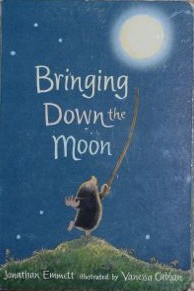
IMG_0749Bringing Down the Moon by Jonathan Emmett and illustrated by Vanessa Cabban, boardbook, first published by Walker Books Ltd in 2001, this edition published by Walker Books Ltd in 2004.

One night Mole burrows up through the dirt and sees the moon for the first time. He doesn’t know what it is, but it is so pretty, he wants to catch it. He tries jumping and reaching it with a stick and climbing a tree to get closer to it, but nothing works, and he disturbs all his friends along the way. But when he thinks he has broken the moon, his friends are there to console and reassure him.

Bringing Down the Moon is one of my pre-schooler’s favourite board books, and we enjoy reading it together before bed. She loves it when Mole yells “hot-diggerty!”, she thinks that is a very funny phrase! I also like this story of discovery and friendship. It is a lovely story with beautiful illustrations. Mole is a curious little fellow, and his friends are compassionate and understanding. Mole learns that the moon isn’t near enough to touch, but it is beautiful up there in the night sky. And it’s beautiful that he shares that moment with his friends.


Fly Guy Presents Sharks by Tedd Arnold

Standard

IMG_0513Fly Guy Presents Sharks by Tedd Arnold, paperback non-fiction reader, published by Scholastic Inc in 2013.

Fly Guy and Buzz head to the aquarium to learn about sharks in this informative reader. It contains plenty of photographs throughout the book, complementing the interesting factual text. And Fly Guy and Buzz are always there, leading the way to more knowledge on sharks.

Moving onto non-fiction titles can be a little scary as they often have longer and harder words, and are more complicated than their fictional counterparts. Using some well loved characters, such as Fly Guy and Buzz, is useful in piquing the interest of young readers, especially those that may be reluctant to try non-fiction. I was impressed with the simple and interesting layout and facts. There was enough factual information to sink your teeth into (sorry about that awful pun!) without it becoming overwhelming.

This book is aimed at lower primary school children as a reader, but I read it to my preschooler, and she really enjoyed it. She loves Fly Guy, so this book had appeal before we even opened it. My preschooler did learn some things about sharks, such as they breathe through gills and they don’t sleep, she was particularly impressed by the Great White Shark being able to smell blood from so far away. She told me she is glad she’s never met a shark! She also liked the comments that Buzz makes, and the picture of Fly Guy pretending to have shark teeth. Combining Fly Guy and such an engaging topic as sharks was a stroke of genius, and we look forward to reading more in the Fly Guy Presents series.


Underpants, Thunderpants by Peter Bently and Deborah Melmon

Standard

IMG_0508Underpants, Thunderpants by Peter Bently and illustrated by Deborah Melmon, paperback picture book, published by Parragon in 2011.

On a fine and sunny day, Dog hangs out his underpants to dry on the line. Then a thunderstorm whips up the wind, blowing the underpants right off the line and spreads them all around. They land in some interesting places, including in the jungle and the ocean, and one pair even gets blown right out into space.

At a time when my children are obsessed with toilet humour, this book was a good find. They think any story about underpants is funny, and this rhyming tale definitely tickled their funny bones! A perfect book for preschoolers, with a short story, large text and clear, colourful pictures. I like the octopus that gets four pairs of the undies, and no surprises,  my kids like it best when the hunter goes splat in the poop. I wasn’t quite ready for the book to end actually, it just felt like there should have been more, but maybe that was because my kids were laughing and I wanted to extend the experience! Underpants, Thunderpants is a fun book.

The Big Beet by Lynn Ward and Adam Carruthers

Standard

IMG_0440The Big Beet by Lynn Ward and illustrated by Adam Carruthers, paperback picture book, published by Omnibus Books in 2013.

When Thelma McGruff feels like a burger for tea, her husband Bertie goes out to the field to pull a fresh beetroot. The oversized beet is hard to pull up, and Bertie suggests having canned beets instead. Thelma prefers fresh and she goes to help Bertie pull up the beet. Even with the two of them, they can not pull up the beet. A couple going by stop to help, and then a few more helpers arrive, until there is a line of people trying to pull up the big beet. Then along comes a tiny girl in a frilly tutu who wants to help too, but everyone thinks she will be too small to make any difference.

This book has rhyming text and a good rhythm when read aloud. It is perfect for sharing, and is loved by my preschooler. She laughs at the story and at the illustrations. She loves that there are lots of animals below ground trying to hold the beet in while all the people above try to pull it out. She also likes the other things she can see underground, like the space ship and some dinosaur bones. Every time one of the people falls over, she laughs, it is a funny read.

According to the back of the book, this is based on a traditional folk tale, but I don’t think I know that one. It has certainly been given an Aussie twist though. Beetroot on burgers is very Australian, along with the barbie and Pavlova, playing wheelie bin cricket and the character’s nicknames too. I liked this about the book.

This story actually reminds me a bit of Pamela Allen’s Who Sank the Boat? in that it is the smallest and most unlikely participant that tips the balance. Working together can accomplish things that an individual cannot, and everyone can contribute. This is a good lesson that children can take away from this story. The Big Beet is most suitable for preschoolers and lower primary school children, but I also enjoyed it.