Tag Archives: kids non-fiction

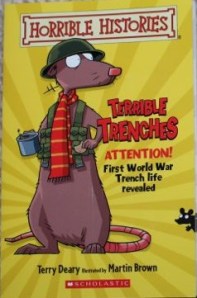
Horrible Histories: Terrible Trenches by Terry Deary and Martin Brown

Standard

IMG_0831Horrible Histories: Terrible Trenches by Terry Deary and illustrated by Martin Brown, paperback non-fiction, 93 pages, this edition published by Scholastic Australia in 2014.

This book is packed full of facts about living through the First World War, presented in an interesting and engaging fashion. The illustrations are illuminating, and often amusing, while educating young minds as to the life soldiers faced in the trenches. The book was divided into two sections, covering both sides of the war. The first section is about the British soldiers, and the second about the German soldiers. It was nice to have both sides presented without the bias often seen in other history texts.

This was a very appealing non-fiction title suitable for primary age school children. History can often be presented in a bland and boring way to children, but this Horrible Histories book is certainly neither of those. Lots of black and white illustrations and comic scenes entertain and educate, as well as lightening the subject matter, and dispersing the text, making it easier for younger kids to read.

I enjoyed reading this book and learning from it. Reading about the different weapons, the uniforms, food and slang used in the trenches was very interesting and enlightening. My second-grader is also enjoying this book. We will definitely be looking for more Horrible Histories titles to read soon!

Fly Guy Presents Sharks by Tedd Arnold

Standard

IMG_0513Fly Guy Presents Sharks by Tedd Arnold, paperback non-fiction reader, published by Scholastic Inc in 2013.

Fly Guy and Buzz head to the aquarium to learn about sharks in this informative reader. It contains plenty of photographs throughout the book, complementing the interesting factual text. And Fly Guy and Buzz are always there, leading the way to more knowledge on sharks.

Moving onto non-fiction titles can be a little scary as they often have longer and harder words, and are more complicated than their fictional counterparts. Using some well loved characters, such as Fly Guy and Buzz, is useful in piquing the interest of young readers, especially those that may be reluctant to try non-fiction. I was impressed with the simple and interesting layout and facts. There was enough factual information to sink your teeth into (sorry about that awful pun!) without it becoming overwhelming.

This book is aimed at lower primary school children as a reader, but I read it to my preschooler, and she really enjoyed it. She loves Fly Guy, so this book had appeal before we even opened it. My preschooler did learn some things about sharks, such as they breathe through gills and they don’t sleep, she was particularly impressed by the Great White Shark being able to smell blood from so far away. She told me she is glad she’s never met a shark! She also liked the comments that Buzz makes, and the picture of Fly Guy pretending to have shark teeth. Combining Fly Guy and such an engaging topic as sharks was a stroke of genius, and we look forward to reading more in the Fly Guy Presents series.


Basher Basics: Maths by Dan Green

Standard

IMG_0158Basher Basics: Maths by Dan Green, paperback non-fiction, published by Kingsfisher in 2010.

Covering the basics of maths in an amusing and informative way, this book is a good read for younger learners. It is divided into four sections, one introducing numbers, one for shapes, one for operations and one for data. Within each section, the different aspects of maths, such as Add, Fraction and Average, have been personified with imaginative drawings, and a brief overview of what each one is. There are also some examples to help reinforce the information. At the end of the book there is a glossary of maths terms for quick reference.

This book contained simple language and easy to understand explanations of math basics. All of the information is presented in an appealing way suitable for children. The colour illustrations are well designed and fun. I think this book would be most helpful for students in lower to middle primary school. It is a good addition to our home library for both our second grader and our preschooler.