Category Archives: Children’s Book Council of Australia winners/shortlisted

I’m a Dirty Dinosaur by Janeen Brian and Ann James

Standard

IMG_1307I’m a Dirty Dinosaur by Janeen Brian and illustrated by Ann James, hardback picture book, published by Puffin Books in 2013.
A dinosaur who doesn’t want to wash, splashing in puddles and sliding his tail through the mud. He really is a dirty dinosaur, with dirty feet and dirty tum and dirty snout.

This funny rhyming tale of a dinosaur who loves to get muddy was very well received by my preschooler and toddler. They laughed and pretended to be the dinosaur, they also like to get very dirty and not have a bath! Suitable for preschoolers and early readers with it’s simple language and large text, this is sure to become a quick favourite. I liked the illustrations, which were simple and different, as the illustrator appears to have used actual mud to create the dirt and mud of the story. This technique is very effective. Overall, a good book for young children.


* I’m a Dirty Dinosaur was an honour book for the 2014 Children’s Book Council of Australia Book of the Year in the Early Childhood category.

Misery Guts by Morris Gleitzman

Standard

Last Import - 1Misery Guts by Morris Gleitzman, paperback novel, 121 pages, first published by Piper in 1991, this edition published by Pan Macmillan Australia in 1996.

Keith and his parents live above their fish and chip shop in London, in a drab building, in a drab street, in a drab city. Keith thinks his parents are a pair of misery guts, depressed and unhappy with life, and all he wants to do is cheer them up. He decides the best thing to do would be to move to Australia, where he believes they will find paradise and happiness. His parents do not want to move to the other side of the world, and they resist Keith’s plan for as long as possible, but finally, after a devastating fire, they agree, and pack up for the long flight to their new home on  the far north coast of Queensland.

A hilarious story of a boy trying his best to make his parents happy, this book made me laugh, both as a child and as an adult. Only a boy could think a smelly, dead rainbow fish would be the perfect cure for depression! But to go all the way to Australia based on nothing more than a fish and a picture takes plenty of courage. Keith works hard to pull it off, including hiding their proximity to the dangerous jellyfish, coconuts and crocodiles that inhabit their new home town. Keith even makes a new friend and ropes her into his plans for his parents’ happiness. Suitable for primary school students, Misery Guts is a heartwarming tale of a boy’s love for his parents, and the lengths he will go to make them happy. Well worth the read.


Diary of a Wombat by Jackie French and Bruce Whatley

Standard

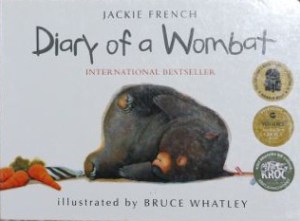
IMG_1171Diary of a Wombat by Jackie French and illustrated by Bruce Whatley, boardboard picture book, first published by HarperCollinsPublishers Australia Pty Ltd, this edition published in 2007.

This is a delightful children’s book about the life of a pet wombat. She sleeps, she eats, she digs holes, she sleeps, and she causes all sorts of destruction and mayhem, she sleeps again. Her human family continue to love her, as she digs up the flowers, chews the doormat and demands lots of carrots.

My children love this book, it is definitely a favourite. They love all the trouble that the wombat gets into, they think it is very funny! The story is written in a diary format, with short, yet descriptive entries for each part of each day. The illustrations are very distinctive, perfectly capturing the wombat’s mood. This is a wonderful book to share with preschoolers and lower primary school children, it will entertain them and it will make them laugh. You’ll probably find yourself chuckling too and wondering why you don’t have a pet wombat to liven up your days!

King Pig by Nick Bland

Standard

IMG_0509King Pig by Nick Bland, hardback picture book, published by Scholastic Australia in 2013.

King Pig has a kingdom full of sheep that don’t seem to like him, and he doesn’t understand why. He desperately wants them to adore him, but nothing seems to work, and this is the one thing that he can’t command them to do. One night he has an idea, and he wakes up all the sheep to make him some new fancy clothes, but it doesn’t impress the sheep. What can he do to remedy the situation?

In this book we see that being powerful doesn’t automatically make one likable. It is much better to be nice and considerate of others, and being bossy all the time only leads to resentment and discontent. This is a hard lesson for King Pig to learn, and a good message for our children. My kids enjoyed this book, but not quite as much as the other Nick Bland books we have. It wasn’t as funny, though we still liked the story and the illustrations are lovely. I liked the way that the sheep had their wool dyed and removed, while my kids liked it when King Pig used one of the sheep strapped to a wooden handle to clean his castle. This is a good book for preschoolers and kids in lower primary school.


* King Pig was an honours book for the 2014 Children’s Book Council of Australia Book of the Year in the Picture Book category.


The Runaway Hug by Nick Bland and Freya Blackwood

Standard

IMG_0510The Runaway Hug by Nick Bland and Freya Blackwood, paperback picture book, published by Scholastic Australia in 2011.

When Lucy asks for a hug before bed, Mummy tells her it is her last one. Lucy promises to return it, and Mummy gives her a nice, gentle hug. Then Lucy runs off to share it with the other members of her family, where it becomes bigger and peanut-buttery, but still nice. The hug runs away with Annie, and Lucy chases her to get it back, but it’s not easy, and she really wants to give Mummy back her last hug.

This is a sweet book about sharing love within families and the differences each family member brings. It contains simple language suitable for emergent readers to try, and delightfully quirky illustrations. At the start of the story, Mummy appears to be searching for a skirt in the dirty wash pile in just her undies and shirt, despite it being almost bedtime. I liked that the house was messy, there were drawings on one of the walls and Mummy was breastfeeding the baby at the end. The steps in the house also made me think of the MC Escher house. I really enjoyed the uniqueness of the illustrations, and the realistic portrayal of a house with four children in it.

The Runaway Hug is a nice book to share while cuddling up with your child. It leaves us with a warm and happy feeling each time we read it together. Best for preschoolers and lower primary school children, this award winning* picture book is loved by both my preschooler and my second grader.


* The Runaway Hug won The Children’s Book Council of Australia Book of the Year in the Early Childhood category in 2012.


The Pocket Dogs by Margaret Wild and Stephen Michael King

Standard

IMG_0439The Pocket Dogs by Margaret Wild and illustrated by Stephen Michael King, paperback picture book, first published by Omnibus Books in 2000, this edition published by Omnibus Books in 2001.

Mr Pockets owns a big blue coat with two big pockets. His little dogs, Biff and Buff, ride in his coat pockets every day as he walks to the shops. A hole develops in Biff’s pocket, and it gets bigger and bigger until Biff falls right through it and is lost. Several people try to help Biff, but he runs away because he is Mr Pocket’s pocket dog and he just wants to be reunited with Mr Pockets and Buff.

This is a cute picture book that my kids really like, it is also popular at their school with the preschoolers and lower primary school children. The language is easy, the story interesting and the pictures are engaging. It shows that knowing who you are and feeling that you belong somewhere are important in life. Biff finds that he is a pocket dog and only a pocket dog, and he belongs with Mr Pockets and Buff, and that makes him happy. My preschooler likes to curl up in my lap to read this book together when she is tired. She likes Biff’s short adventure and his reunion with his best friends.

The Terrible Plop by Ursula Dubosarsky

Standard

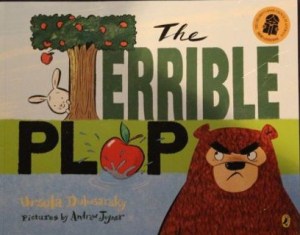
IMG_8646The Terrible Plop by Ursula Dubosarsky and illustrated by Andrew Joyner, paperback picture book, first published by Penguin Group (Australia) in 2009, this edition published by Penguin Group (Australia) in 2012.

The rabbits are having a relaxing snack by the lake when they hear a loud noise. It frightens them and they run away from the lake as quickly as they can telling all the animals they meet on the way about the “Terrible Plop”. They come to a bear who doesn’t believe anything could be scarier than him, and he forces the smallest of all the rabbits to show him where this “Terrible Plop” is.

Just as some children are wary of trying new things, the littlest rabbit discovers that some things seem scary at first, but once they are explained, they are not really scary at all. This is something most people can relate to. The Terrible Plop is an entertaining story with rhyming text and lovely illustrations. It is an excellent read-aloud book, and I love sharing this one with my kids. Great for preschoolers and lower primary school children, this story is sure to become a favourite.

Rowan of Rin by Emily Rodda

Standard

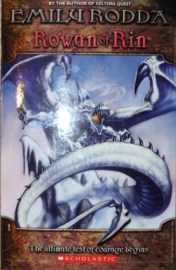
IMG_8107Rowan of Rin by Emily Rodda, paperback, 138 pages, first published in 1993, this edition was published by Omnibus Books (part of the Scholastic Group) in 2005.

Rowan is a young boy, living in the little village of Rin with his mother, Jiller and his younger sister, Annad. Rowan is a caring, quiet, and shy boy, different to the other children of Rin. He is thought of as a weakling by many of the other villagers, who do not understand him. His job is to tend to the Bukshah, the gentle beasts that provide milk and wool to the people of Rin.

When the stream from the mountain that supplies the drinking water for the bukshah ceases to flow, the villagers are concerned, their lives depend on the bukshah. They must climb the mountain to discover the cause of the interrupted flow. Unexpectedly, Rowan must join the party of villagers chosen to embark upon this quest. They have a map to guide them, but it is full of riddles, and the path is full of dangers. And at the top of the mountain there is rumoured to be a dragon. Rowan and his companions have a frightening and arduous journey ahead, but they all must be brave and continue on regardless of any possible obstacles in order to restore the flow of water down the mountain. Rowan doubts he is up to the task at hand, but he sets out on the adventure of his life to save the bukshah and the village of Rin.

While this book is aimed at middle primary school children, I still love this story as an adult. It’s got adventure, fantasy, anticipation, riddles, and a dragon! I read this with my second grader, and she also loved the story. Each riddle gave us a great opportunity to discuss what it meant, and talk about what we thought might happen next in the story, and how it might affect the characters. It is very well written, and it is easy to bring Rowan and his traveling companions to life. I highly recommend this book for any child looking for a good adventure story.


Rowan of Rin won The Children’s Book Council of Australia Book of the Year in the Younger Readers category in 1994.

Change the Locks by Simon French

Standard

IMG_3406Change the Locks by Simon French, paperback, 103 pages, published by Ashton Scholastic Pty Limited in 1991.

Steven, an eleven year old boy living with his Mum and baby brother, Dylan, doesn’t remember much about his early life, and any questions he asks are deflected by his mother. Her life is in tatters, as she tries to cope with her abusive ex, no job and living out of town without a car. There isn’t much left over for Steven and Dylan, and most of Dylan’s care is left to Steven, a big responsibility for a boy. When Steven’s teacher starts a pen pal program with a class from another school, Steven’s pen pal’s name sparks a memory. He is sure that he has heard that name before, but he can’t quite place it. He is puzzling over this when he and his best friend, Patrick, discover an old newspaper under the flooring while they are helping his parents with some renovations. The newspaper has an article that just might be about Steven and his Mum, but it leads to more questions than answers for Steven, and he really wants to find out the truth. He feels that he is old enough now to know how and where his life began, and why he’s never been told about it before, but his mother may not be ready to tell her story.

This book is fairly short for a novel, but it is still a good read. Steven has to cope with things that many kids will have no exposure to, such as not knowing his father or grandparents, caring for his younger brother, even during the night, which makes him very tired, and being scared of his mum’s ex-boyfriend. These things make Steven different to other kids, and children can often be mean to those that are different, making his school life harder, just as his home life is also difficult. These are great burdens for a boy of that age. The subject matter is handled well, and the story is compelling. I remember reading this for the first time in about year four, and handling it well, though we also discussed it in class, which allowed for more understanding of the themes and issues presented in the story. This is especially important for younger readers so that they get the most out of the book. It’s probably best for middle and upper primary age children.

Rain May and Captain Daniel by Catherine Bateson

Standard

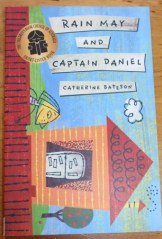
IMG_3407Rain May and Captain Daniel by Catherine Bateson, paperback, 138 pages, published by University of Queensland Press in 2002.

When Rain’s parents separate, her mother, Maggie, decides that they will leave Melbourne and move to Clarkson, a small country town in rural Victoria. There’s not much to the town, it doesn’t even have a pizza place, and the old cottage they move into is tired and rundown. Maggie is determined to make a go of it in their ‘dream house’, even if Rain isn’t happy with the move. Then she meets Daniel, the boy next door. Rain and Daniel are about the same age, and despite their differences they become firm friends. Rain has to cope with visits to her father in Melbourne where he lives with his new girlfriend Julia, and this situation isn’t easy for her. But when she discovers that Daniel is ill, it gives her life some perspective, and the strength to make the most of what she has.

A friend lent me this book, and I enjoyed it. It is written in a somewhat unconventional way, with most of the story told from Rain’s perspective, including some fridge poems her and Maggie write to each other. The rest of the story is told in a log-book format from Captain Daniel’s perspective, as he records events in Star Trek style.

The characters are interesting, well written, and believable. Rain’s friendship with Daniel sees her stand up for him, but she still resents him sometimes. And Daniel doubts that Rain will want to be friends with him once she gets to know the ‘cool’ kids. Diana, Daniel’s mum, worries too much, and is obsessively tidy. Rain’s father and Julia work a lot and have trouble finding time for her, while Maggie has a steadfast resolution to make their new life work and goes at it with gusto. These flaws and quirks add reality to the characters and to the story.

The book itself is a fairly easy read, but I think some of the content and themes, such as divorce and dating, might be more suitable for middle to upper primary school age kids and beyond. Younger children, though they may be capable of reading the text, wouldn’t necessarily understand or appreciate the story very well.


* Rain May and Captain Daniel was the winner for the 2003 Children’s Book Council of Australia Book of the Year in the Younger Readers category.