Category Archives: Themes

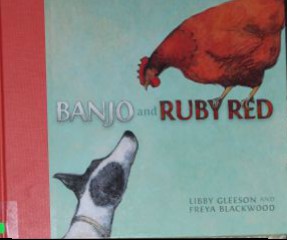
Banjo and Ruby Red by Libby Gleeson and Freya Blackwood

Standard

IMG_1486Banjo and Ruby Red by Libby Gleeson and illustrated by Freya Blackwood, hardback picture book, published by Little Hare Books in 2013.

Banjo is a chook dog. It is his job to round up the chooks and get them into their pen to be shut in for the night. He barks and chickens come from all over, except Ruby Red, who sits on the wood heap and ignores Banjo. When Ruby Red falls ill, Banjo finds her and cares for her during her recovery.

Gorgeously illustrated, this story of a wayward and head strong chook and her diligent round-up dog, is both moving and funny. I liked the barking and the squarking, with chooks flying everywhere, it reminded me of the chook yard my grandparents had when I was a child. My preschooler liked that Ruby Red ignores Banjo until he topples the wood pile, this made her laugh. I think she saw herself in Ruby Red, stubborn and resistant til the last! My second grader liked Banjo, and how he cared for Ruby Red when she was sick, even though she had antagonised him in the past. Friendship and love can conquer all.

Banjo and Ruby Red is a lovely book for sharing with preschoolers and lower primary school children, and a must have for primary school libraries!


* Banjo and Ruby Red was an honour book for the 2014 Children’s Book Council of Australia Book of the Year in the Early Childhood category.

Cardboard Roll Sheep

Standard

A loves sheep, and spends a lot of time playing with her sheep figurines. She also likes to draw and make sheep. This sheep was made with a cardboard roll and some cotton balls.

IMG_1500

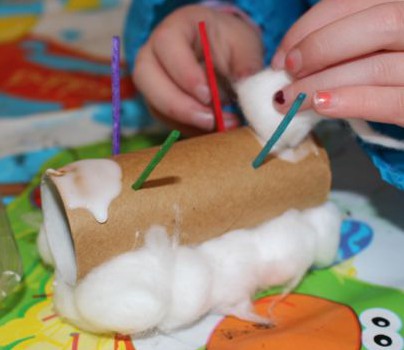
Matchstick legs.

Matchstick legs.

We added legs to the cardboard roll first. I made some small holes and A poked a coloured matchstick into each one. Then she got to gluing on the wool, which was lots of cotton balls. She added so many cotton balls that the sheep became a little heavy for its legs! Next time I think we might need to use popsticks or something else a little sturdier for legs. Either that, or we make the sheep less woolly.

Adding wool.

Adding wool.

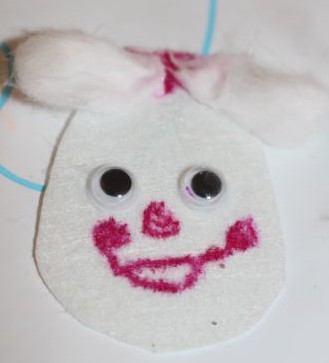
For the face, we used a piece of white felt. A decorated it with a mouth and nose and some googly eyes. She used a little bit of the cotton wool to make two droopy ears, and glued them to the top of the the head. Then she used some craft glue to stick the face to the body, and she had her sheep.

The sheep's head.

The sheep’s head.

A insisted it was just a baby lamb, but I think it looked more like a sheep that hadn’t been shorn for about three years!

A very woolly sheep.

A very woolly sheep.

Baby Bedtime by Mem Fox and Emma Quay

Standard

IMG_1479Baby Bedtime by Mem Fox and illustrated by Emma Quay, hardback picture book, published by the Penguin Group in 2013.

A mummy elephant gets her baby ready for bed with a beautiful bedtime lullaby. She tells her baby all the things she could do, such as nibbling on his ears, and gazing at him all night, but then the time for sleep has come.

Baby Bedtime is a lovely lullaby of love from a mother for her baby. The sentiment would be shared by many parents, and I definitely feel this way about my own children. The illustrations are just gorgeous, and gently rendered, making me feel relaxed and calm. Helpful for lulling little ones into sleep, this is perfect for reading to toddlers and preschoolers before bed. My second grader liked this story, but she thought she was a bit old for it.

Big Book of Aussie Dinosaurs by Kel Richards and Glen Singleton

Standard

IMG_1489Big Book of Aussie Dinosaurs by Kel Richards and illustrated by Glen Singleton, hardback non-fiction, 25 pages, published by Scholastic Australia in 2014.

Over the years we have read many dinosaur books, but I think this is the first one exclusively about Australian dinosaurs. It is a clear and simple introduction to this topic, suitable for preschoolers and lower primary school children. It contains facts about each dinosaur, with quirky illustrations on every page. My preschooler liked the carnivores running around with knives and forks. Her favourite dinosaur is Minmi, and she liked that a carnivore’s knife and fork were drawn crumpled from trying to penetrate her hard bony plates.

There is a glossary of Australian dinosaurs at the back of the book with a picture, the full name, phonetic pronunciation and the meaning of the dinosaur’s name. We tried saying all of the names aloud, some of them were quite difficult!

Prefect for all small dinosaur lovers, Big Book of Aussie Dinosaurs deserves a place in any dinosaur book collection!


Treasure Bottle

Standard
The shaken bottle.

The shaken bottle.

One of the preschool classes at school made some pirate treasure bottles as part of their pirate theme. A was intrigued by the treasure bottles, and wanted to make one at home. The bottle contained a variety of items, including sand, coloured water, glitter, beads, pebbles and other crafty materials.

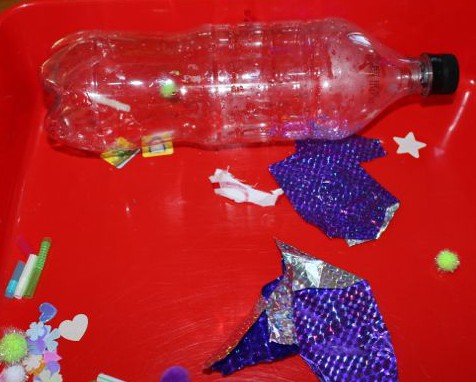
The bottle and some of the treasures.

The bottle and some of the treasures.

We used a clear plastic bottle to place our treasures in. Some of the treasures included plastic beads, coloured plastic, sparkly pom poms, cut up plastic straws, some broken loom bands, and lots and lots of glitter. The kids took turns adding treasures to the bottle, then I used a funnel to add silver and gold glitter. Once all our treasures were in the bottle, I filled it with water and tightened the lid. For bottle crafts like this, I normally add glue to the thread of the lid before screwing it back on too, so that the lid doesn’t accidentally come off and result in a huge mess.

Tipping the bottle upside down.

Tipping the bottle upside down.

Watching the contents settle.

Watching the contents settle.


The kids squeezed the bottle, tipped it upside down, and shook it. They watched to see what sank and what floated. They watched as the contents settled and swirled. They were mesmerised.

Shell Photo Frames

Standard
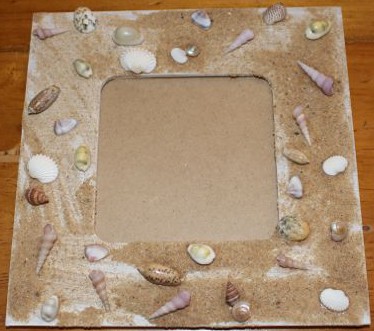
L's frame.

L’s frame.

IMG_1453

A’s frame.


It’s nice to have photos displayed around our home, but most of our frames are a little boring. I picked up some plain wooden photo frames in Bunnings that we could decorate any way we pleased. We made them into shell frames.

Painting the frame white.

Painting the frame white.

First we gave the frames an undercoat of white acrylic paint. Both L and A got white paint everywhere, so I was glad we had the muck mat down. Painting the frames wasn’t vital, but I thought it would look better than the plain wood.

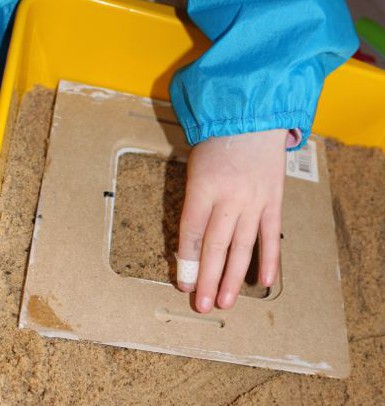
Pressing the gluey frame into the sand.

Pressing the gluey frame into the sand.

Once the paint was dry, the kids painted on a thick layer of PVC glue all over the front of the frame. I had placed some clean sand (sandpit sand from Bunnings) into a tray big enough for the frames to be placed face-down into the sand. The kids took turns to put their glue-covered frames into the sand. Just pressing the frame down into the sand was quite effective at getting the sand to stick to the glue. There was the occasional patch that didn’t have sand, but the kids just added a bit more glue and then sprinkled sand onto these places, and pressed the sand down.

Adding glue to a shell.

Adding glue to a shell.

We left the sandy frames to dry for long time (due to damp weather), and then we shook off any excess sand that wasn’t stuck down. Now we used PVC glue to add some small sea shells to the frames.  A put all of her shells together in one corner. She used so much glue to place her shells, it took several days to dry completely. L placed just a few shells down two sides, while I added shells randomly all over the frame I decorated.

Sticking shells down.

Sticking shells down.

These frames look very impressive, and they were fun to make. They will look even better once we get photos into them!

My shell frame.

My shell frame.


Kissed by the Moon by Alison Lester

Standard

IMG_1393Kissed by the Moon by Alison Lester, hardback picture book, published by Penguin Group (Australia) in 2013.

The wishes of a mother for her child. From waking to birdsong, experiencing the great variety of nature, and drifting into dreams, Kissed by the Moon, reads like a lullaby of love between mother and child.

This heart-warming book captures the beauty of the mother and child relationship. For her child she would like the simple pleasures of love, happiness, contentment, safety and experiencing nature in all its forms, things that many parents want for their own children. It is also beautifully and brightly illustrated, a pleasure to see. Kissed by the Moon is a lovely book to read to children before bed, from toddler through primary school, it will remind them of their parents’ love and help them to settle down for a peaceful sleep.


Jeremy by Chris Faille and Danny Snell

Standard

IMG_1357Jeremy by Chris Faille and illustrated by Danny Snell, published by Working Title Press in 2013.

Jeremy is a baby kookaburra that has fallen out of his nest. The family cat brings him home when he is just a wrinkly little pink ball with closed eyes. The nest is too high to return the bird to, so the family look after him, keeping him warm and feeding him. Jeremy grows feathers, and gets bigger and stronger. All too soon he is ready to face the world on his own.

Jeremy is a heart warming tale of survival, that also serves to introduce the reader to the basics of how a kookaburra develops. The story itself is a simple narrative following Jeremy’s progress from ugly newborn to young adulthood, when he is ready to fend for himself.

Inside the front and back covers, lots of facts about kookaburras are presented, considerably increasing the depth of knowledge gained from this book. The illustrations in Jeremy are an asset to this book, as they are wonderfully life-like, and so detailed. They bring Jeremy to life as he grows and changes.

Several times as a child I found a poor baby bird that had fallen or been pushed from its nest, and tried to save it. None of mine were as lucky as Jeremy though. I was pleased that Jeremy grew into a healthy young kookaburra that could be released back into the wild, despite his shaky start. My preschooler was surprised, having never seen a newly hatched bird,  that baby birds have no feathers and are completely defenceless. She enjoyed the extra facts about kookaburras, and I’m pretty sure she learnt some things!  As this book is mostly non-fiction disguised as a picture book, I think it would be an excellent tool to help encourage children into reading more non-fiction. Good for curious kids in primary school and preschool, I enjoyed sharing Jeremy with my daughter very much.


* Jeremy was the winner of the 2014 Children’s Book Council of Australia Book of the Year in the Eve Pownall Award for Information Books category.

The Swap by Jan Ormerod and Andrew Joyner

Standard

IMG_1358The Swap by Jan Ormerod and illustrated by Andrew Joyner, hardback picture book, published by Littler Hare Books in 2013.

Caroline Crocodile is very jealous of her baby brother. Mama Crocodile is always saying how wonderful he is, and giving him big smoochy kisses. Caroline thinks her brother is just a big smelly and drooly mess, and she really wants Mama Crocodile to herself. So when Mama Crocodile asks Caroline to look after her brother while she pops into the hat shop, Caroline decides to trade her brother for a new baby  at The Baby Shop. She tries a baby panda, twin tiger cubs and an elephant, but none of them are quite right. Perhaps her baby brother really is the best brother to have after all?

A beautiful picture book about the love of a sister for her brother, this story touched my heart. My preschooler chose this book to read before bed last night, and it was lovely to share it with her. She has a baby brother of her own, who she thinks is often smelly and dribbly just like Caroline’s little brother. I’m pretty sure my preschooler has considered swapping her brother on occasion (when he threw her toothbrush in the toilet, bit her tummy hard enough to draw blood, emptied a water bottle into her bed…), yet she loves him dearly, and knows that he is her perfect little brother. Baby brothers or sisters often get a lot of attention, but this doesn’t diminish an older sibling’s love or importance, it’s just that babies are so messy and dependent! It can take a while for an older sibling to realise this, just like Caroline. And just like Caroline, sometimes older siblings might be jealous of a baby in their family. My preschooler really related to Caroline Crocodile and laughed a lot when Caroline tried to trade her brother in. She also thought that the antics of the substitute brothers were hilarious. I liked the twin tigers that were “too tiring”, as they quickly destroyed a toy shop and menaced the other children, while my preschooler liked the baby elephant sitting in the fountain. The illustrations in The Swap are colourful and entertaining. There were plenty of things for my preschooler to spot, especially in the town scenes. We enjoyed looking carefully at all the pictures. Caroline Crocodile’s facial expressions are wonderfully realistic and it was easy to see how she was feeling.

Especially good to read to big brothers and sisters, The Swap is a great story for all preschoolers and lower primary school children.


* The Swap was the winner of the 2014 Children’s Book Council of Australia Book of the Year in the Early Childhood category.


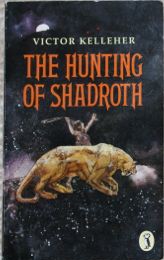
The Hunting of Shadroth by Victor Kelleher

Standard

IMG_1356The Hunting of Shadroth by Victor Kelleher, paperback novel, 192 pages, first published by Kestrel Books in 1981, this edition published by Puffin Books in 1983.

Young Tal is a member of the Clan, a people that live simply in cave dwellings overlooking the gentle rolling slopes down to the Greenlands, an area of thick jungle. Living in the Greenlands is the large cat-like creature known as the Feln, a gentle beast, living in peace with the Clan. However, when something kills some of the Clan’s cows, the chieftain, Kulok, blames the Feln and sets out to destroy them. Tal is forced onto the hunt, but cannot bring himself to kill the Feln, and is cast out of the Clan for cowardice. Tal knows that the Feln is not the problem, a malevolent force, known in legend as Shadroth, has risen in the Greenlands. It is up to Tal and his best friend, Lea, to travel beyond the Greenlands to seek help. It will take great courage and persistence to defeat Shadroth and bring peace to the Greenlands and the Clan once more. With the Feln and Lea by his side, Tal must face his fear and fight for all he has ever known.

As a child in primary school I was obsessed with Victor Kelleher, I read as many books by him as I could find, but The Hunting of Shadroth was my favourite, one that I read many times. I hadn’t read it for more than a decade though, until I came across this old copy in a secondhand book shop. I was a bit hesitant to start reading it in case it didn’t stack up to my memories of it, but I needn’t have worried! I found this to be as compelling a read now as it was when I was a child.

While it is a fantasy novel, it draws on many aspects of our own reality and history, and couples this knowledge with descriptive imagery to really bring the story to life. Following Tal and Lea on their adventure, their fight and their friendship with the Feln, I found myself racing through the pages, not wanting to put it down until I knew the outcome. Each time Shadroth appeared, I could image the terror he would induce among the Clan. He is a bit scary, and there are parts of the story that are quite dark. For this reason, The Hunting of Shadroth, while suitable for middle to upper primary school children based on reading and comprehension abilities, there are kids that may find it too frightening to read. Other children may find it more exciting than scary. My second grader has informed me that she will wait until she is a bit older, and that’s fine. While I wait for her to be ready, I will just have to re-read more of the Victor Kelleher books I so loved many years ago.