Category Archives: People/The Body

Ears, Eyes, Nose by Rebecca Bondor

Standard

IMG_1191Ears, Eyes, Nose by Rebecca Bondor, a Rookie Toddler boardbook, published by Children’s Press (Scholastic) in 2014.

This boardbook introduces young children to some of their body parts. It contains clear photographs of children pointing to their own ears, eyes, and other parts. Seeing children just like them can help toddlers and young children to engage in learning new things. And with only one large print word per photo, and a sturdy board construction, this is a great book to start learning body parts with babies and toddlers.

Ten Tiny Toes by Caroline Jayne Church

Standard

IMG_1195Ten Tiny Toes by Caroline Jayne Church, boardbook, published by Cartwheel Books in 2014.

A simple and engaging book for toddlers celebrating their bodies. As I read through Ten Tiny Toes with my son (15 months old), I encouraged him to point to each part of his body and do the actions in the book. He liked looking through the book and pointing to the pictures, and especially grabbing his toes when we read ‘and ten tiny toes!’ He did laugh and giggle when we touched his tummy too. The text was large with rhyming language, and the illustrations were simple, yet nice. This story helped us to focus on learning parts of the body in a fun way that many toddlers will enjoy.

Amazing You! by Dr. Gail Saltz and Lynne Avril Cravath

Standard

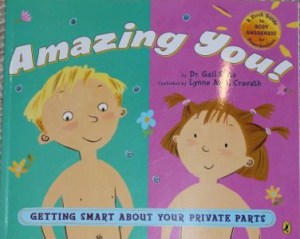
IMG_1170Amazing You! by Dr. Gail Saltz and illustrated by Lynne Avril Cravath, paperback non-fiction, first published by Dutton Children’s Books in 2005, this edition published by Puffin Books in 2008.

Amazing You! is a basic look at the reproductive systems for young children. Aimed at preschoolers, this book provides information on body awareness and answers questions about ‘private parts’. It is a good first journey into what can be an awkward topic for many parents.

The text and illustrations are clear and simple, using anatomical names and easy to understand language. There is also a helpful section at the back of the book for parents on talking about sexual curiosity and where babies come from with their children. When it comes to describe how babies are made, it does not go into extensive detail, but sticks to the basics of egg and sperm, all a preschooler really needs to know. The book mentions that sexual curiosity is natural and normal, including masturbation and asking questions. It also reminds us that our bodies and our sexual organs should not be a source of embarrassment or shame, because they are all part of us, and we are amazing!

Mummy Laid an Egg! by Babette Cole

Standard

IMG_1174Mummy Laid an Egg! by Babette Cole, non-fiction paperback, first published by Jonathan Cape in 1993, this edition published by Red Fox in 1995.

Dad and Mum have decided to tell their kids where babies come from. They tell the kids that sometimes dinosaurs deliver babies, or they can be grown from seeds, made from gingerbread, or they can even be found under rocks! And in this case, the kids exploded from a huge egg that Mum laid on the couch. The kids think this is hilarious. They quickly begin on a journey to set their parents straight, including lots of drawings explaining just how babies are made.

A light-hearted look at reproduction, this book is perfect for younger children from preschool up. The drawings are humorous, educational, and appropriate for the intended audience. The language is easy to understand for children, and the subject matter is treated without any of the seriousness that sometimes surrounds this often delicate topic. I think this book would be especially good for parents who are a little nervous about having “the talk” with their kids, it is a great way to lighten the mood.

Both my preschooler and second grader love this book. I think that it is the best introduction to the sensitive subject of conception and reproduction that I have come across. It is honest, frank and amusing. I particularly like the pages that show how mummies and daddies fit together, some truly awkward and hilarious positions! My kids laughed at the ridiculous stories that the Mum and Dad tell their kids, as well as at many of the drawings throughout the book. It covered the basics, and my kids were happy with the content, re-reading it several times, asking questions and discussing it. A really nice book, I am very glad I purchased Mummy Laid an Egg!


What Makes a Baby by Cory Silverberg and Fiona Smyth

Standard

IMG_1168What Makes a Baby by Cory Silverberg and illustrated by Fiona Smyth, non-fiction hardback, published by Seven Stories Press in 2012.

This book is bright, colourful and simple, and suitable for young children who are first becoming curious about where babies come from. It introduces sperm and eggs, and the concept that both are required to create a baby, but it is quite vague about how this actually happens. In fact the whole book is rather vague. It is one of the most abstract non-fiction books I have ever read. However, while it doesn’t present detailed information, it does provide prompts to begin the discussion of this issue in as much detail as a parent thinks is appropriate for their particular child at the time. It also provides opportunities for kids to ask questions. This book could be used to start a discussion that many parents find difficult to conquer.

I read this with my preschooler and second grader. They both thought the illustrations were a bit odd, especially the people that were coloured with blue or green or purple skin. My preschooler said a few times that people are not that colour! They were also amused that the sperm and egg had been given faces and that they perform a special dance together to form a baby. I think this book was actually too abstract for them, and they were quite distracted by the less than life-like pictures. They asked a few questions, but it didn’t develop into a deep conversation about how babies are formed, instead, it left them with a very superficial view of how life develops. We used this book as a first stepping stone onto more detailed texts.

The Bare Naked Book by Kathy Stinson and Heather Collins

Standard

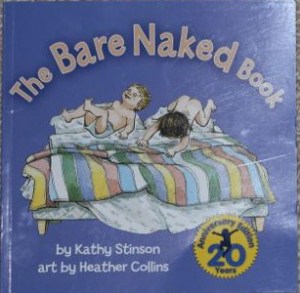
IMG_1167The Bare Naked Book by Kathy Stinson with art by Heather Collins, paperback non-fiction, first published in 1986, this edition published in 2006 by Annick Press.

This is a simple look at our bodies, and the different parts that make them up. With basic language and clear illustrations, this is a nice book for toddlers and preschoolers. It introduces each part of the body, with some illustrated examples of each, such as pushing arms, hairy nipples and stamping feet. At the end of each page, it asks the child to locate that body part on themselves, which is a great prompt for learning body parts and for body awareness.

My preschooler liked the pictures, and had fun locating all her body parts as suggested by the book. She enjoyed perusing this book on her own too, looking at the pictures, and pointing out what the different parts of the body were doing.

Wooden Peg Dolls

Standard
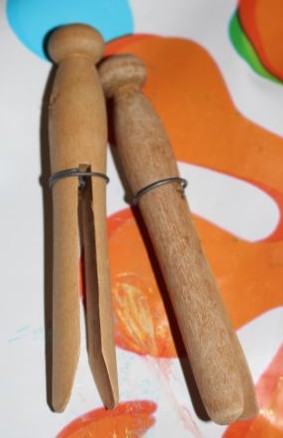
Wooden pegs.

Wooden pegs.

A friend gave me an old tin full of wooden dolly pegs recently, which are just perfect for making little dolls.

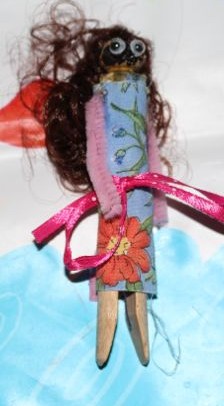
L and A each took a peg, and then went through our fabric scrap bag to find something to make some clothes. A made her doll a dress by wrapping a strip of floral fabric around her peg. I helped her tie a thin ribbon around the doll’s waist. L used two strips of fabric to make a shirt and some shorts.

A's lovely hair.

A’s lovely hair.

They used some craft doll’s hair to give their dolls lovely flowing locks. I had to help A gets her hair glued down so that it only covered the back of the head. L also had a bit of trouble getting the hair onto her doll, as once it hit the glue, it stuck to her fingers as well.

L drawing on a face.

L drawing on a face.

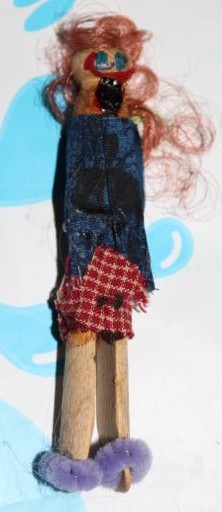
A added some pipe cleaner arms to her doll, and L made shoes out of pipe cleaners for her doll. L decided her doll did not require arms. They both used markers to draw on a face, but A’s went wrong, and she ended up colouring the whole of her doll’s face in black. So we added some tiny googly eyes on, which make the doll look a bit scary, but A was very happy with it.

L also added some details to her doll’s outfit using the markers. She said this doll would be the perfect size to use as a worry doll. L sometimes likes to use a worry doll to help keep herself calm when she knows she will be in a stressful situation, such as going to the dentist or having a vaccination.

A's doll.

A’s doll.

L's doll.

L’s doll.


Yarn Dolls

Standard

I remembered making yarn dolls when I was a child, and I wanted to try it with the girls.

IMG_8878

Wrapping the yarn around the cardboard.

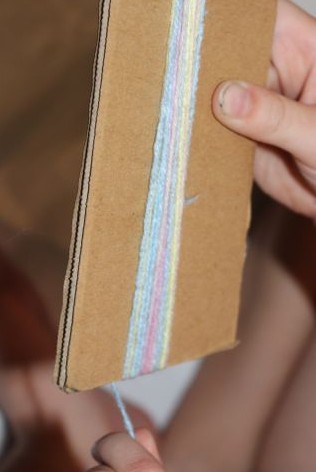
Wrapping the yarn around the cardboard.

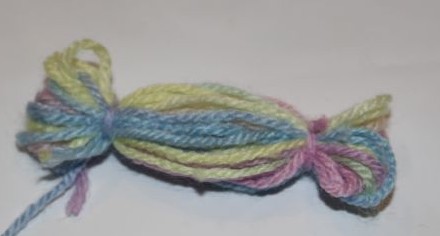
First I cut some sturdy cardboard up into two rectangles to use to wrap the yarn around to make the body of the doll. I started each child off by winding the yarn around a few times, and then they continued to wind it until it was as thick as they wanted it to be. Once that was done, I helped them remove the hank of yarn from the cardboard. From this yarn we would make the head, body and legs of the doll.


Tying yarn around the body to form the head.

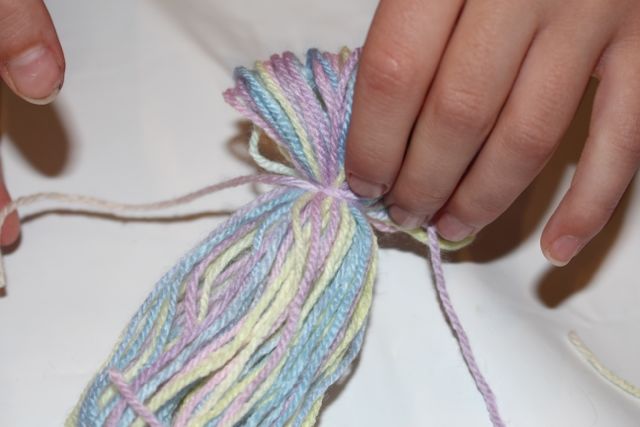
Tying yarn around the body to form the head.

The body with hair, head, body and legs.

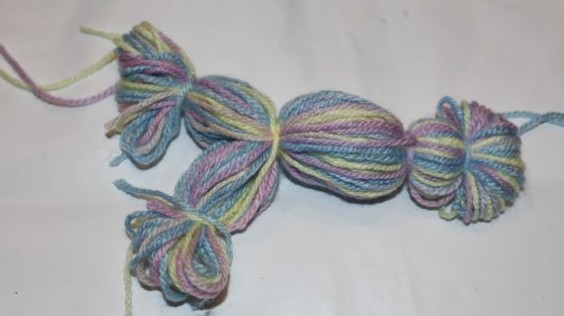
The body with hair, head, body and legs.

L cut a few pieces of yarn off the ball to use to tie around the hank of yarn to differentiate the hair from the head, and the head from the body and the body from the legs. L tied her knots, but A had difficulty, and asked me to help her do this part. Once the yarn was tied around the body at the top of the legs, we split the yarn beneath this into two roughly equal parts, forming the legs. A small section at the base was also tied off to form feet.

Arms ready to be added to the body.

Arms ready to be added to the body.

To make the arms, the kids wrapped some more yarn around their cardboard, but this time, around the shorter sides of the rectangle. This hank of yarn was also not as thick as that of the body. Once we had removed this yarn from the cardboard, a small section on each end was tied off to form the hands.

We carefully threaded the arms through the body of the doll, and secured the arms in place using another piece of yarn wrapped around the doll’s chest in a criss-cross under the arms and around the back. We snipped off all the loose threads from our knots, and then the dolls were done. L left her doll just as it was, but A added some tiny googly eyes to her doll, but not other facial features.

IMG_8876

Bottle Doll

Standard

A is crazy for dolls of all sizes and shapes. She does a lot of pretend play with them, in particular she likes to give them baths…. which are not always so pretend. She carries them around, takes them on outings, and to bed. A asked if we could make some dolls for craft, so we gave it a go. I remembered using a soft drink bottle to make a doll when I was a child, so we started with making a bottle doll.

The doll's head.

The doll’s head.

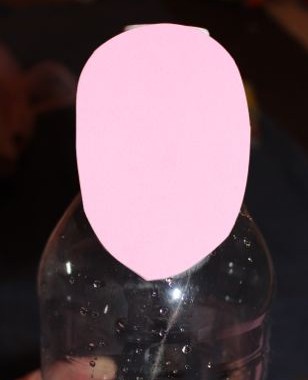
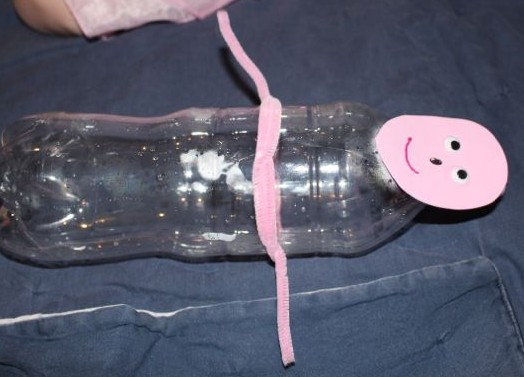
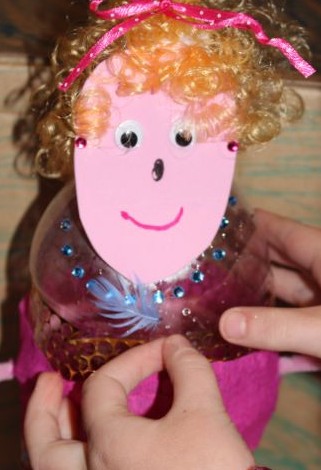
We had an empty mineral water bottle that we washed out, and removed the label from. I cut out an oval of pink foam for the doll’s face, and A glued it to the top of the bottle. A decorated her doll’s face, giving her googly eyes, and using a marker to make a mouth and a nose.

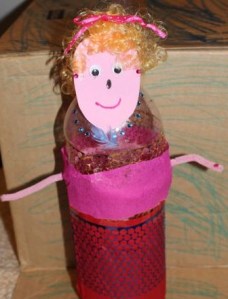
IMG_8631I twisted two pink pipe cleaners today to make one long one, and I helped A to wrap this around the bottle to make some arms.

Then A got down to the very serious business of dressing her doll. She decided her doll should be wearing a shirt and a skirt. She chose to make the skirt from red tissue paper and blue honeycomb mesh, and the shirt from gold honeycomb mesh and pink crepe paper. I helped her to poke the doll’s arms through the mesh and crepe paper of her shirt. I held the shirt and skirt shut at the back while A taped them together. She is getting much better at removing tape from the dispenser without sticking it to itself now.
Adding hair.

Adding hair.

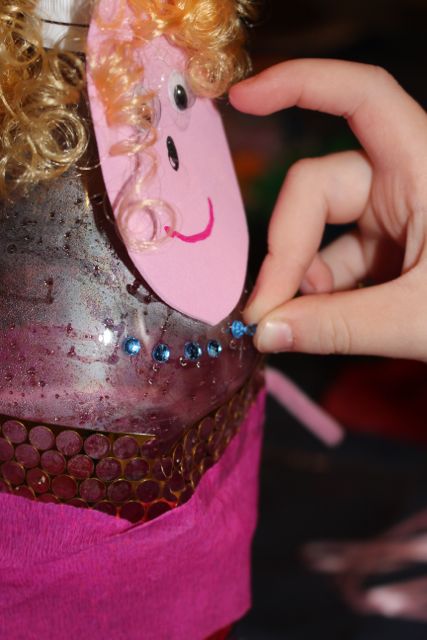
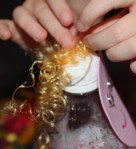
Once she was dressed, it was time to “make her pretty” according to A. She didn’t like the bald look her doll was sporting, so she added some curly doll’s hair to the top of the bottle and around her face.

Placing her necklace.

Placing her necklace.

A also used some stick-on gems to giver her doll a necklace, some earrings and a little watch.  She found a thin pink ribbon in the craft box and asked me to make her a bow to place in the doll’s hair too.

Adding the final touches.

Adding the final touches.

As a final decoration, A placed a small blue feather as a pendant on the doll’s necklace.

A made a bed for her new bottle doll beside her own bed that evening, so she would be comfy and warm, and ready to play first thing in the morning.
 

IMG_8639