Tag Archives: children’s novel

The Ice-Cream Man by Jenny Mounfield

Standard

IMG_4309The Ice-Cream Man by Jenny Mounfield, paperback novel, 187 pages, published by Ford Street Publishing in 2008.

Three boys like to visit a secluded billabong to escape their everyday problems and the challenges that life has presented to them. Marty suffers from Cerebral Palsy and spends most of his time in a wheelchair, Rick is living with his alcoholic mother after his dad died in a car accident, and Aaron is being severely bullied by his older step-brother. Their difficulties bring them together as friends, but the encounter with the ice-cream man will bond them for life. It’s very hot this summer, and the ice-cream van has been doing the rounds about town, tinkling its music to let all the kids know that it’s coming their way. The boys decide to play a prank on the ice-cream man when he doesn’t stop the van for them. What seems like getting even has consequences that the boys are not prepared for.

The Ice-Cream Man is a thriller for upper primary school to lower high school students. It was a little creepy at times, with some foul language and violence, but it wasn’t too scary for kids to read. Though perhaps they might think twice about playing pranks on other people in the future!

The main storyline involving the prank and the scary, stalking revenge that the ice-cream man begins against the boys was interesting and suspenseful. I did want to keep turning the pages to see what would happen next. I hope there are no crazy ice-cream men out there terrorising children, but this book makes it feel like there just might be one lurking around the next corner, just waiting for the slightest provocation.

I also found that I was quite interested in the boys themselves. Each of their stories were different, and each of them were facing different challenges that most kids will not have to endure, yet they were still moving forward and were able to trust and rely on each other. Friendship is so very important in life, and this is a nice reminder that friends don’t care what you look like or where you live, but they will always have your back.

The three boys were well described, though I found Aaron’s hair colour to be incongruous to his character. I just kept wondering why he would dye his hair in a shade that would only antagonise his step-brother further, when he was already scared of him and trying to stay out of his way. Of course, it’s completely inconsequential, it was just one of those little things that get stuck in my head, and it certainly didn’t detract from the suspense of the story. Otherwise, Aaron was a little down-trodden, as could only be expected after the treatment he had been receiving from his step-brother. I thought he became more likeable as the story progressed. I liked that Marty felt liberated and empowered by his wheelchair, that he didn’t feel sorry for himself. He made for an inspiring main character. And I felt that Rick was leading the hardest and saddest life of the three of them. His mother should have been there for him, but in her grief, Rick was left as the responsible one. Sad though it is, it smacked of reality. All three situations were well written.

I think The Ice-Cream Man is a good introduction into this genre for kids and teenagers. It was a good story and well written. I am happy for my third grader to read it, though perhaps not just before bed!
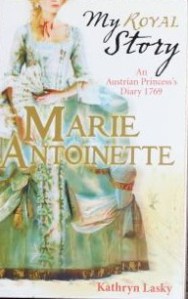


My Royal Story: Marie Antionette by Kathryn Lasky

Standard

IMG_4172My Royal Story: Marie Antionette by Kathryn Lasky, historical fiction, 221 pages, first published by Scholastic Inc. in 2000, this edition published by Scholastic Ltd. in 2010.

Maria Antonia Josepha Johanna is the youngest daughter of the Empress and Emperor of the Holy Roman Empire, and she is destined to become Marie Antionette, Queen of France. It is 1769, and the child Antonia is only thirteen, but she is soon expected to marry the dauphin of France, Louis Auguste, who will ascend the throne once his grandfather passes. Antonia must learn many things as she leaves her childhood and her home in Austria to evolve into Marie Antionette of France.

This diary style historical fiction is based on the teenage years of Marie Antionette, who ruled France with her husband, Louis XVI, in the late 1700s. It is a very interesting story told in first person diary entries beginning when Antonia is just thirteen. It explores her world as an Archduchess, and her transformation from child into adult, wife and future leader of France. So much is expected of her at such a young age. Her mother believes that her successful marriage to the dauphin of France will secure peace in Europe, and as such, Antonia has much responsibility and power resting upon her young shoulders. The extravagance of court and palace life is almost unimaginable, as is the strict etiquette and sheltered lifestyle these rulers lead. They are so far removed from those that they rule over, it is no wonder that revolution came to France.

An engaging story well executed, My Royal Story: Marie Antionette, is suitable for upper primary school students and older. This is a great way to introduce some history into your child’s life. By telling the story from Marie Antionette’s perspective as a teenager, it helps the young reader to identify and empathise with her. There were also some historical notes and family trees at the end of the story, explaining a little bit about the time period and what happened to Marie Antionette, Louis Auguste and their children. Using the story to spark interest in this part of history can be a springboard for exploring the life and death of Marie Antionette and the changes that descended upon France and Europe in the late eighteenth century more thoroughly.

My Royal Story: Marie Antionette is only one title in the My Royal Story series, and I am interested in reading more of these titles. History can be very dry, but I was pleased to find a book that makes discovering history fun and compels one to investigate the historical period and figures further.

Florence Takes the Lead by David Harding

Standard

IMG_4099Florence Takes the Lead by David Harding, paperback chapter book, 85 pages, published by Random House Australia in 2012.

Ben has a beautiful shaggy sheep dog called Florence, who is his best friend, and goes most places with him. When his parents decide to have a long weekend away in the country, Florence goes with them to stay at the guesthouse. Together they discover a pig farm still using the old methods of sow stalls and farrowing crates, which means that the pigs are heavily confined. Can Ben and Florence help to liberate the pigs and educate the farmer regarding more humane pig farming practices?

Florence Takes the Lead is part of the RSPCA Animal Tales series, which promote the humane welfare of animals. These books are suitable for lower and middle primary school students, and will be particularly appealing for animal lovers. This was a reasonably simple adventure story with an important message about animal welfare, and the great work the RSPCA do. While the story is fictional, the adventure is based on animal welfare situations that unfortunately do happen. However, these books are a fun way for younger children to become aware of the various issues facing animals and those that advocate for them. After the story ends, there is a fact file, first providing some information about the RSPCA, and then some information about pig farming in Australia. And there are more books in this series just waiting to be explored!


The Rain by Virginia Bergin

Standard

IMG_4096The Rain by Virginia Bergin, paperback novel, 386 pages, published by Macmillan Chidlren’s Books.

Ruby Morris is just a teenager living in a small town in rural England when the end of the world as she knows it arrives in the form of killer rain. One minute she’s passionately kissing the boy of her dreams, the next, people are dying. The merest touch of the poisonous water is enough to kill, wiping out millions within a few days. Ruby sets out across the country to find her Dad, putting her survival skills to the test.

The basis of The Rain is an apocalyptic event, causing a devastating loss of human life. The cause behind the development of killer rain is established clearly and early on in the story, which seems to be rare among books of this genre that I have read. A contaminated water source is a great start for an apocalypse, though I was surprised by the violent and bloody way in which people affected by the water died. Complete loss of a safe water supply is truly a terrifying thought. The story dealt with the short-term requirements of finding safe water to drink and ahelter, but didn’t explore the complications that would arise due to such finite resources. Perhaps the sequel, The Storm, will delve deeper into the more long-term consequences of contaminated rain.

The Rain is written in the first person as Ruby. I tried hard to like Ruby, she’s just lost her family and her friends, and she’s trying to survive in this new and dangerous world, and I could feel sorry for her, but I couldn’t really like her. Before the rain came, she was obviously one of the popular kids, stuck-up, selfish, shallow and egotistical. Not exactly the perfect picture of someone who will rebuild the world post-apocalyspe, but I thought she would start learning to be someone of more consequence on her journey. I didn’t like the way that she treated Darius, as if he was completely beneath her. She refers to him as a nerd, but he is smart and practical, exactly the sort of person you should want on your side if the world ever comes to an end. I was disappointed that Ruby still considered Darius to be socially inferior despite the whole of humanity crumbling about them. And instead of collecting practical supplies, she loots make-up and clothes her mum and stepdad would never have let her wear. Hey, I’ve never been part of an apocalypse, so who knows what crazy things I would do, but I just can’t imagine mascara and sequins will be high on my list of things to do.

I generally quite like apocalyptic and dystopian novels, and this novel was okay, but I didn’t like it as much as I expected. My difficulty in liking Ruby really clouded my enjoyment of the story. The abrupt ending of the story surprised me too, until I realised that there was to be a sequel. The Rain left me with lots of questions. I’m wondering how society will develop without a clean source of water, not only to drink, but to produce food as well. Will the rain become safe again, will there be tests developed to identify safe water? And what happens to Ruby, Darius and Princess? I’m interested enough to read the second book, and it leaves me with hope that Ruby will develop into a more likeable heroine.

Due to the complicated themes contained within this novel, The Rain is most suitable for high school students and up.


Ratburger by David Walliams

Standard

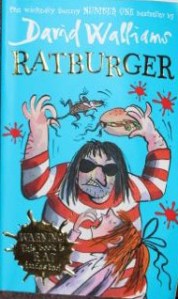
IMG_3921Ratburger by David Walliams and illustrated by Tony Ross, paperback novel, 317 pages, published by HarperCollins Children’s Books in 2012.

In a council flat high in an old leaning building, lives Zoe, with her unemployed father and her horrible and lazy stepmother. She is quite alone in the world, with her Dad always at the pub, and her hateful stepmother eating crisps on the couch all day either ignoring her or screaming at her, but never once being nice. The school bully lives in the same block of flats too, and never misses an opportunity to give Zoe a hard time. Then comes a small rat into Zoe’s room and changes her life forever. Zoe’s rat is intelligent and Zoe begins training him to do tricks, whilst planning to become famous performers. Unfortunately the man that runs the burger van outside the school at lunchtime hears about her pet, and forms a nasty plan of his own.

Reminiscent of a Roald Dahl tale, possibly crossed with an Andy Griffiths story, Ratburger was funny, inspiring and touching, a tad silly, but most of all it was entertaining. Filled with plenty of gross stuff, such as disgusting grown-ups, nose picking, foul food, spitting, rats and of course ratburgers, this book appealed to my third grader and her friends. At the moment they all seem to be obsessed with bodily functions and smells… even just the names for different body parts and functions can have them in hysterics! My daughter also liked that many of the grownups in the story were depicted as being a little evil and a lot eccentric. Even Raj, the shopkeeper, had his oddball moments, including re-selling lollies Zoe had sucked, or chocolate bars less one bite. This view of adults satisfied my daughter’s perception that adults are just as weird as kids deep down, normally they just hide it better!

Ratburger was interspersed with black and white illustrations by the wonderful Tony Ross, author/illustrator of the Little Princess picture book series (very much loved in our house!). These illustrations caused much giggling alongside the story, adding further interest to an already engaging plot.

Ratburger was our first taste of David Walliams as an author (I’d already been laughing at him for years as a comedian, but my kids don’t know that!), and it has not been the last. My third grader begged for more of his books while barely laying this down after reading it for the first time. I love a book that can make my kids laugh, so as soon as I could, I bought a few more of his books, and they have been quickly devoured. If you’re looking for something that’s sure to make your middle to upper primary school child laugh themselves silly, try Ratburger, and wait for the guffaws!

Lulu Bell and the Birthday Unicorn by Belinda Murrell and Serena Geddes

Standard

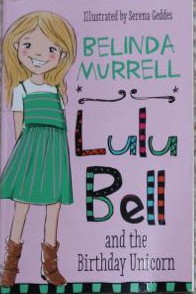
IMG_3813Lulu Bell and the Birthday Unicorn by Belinda Murrell and illustrated by Serena Geddes, paperback chapter book, 86 pages, published by Random House Australia in 2013.

Meet Lulu Bell, a great big sister to Rosie and Gus, best friend to Molly and daughter of the local vet. During the preparations for Rosie’s mermaid themed birthday party, their Dad is called out to capture an escaped pony before it can get hurt. Until its owners can be found, the pony is placed in Lulu’s backyard, where the party is soon to be held. Unfortunately the pony gets up to some mischief, upsetting Rosie. Luckily Lulu has an idea that will help to make Rosie’s party the best ever.

A simple story of family, friends and fun, this chapter book captivated my kindergartner. She enjoyed the storyline, and identified with the family, which were very realistic. She liked the way Gus spoke, and called himself “Bug Boy” and the way that Rosie and Lulu interacted as sisters. The idea of a mermaid party was quite appealing to her also!

For self reading, Lulu Bell and the Birthday Unicorn, would suit a slightly more confident reader than one just starting chapter books. While the chapters were reasonably short, and the black and white illustrations frequent, there is more depth to this story than is usually seen in a first chapter book. The language was very suitable for lower primary school children, and the story easy enough to follow. I read this one to my kindergartner as she’s not yet onto chapter books, and she has already asked for more Lulu Bell!


Winterkill by Kate A. Boorman

Standard

IMG_3715Winterkill by Kate A. Boorman, paperback novel, 344 pages, published by Faber and Faber Limited in 2014.

Strictly ruled by a group of council members, the settlement has been isolated and lost from other people for several generations. It is surrounded by tall walls from which guards watch the surrounding forest through the night, waiting for signs of the malmaci, a dangerous beast that sometimes takes settlement members. It is important that no one leaves the safety of the settlement after dark, and even during the day, no one should stray too far into the woods. Most of the members of the settlement are obedient and adhere to the routines, rules and rituals of their community, but sometimes a member will stray from the path, becoming known as wayward or stained, bringing shame to their families. Another major concern for the settlement is the freezing winter known as the Winterkill which is almost upon them as Emmeline comes of age. As a cripple and a stained person, she is surprised by a marriage proposal, while still trying to figure out her feelings for another boy in the settlement. All the while she is drawn to the woods, curious as to what lies beyond the settlement. Her curiosity may result in dire consequences for herself, and the other members of her community, but without risk, there can not be discovery.

Winterkill reminded me a lot of M. Night Shyamalan’s film The Village. There were many similar points, isolated village, monster lurking in the forest, overbearing and strict leaders. I liked that movie, but I like this book even more. Right from the start I liked Emmeline. She has determination, courage and individuality in a society which promotes conformity and compliance. A very interesting and strong character that jumps from the page, I just wanted everything to work out well for her. I also liked Kane, the boy that Emmeline fancies. He too, was very well written, interesting and somewhat mysterious. The characters and the landscape became increasingly clear to me as I read, or more fell into Emmeline’s world. I felt her isolation, her shame, her disappointment and wariness. And I felt her desire to explore, to love and to make her Pa proud again. This is definitely a story I won’t forget in a hurry.

This young adult novel is suitable for upper primary through high school students. I found Winterkill to be an intriguing and page-turning read that I would recommend for any fan of dystopian fiction. I have read on Kate A. Boorman’s website that this to be the first book of a triology, with the next book to be released later this year. I will be eagerly awaiting the next installment.


Black Ice by Becca Fitzpatrick

Standard

IMG_37131Black Ice by Becca Fitzpatrick, paperback novel, 392 pages, published by Simon & Schuster in 2014.

Britt Pfeiffer has convinced her best friend, Korbie, to backpack through the Teton Ranges in Wyoming for the spring break of their final year of high school. The girls have very little experience hiking through the ranges, but Korbie’s parents’ own a large cabin on the shores of a lake in the mountains, which they can use as a base for their adventure. The weather turns foul as they journey up the mountain, forcing them to abandon their vehicle and seek shelter from the driving snow. Sodden and fatigued they find salvation in a small cabin in the forest, where two young men are also waiting out the storm. For two pretty and exuberant girls, it should be fun to shack up with two handsome lads like Mason and Shaun for the night, but the boys have plans, and the girls are at their mercy. Britt finds herself fighting her way down the mountain through the dark and swirling storm, surrounded by dangers both environmental and human.

Elements of adventure, mystery, suspense, and romance are intertwined in this captivating young adult novel. Black Ice was a sled ride through the mountains, full of twists and dark turns, that kept me guessing. There were some well written action sequences, with plenty of teenage deliberation and introspection, and some non-graphic romantic scenes. It was an exciting read with palpable tension, that I blew through quickly as I needed to know what happened next.

The characters were all rather bratty and entitled, and I greatly disliked Korbie and her brother, Calvin. It seemed incongruous that Britt would be friends with Korbie, but they had been friends for a long time and it is often hard to let those relationships go. I liked the way that Britt developed as a character through the story. From reliance on the men in her life while taking them for granted, she grows to be a more resourceful, strong and independent leading lady. This traumatic experience strengthens rather than unravels her, always good for a female protagonist. Mason was a very complicated, yet intriguing character which many moods and secrets. He could have gone either way for most of the book, while Shaun was obviously derailed and dangerous. The shallowness and selfishness of several of the characters served to highlight the complexity and intensity of Britt and Mason.

Being a young adult novel, plenty of teenage issues were touched upon, relationships, first love, kissing, physical and emotional insecurities. This helps to shape the novel into something that teenagers can relate to, and it seems to be endemic in this genre. While the sexual elements of this book were quite tame, there was violence and death that may disturb more innocent or immature readers.

Black Ice is most suitable for middle to upper high school students and beyond.

Friday Barnes Girl Detective by R. A. Spratt

Standard

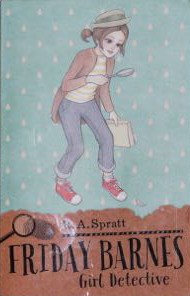
IMG_3690Friday Barnes Girl Detective by R. A. Spratt, paperback novel, 256 pages, published by Random House Australia in 2014.

Friday Barnes Girl Detective is a new series from R. A. Spratt, the creator of the Nanny Piggins series. The story follows Friday Barnes, a rather unusual eleven year old, with an uncanny ability of solving mysteries. She is the youngest daughter of two academics who have not the time nor the inclination to provide their genius daughter with the emotional support and attention that most children experience. They are just a little too preoccupied with their work, which has left Friday to to do much as she pleases. As she mostly likes to learn, experiment and observe, she doesn’t usually get up to too much mischief. After Friday solves a bank robbery case, she uses the reward money to enrol herself at Highcrest Academy, the most exclusive boarding school in the country. As soon as she arrives, Friday realises that beneath the school’s veneer of respectability are mysterious occurrences, learning competitiveness and general rich-kid hi-jinks. She quickly finds herself solving cases of missing homework and false accusations, dealing with a boy in her class who inexplicably appears to hate her, and most interesting of all, the Yeti that has made a home for itself in the school’s swamp.

Friday is a very interesting character. She is intelligent, precocious, peculiar, observant, and yet lacks the ability to correctly decipher social cues, and she dresses terribly! She reminds me a lot of that great and strange detective, Sherlock Holmes, who has been a favourite of mine since childhood. This young detective has definitely got me interested. I was reading this book to my third grader, a few chapters each day, except she liked Friday Barnes so much she sneakily read the rest of it without me!

All the characters were well written, and easily conjured in the imagination. I quite liked Friday’s best friend, the airy Melanie, who fulfilled the faithful sidekick role so well. And of course, our hero must have an arch nemesis, in this case, Ian Wainscott, who has a penchant for mean pranks and snide remarks.

As Friday is a genius this book contained some advanced language and terms that my third grader had not run across previously, mostly regarding her abilities in maths and science. I explained these terms, but they seemed mostly to serve the point of Friday’s extreme intelligence rather than to progress the story, and as such their inclusion did not lessen the enjoyment my third grader gained from the book. She quite happily devoured the story as it should be taken, with great enthusiasm and intrigue.

Suitable for children in middle primary school through to lower high school, Friday Barnes Girl Detective is the start of a great series, sure to entertain young mystery fans. We are now eagerly anticipating reading the second book in the series, Friday Barnes Under Suspicion, which has been recently released in Australia.

The Haunting of Lily Frost by Nova Weetman

Standard

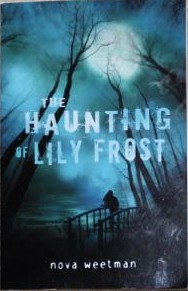
IMG_3158The Haunting of Lily Frost by Nova Weetman, paperback novel, 230 pages, published by University of Queensland Press in 2014.

When Melbourne teenager Lily Frost discovers her parents have decided to suddenly move the family to a small country town two hours out of the city, she is very upset. When she sees the house that her parents have bought in the little town of Gideon, she is even less impressed. It is a large house, but it’s big and spooky, and the attic room seems to be calling her. Lily is ripped away from her safe city life with her best friend, Ruby, and finds herself making friends with a cute boy, Danny, and being haunted by the ghost of a missing girl. Tilly, who disappeared nine months before is trying to tell Lily something, but will anyone believe her, or is she imagining it all?

The Haunting of Lily Frost wasn’t terrifying, but there were some creepy scenes. Reading about the attic room in the big old house, I got a bit of a shiver. The house that I conjured up looked extremely scary, with huge gaping eye windows and a screaming door mouth. Okay, I’ve probably read a few too many spooky house stories, but what can I say, I love them! Also I was reading this book late at night, with only my reading lamp, which added to the atmosphere. All ghost stories should be read at night for the full effect!

As a character, Lily was a little pouty and selfish, but I am seeing her as her parents would see her. For a teenager, I think she was well described and developed, along with the other teenage characters. Danny and his twin sister Julia were interesting characters. Julia was so bitter and mean and very catty towards Lily, without any possible cause, which I think is all too common in high school. Danny was extremely different to his sister, he was sweet and welcoming, though he wasn’t entirely altruistic, he wanted a friend outside of the small group of narrow-minded individuals already attending the school in Gideon. Lily was not used to making friends easily, and this made her wary of Danny’s initial overtures of friendship. These felt like normal and real teenage interactions, which really helped to enliven the story. I also liked Lily’s  little brother, Max, so easy going and a bit of a snitch, just as I imagine younger brothers to be. The teenager angst angle, was good, with Lily’s and Ruby’s relationship and how they interact when separated. How the relationship fared once complicated by boy issues, including Ruby’s reactions to Lily’s jealousy and selfishness had a ring of truth, and assisted in developing the characters even further. The reader was really able to know the characters.

The Haunting of Lily Frost was a fairly standard ghost story suitable for upper primary school and high school children. It contained all the important elements, such as suddenly cold air, moving objects, mystery and the sensation of being touched by something that cannot be seen. Still, I found myself eager to discover what had happened to Tilly, which kept me turning pages. The plot would thicken at just the right moments, and some of the chapters left me hanging, forcing me to read ‘just one more chapter…’. As the story progressed, the tension built, leaving me wondering if Lily was actually losing it. Overall I liked this book, it was very entertaining. I think that children and teenagers interested in ghost stories and mysteries should definitely try it (possibly at night by torchlight!)