Category Archives: Fine Motor Skills

Counting with a Hole-punch

Standard

Putting holes into paper with a hole-punch is almost as much fun as cutting paper into tiny pieces with the scissors… At least according to A. Both are good for her fine motor skills and coordination. Both have the potential for a huge amount of mess, which is very appealing to her , yet not quite so appealing for me! Using the hole-punch makes less mess as long as she doesn’t open the part where the little punched out circles collect… And we can use it for a simple counting activity.

We used a single hole-punch as it is easier for A to use. I cut up some paper and wrote numbers on each piece, then asked her to punch that amount of holes into the paper. Initially I left the sections together, but quickly realised she would need the sections separated to make it easier to punch the holes around the edges of the paper. So I cut the paper into separate pieces for each number. She really liked doing this activity. She carefully counted each hole to make sure she got the right number on each section of paper.

Once A had finished with the hole-punch, L used it to make lots of holes in a piece of scrap paper, just because it is fun 🙂

IMG_2310IMG_2313IMG_2316


m&m Maths

Standard

A bag of m&ms can be yummy and educational! We bought a bag of m&ms on the weekend, but before the kids scoffed them down, I got them to do some activities with them.

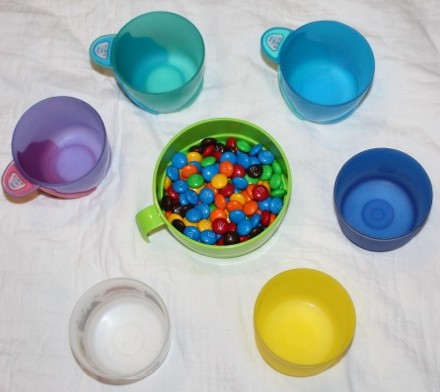
First they sorted them out based on colour. A liked picking up the blue ones best. They put each colour into separate little bowls.

Before sorting.

Before sorting.


During sorting.

During sorting.


Then they laid each colour out into lines, to visualise which colour was the most and least plentiful. L counted each colour by twos, recorded the amount, and wrote it in tally form. A tried to count some of them too, but got tired after reaching 20 and told me I could do the rest.

Laying the m&ms out.

Laying the m&ms out.

L's count of the m&ms.

L’s count of the m&ms.


L added the numbers for each colour together to find out how many m&ms were in the bag.

Making a pattern.

Making a pattern.

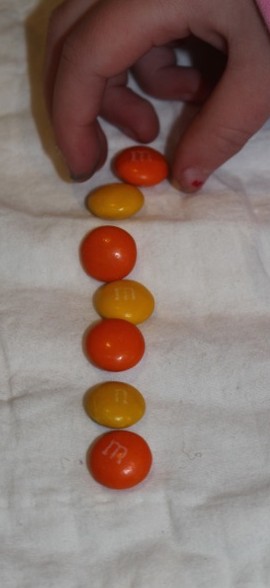
Continuing a pattern.

Continuing a pattern.

A made some patterns with the m&ms and placed the next m&m onto the end of some patterns I made. L did some patterns too, and then made a self-portrait in m&ms. Unfortunately she swiped it away before I had a chance to get a photo. It was pretty neat though.

And finally I let them eat some 🙂


Straw Necklaces

Standard

IMG_2149

Another beading activity, one that is very cheap and easy, but still plenty of fun. I took two packs of coloured drinking straws and cut them up into small lengths (no measurement required!). Then I gave each of the kids a piece of poly string, and let them thread the string through the cut up straw lengths, as if they were beads. After they filled the string with straws, I tied the ends together so that they could be worn as necklaces. They each made several of these necklaces, and we have plenty of straw pieces left over for another day.

IMG_2153IMG_2167

Beading Necklaces

Standard

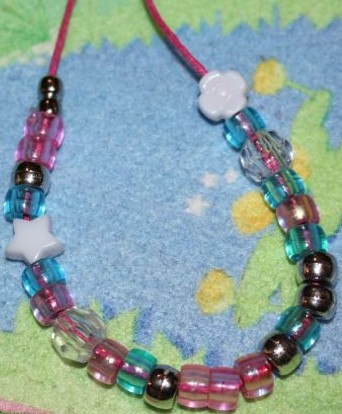
IMG_2105Since L was able to thread beads onto some elastic, she has loved making her own necklaces and bracelets. Plastic beads are readily available and reasonably cheap, and are great for beading fun with the kids. It is cheaper, and longer lasting than store-bought play jewelery, and you get all the fun of creating something for yourself with the beads you want to use. L and A use the jewelery they have made in their dress-ups, and often wear them around the house and out and about just because they like them. They have also made them as gifts for their friends.

We usually use elastic for our beading projects, as it makes it easy for the kids to put on and take off themselves. Proper clear beading elastic is the best for this, but we have used basic hat elastic too. Unfortunately, after a while, the hat elastic tends to stretch and break, which requires tying the broken section together (more knots on the necklace) or re-threading the beads.

IMG_2106This time, however, I had some pre-made non-stretchy necklace lengths with clips to do them up, I think they came from Spotlight. Only the beads with the larger holes would fit over the end of each length, but the kids didn’t mind, they threaded lots of beads onto them, and then wore them about the house. I had to help them undo and fasten the clips though, so it didn’t lend itself to independent dress-up play as much as the elastic ones we’ve made.


IMG_2109

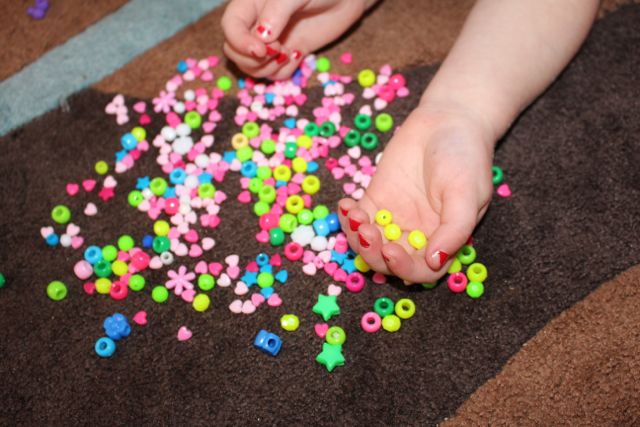
IMG_2111A also spent some time running her hands through the beads, swishing them around with her fingers, and trying to get them to stick to her hands. She liked the sensation of rolling the beads in her palms, and spreading them on the floor.

Sensory play with the beads.

Sensory play with the beads.

Sorting and Patterns with Beads

Standard

IMG_2028

A big pile of plastic beads and we were set for an hour of fun! A separated all these beads into different coloured piles. She was particularly excited about the four shades of pink she found. She also liked the fluoro yellow and fluoro green beads, though she called them “blue-ray” colours 🙂

Sorting.

Sorting.

More sorting.

More sorting.


The sorted piles.

The sorted piles.

Once she had sorted all the colours out we compared the size of each pile. She showed me the biggest piles and the smallest piles. She also counted the number of beads in the smaller piles. We talked about some of the shapes she could see too. Some of the beads were round, some heart shaped, some looked like flowers, and she even found a red butterfly.

We used the beads to practice making patterns. I set out some simple two and three colour patterns and asked A to place the next bead. She liked doing that, and then she made up some of her own patterns with the beads.

Placing the next bead in the pattern.

Placing the next bead in the pattern.

Making patterns.

Making patterns.

Spelling with Beads

Standard

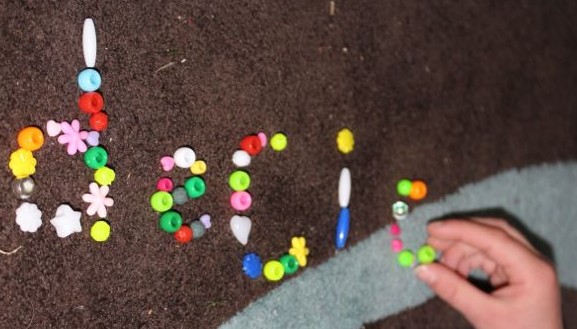
We like to use plastic beads to make play jewelry, but the beads can be used in a number of different ways too. This week we used them for making L’s spelling words. It was a great fine motor skill activity too, as she had to pick up the individual beads in her fingers and place them carefully to make each letter.

IMG_1789IMG_1790

IMG_1792L also did some sorting of the beads, using one colour for a whole letter. The ‘e’ in course is also done in a pattern of white and blue beads. Using these beads for sorting and pattern making will be a fun maths activity for A some time soon.

Marbles and Suction Cups

Standard

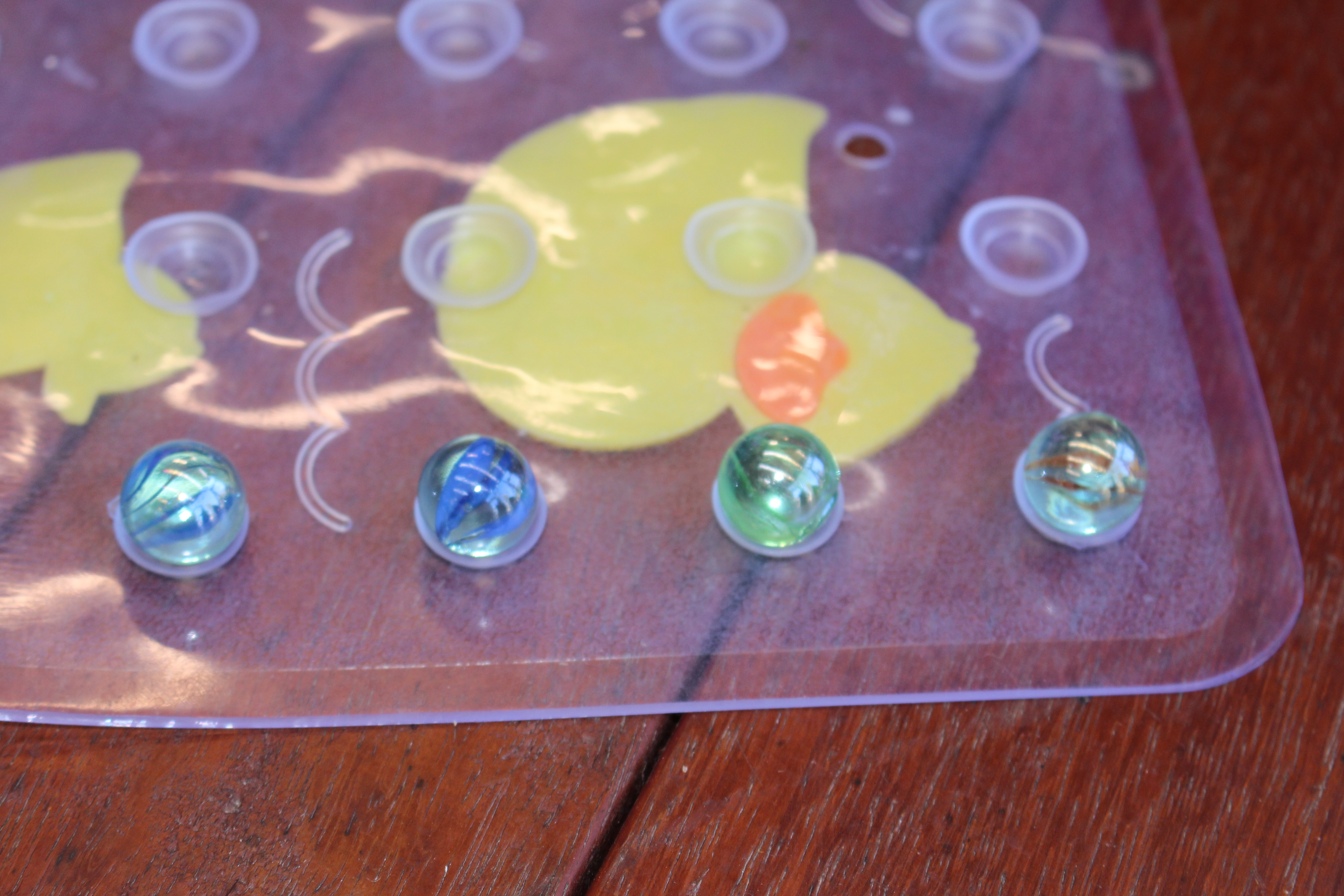
We recently bought a cool rubber bath mat with ducks on it. It looks funky in the bath, and the kids love it. The bottom of it is covered in little suction cups, and thanks to Creative Playhouse, we were able to use it for an activity that didn’t involve the bath this morning. IMG_1017

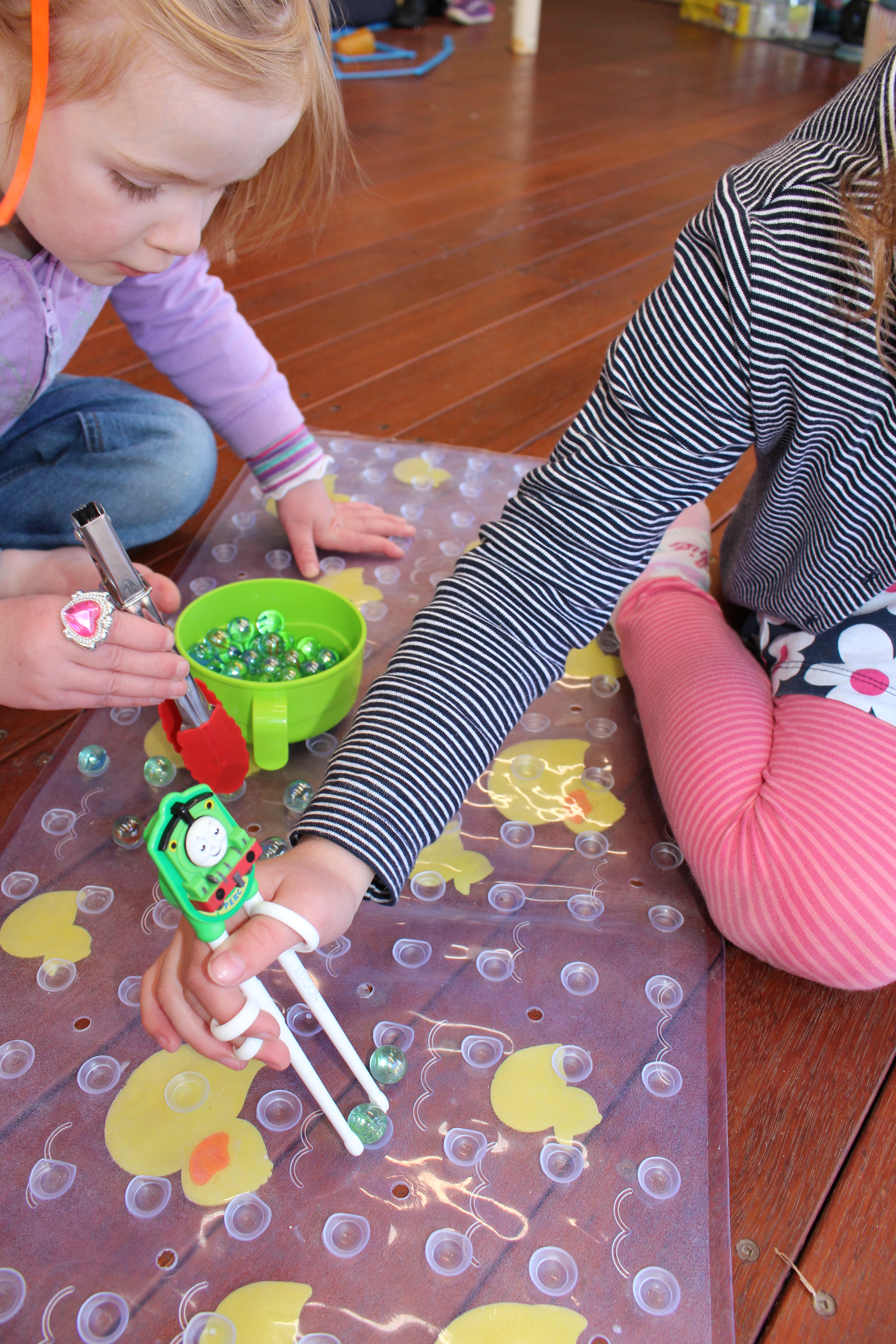
A bag of marbles and a bath mat, add some tongs, chopsticks and large pegs, and we got a great fine motor skill activity.

A using her fingers, L using the red tongs

A using her fingers, L using the red tongs

I placed the bath mat upside down on the deck, with a bowl of marbles. First off, A placed the marbles on the suction cups using her fingers, but that was pretty easy. The red silicone tipped tongs were great for picking up the marbles, but the stainless steel tongs were somewhat difficult to use. L used some chopsticks and the marbles shot out of them across the deck. With some persistence, L mastered the chopsticks and the stainless steel tongs. A preferred the red tongs. We had some large pegs big enough to pick up the marbles, but A didn’t find them particularly interesting.

Using chopsticks.

Using chopsticks and tongs.

I had trouble finding marbles, I thought the cheap shops would have them, but I couldn’t find any. I ended up with a bag from kmart that had all the marbles the same size. I am on the lookout for a bag of assorted sized marbles to try the activity again to see if different sized marbles make it easier or harder. They might be good for an ordering and sorting activity too.

Using the red tongs.

Using the red tongs.