Category Archives: Themes

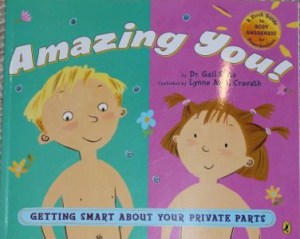
Amazing You! by Dr. Gail Saltz and Lynne Avril Cravath

Standard

IMG_1170Amazing You! by Dr. Gail Saltz and illustrated by Lynne Avril Cravath, paperback non-fiction, first published by Dutton Children’s Books in 2005, this edition published by Puffin Books in 2008.

Amazing You! is a basic look at the reproductive systems for young children. Aimed at preschoolers, this book provides information on body awareness and answers questions about ‘private parts’. It is a good first journey into what can be an awkward topic for many parents.

The text and illustrations are clear and simple, using anatomical names and easy to understand language. There is also a helpful section at the back of the book for parents on talking about sexual curiosity and where babies come from with their children. When it comes to describe how babies are made, it does not go into extensive detail, but sticks to the basics of egg and sperm, all a preschooler really needs to know. The book mentions that sexual curiosity is natural and normal, including masturbation and asking questions. It also reminds us that our bodies and our sexual organs should not be a source of embarrassment or shame, because they are all part of us, and we are amazing!

Diary of a Wombat by Jackie French and Bruce Whatley

Standard

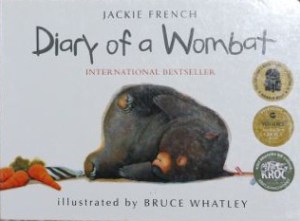
IMG_1171Diary of a Wombat by Jackie French and illustrated by Bruce Whatley, boardboard picture book, first published by HarperCollinsPublishers Australia Pty Ltd, this edition published in 2007.

This is a delightful children’s book about the life of a pet wombat. She sleeps, she eats, she digs holes, she sleeps, and she causes all sorts of destruction and mayhem, she sleeps again. Her human family continue to love her, as she digs up the flowers, chews the doormat and demands lots of carrots.

My children love this book, it is definitely a favourite. They love all the trouble that the wombat gets into, they think it is very funny! The story is written in a diary format, with short, yet descriptive entries for each part of each day. The illustrations are very distinctive, perfectly capturing the wombat’s mood. This is a wonderful book to share with preschoolers and lower primary school children, it will entertain them and it will make them laugh. You’ll probably find yourself chuckling too and wondering why you don’t have a pet wombat to liven up your days!

Mummy Laid an Egg! by Babette Cole

Standard

IMG_1174Mummy Laid an Egg! by Babette Cole, non-fiction paperback, first published by Jonathan Cape in 1993, this edition published by Red Fox in 1995.

Dad and Mum have decided to tell their kids where babies come from. They tell the kids that sometimes dinosaurs deliver babies, or they can be grown from seeds, made from gingerbread, or they can even be found under rocks! And in this case, the kids exploded from a huge egg that Mum laid on the couch. The kids think this is hilarious. They quickly begin on a journey to set their parents straight, including lots of drawings explaining just how babies are made.

A light-hearted look at reproduction, this book is perfect for younger children from preschool up. The drawings are humorous, educational, and appropriate for the intended audience. The language is easy to understand for children, and the subject matter is treated without any of the seriousness that sometimes surrounds this often delicate topic. I think this book would be especially good for parents who are a little nervous about having “the talk” with their kids, it is a great way to lighten the mood.

Both my preschooler and second grader love this book. I think that it is the best introduction to the sensitive subject of conception and reproduction that I have come across. It is honest, frank and amusing. I particularly like the pages that show how mummies and daddies fit together, some truly awkward and hilarious positions! My kids laughed at the ridiculous stories that the Mum and Dad tell their kids, as well as at many of the drawings throughout the book. It covered the basics, and my kids were happy with the content, re-reading it several times, asking questions and discussing it. A really nice book, I am very glad I purchased Mummy Laid an Egg!


What Makes a Baby by Cory Silverberg and Fiona Smyth

Standard

IMG_1168What Makes a Baby by Cory Silverberg and illustrated by Fiona Smyth, non-fiction hardback, published by Seven Stories Press in 2012.

This book is bright, colourful and simple, and suitable for young children who are first becoming curious about where babies come from. It introduces sperm and eggs, and the concept that both are required to create a baby, but it is quite vague about how this actually happens. In fact the whole book is rather vague. It is one of the most abstract non-fiction books I have ever read. However, while it doesn’t present detailed information, it does provide prompts to begin the discussion of this issue in as much detail as a parent thinks is appropriate for their particular child at the time. It also provides opportunities for kids to ask questions. This book could be used to start a discussion that many parents find difficult to conquer.

I read this with my preschooler and second grader. They both thought the illustrations were a bit odd, especially the people that were coloured with blue or green or purple skin. My preschooler said a few times that people are not that colour! They were also amused that the sperm and egg had been given faces and that they perform a special dance together to form a baby. I think this book was actually too abstract for them, and they were quite distracted by the less than life-like pictures. They asked a few questions, but it didn’t develop into a deep conversation about how babies are formed, instead, it left them with a very superficial view of how life develops. We used this book as a first stepping stone onto more detailed texts.

The Bare Naked Book by Kathy Stinson and Heather Collins

Standard

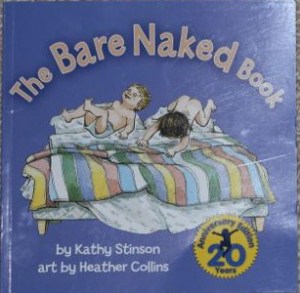
IMG_1167The Bare Naked Book by Kathy Stinson with art by Heather Collins, paperback non-fiction, first published in 1986, this edition published in 2006 by Annick Press.

This is a simple look at our bodies, and the different parts that make them up. With basic language and clear illustrations, this is a nice book for toddlers and preschoolers. It introduces each part of the body, with some illustrated examples of each, such as pushing arms, hairy nipples and stamping feet. At the end of each page, it asks the child to locate that body part on themselves, which is a great prompt for learning body parts and for body awareness.

My preschooler liked the pictures, and had fun locating all her body parts as suggested by the book. She enjoyed perusing this book on her own too, looking at the pictures, and pointing out what the different parts of the body were doing.

King Pig by Nick Bland

Standard

IMG_0509King Pig by Nick Bland, hardback picture book, published by Scholastic Australia in 2013.

King Pig has a kingdom full of sheep that don’t seem to like him, and he doesn’t understand why. He desperately wants them to adore him, but nothing seems to work, and this is the one thing that he can’t command them to do. One night he has an idea, and he wakes up all the sheep to make him some new fancy clothes, but it doesn’t impress the sheep. What can he do to remedy the situation?

In this book we see that being powerful doesn’t automatically make one likable. It is much better to be nice and considerate of others, and being bossy all the time only leads to resentment and discontent. This is a hard lesson for King Pig to learn, and a good message for our children. My kids enjoyed this book, but not quite as much as the other Nick Bland books we have. It wasn’t as funny, though we still liked the story and the illustrations are lovely. I liked the way that the sheep had their wool dyed and removed, while my kids liked it when King Pig used one of the sheep strapped to a wooden handle to clean his castle. This is a good book for preschoolers and kids in lower primary school.


* King Pig was an honours book for the 2014 Children’s Book Council of Australia Book of the Year in the Picture Book category.


Rainbow Milk

Standard

When I was in school, we did an experiment with milk and food colouring that was really cool. I couldn’t remember exactly what went into the milk, so I had a look about the internet, and found the experiment I was thinking of over at DLTK’s Crafts for Kids, and they even had a video showing how it’s done!

Food colouring and milk in the tin.

Food colouring and milk in the tin.

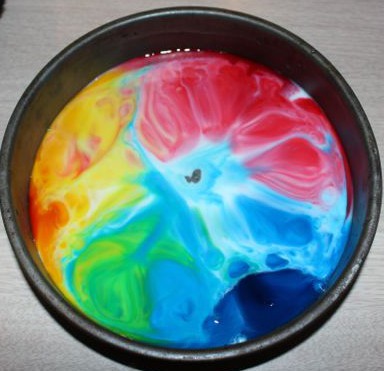
This experiment is really easy, yet so amazing! We placed a shallow layer of milk into a cake tin. We only had light milk, so that’s what we used, and it worked just fine. A used a pipette to place some red, yellow and blue food colouring at roughly evenly spaced intervals around the edge of the tin. Once the food colouring was in, I placed a squirt of dish washing liquid into the centre of the tin, and we watched eagerly to see what would happen.

A few moments after the dish washing liquid was added.

A few moments after the dish washing liquid was added.

The dish washing liquid doesn’t mix with the milk, so it spreads out across the surface of the milk. The food colouring gets caught in the movement of the dishwashing liquid, and causes the colours to move and mix. We got a rainbow! The reaction can continue for a while, making new colours and awesome patterns. There’s no need to mix or move it for the colour mixing to continue. After about ten minutes, A wobbled the tin a little to see what would happen. It made the colours mix even more.

After a few minutes.

After a few minutes.

After about 10 minutes.

After about 10 minutes.


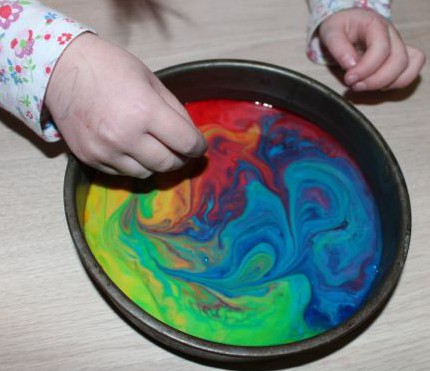
A thought this experiment was so incredible, she asked to repeat it once L and Big L were home. L put a lot of dish washing liquid into the milk, and the reaction happened much more quickly than our earlier attempt. As the colours mixed, Baby T was completely mesmerised by the movement of the colours. This time, after the colour mixing had begun, we let the kids have a toothpick to drag through the colours to make even more interesting patterns. They enjoyed doing this, and kept doing it until the colours had mixed so much it was a murky brown colour. Science is pretty cool 🙂

A few minutes into the second experiment. The spot in the middle is the dish washing liquid.

A few minutes into the second experiment. The spot in the middle is the dish washing liquid.

Using a toothpick to make new patterns.

Using a toothpick to make new patterns.

Don’t Wake the Troll by Ben Kitchin and Ben Redlich

Standard

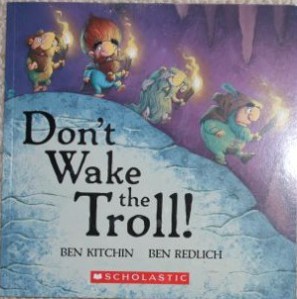
IMG_0859Don’t Wake the Troll by Ben Kitchin and illustrated by Ben Redlich, paperback picture book, published by Scholastic Australia in 2013.

A group of dwarves make a plan to creep deep into the mountain to steal back their treasure from a giant troll. They wait until the troll is sleeping and down the tunnel they go, they have to be very careful not to wake up the troll. As they tip-toe along, there comes a noise, kerlunk, kerlunk. It is their shields banging into their armour, so they ditch the shields, the noise might wake the troll, and on they sneak. But then there is another noise….

A wonderful and amusing adventure with treasure and a big smelly troll. The story is clever and exciting. I just love the illustrations too! There are some very funny pictures that made both my preschooler and second grader laugh out loud. The dwarves look so funny, especially as they start to leave their armour and weapons behind. The troll is very well drawn, covered in hair with great dirty nails, a big warty nose, and flies surrounding his stench, he is funny, yet a little scary at the same time. My kids really got into this book. My preschooler wanted to make all the sounds as the dwarves move down into the troll’s lair. Don’t Wake the Troll also has a very fitting ending. This is a book to be read and read again, especially with preschoolers and children in lower primary school.


Scratch Art

Standard

IMG_0845Scratch art seems to be very popular with the kids at the moment, and I’ve been asked on numerous occasions to buy some of the scratch art card. I remember making our own scratch art paper when I was in primary school, so I thought the kids might like to try this at home.
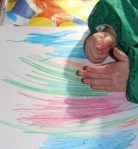
A colouring in her paper.
A colouring in her paper.

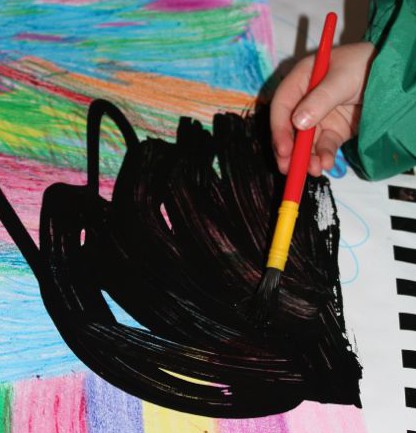
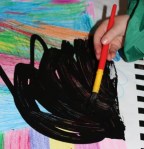
A adding black paint.

A adding black paint.

We coloured in some sheets of paper using crayons, so that the whole page was covered in crayon. We used a rainbow of colours in no particular pattern. A just scribbled all over her piece of paper until it was mostly covered, and then I helped her fill in the edges. Once the colouring in was done, we used thick black paint to cover the paper, covering up the crayon rainbows. We left it to dry.

There was a shaft of sun coming in our lounge room window, so we positioned the paper on the floor in the sun to help them dry a little more quickly. There were still a few wet patches, when ,unfortunately, our cat came inside. I didn’t expect him to decide, not only to walk through the wet paint, but to lay down for a snooze in the sun, right on top of one the black pieces of paper! I have never been so pleased to own a mostly black cat before. When I shooed him off, he trod a bit of paint along the floor, which I had to clean up, but he took care of the rest himself (no need for a bath, luckily!) And what have I learnt from this? Well, for starters, I’ll make sure I shut the cat outside next time we decide to paint on the floor 🙂
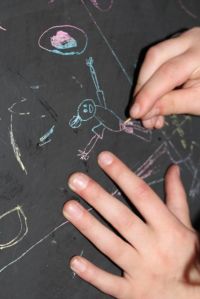
L using a toothpick to scratch out her picture.

L using a toothpick to scratch out her picture.

So eventually, the paint was completely dry, and L and A were able to set about scratching the black paint off to reveal the crayon beneath. They tried a few different items to scratch the paint with, including the end of a spoon, a matchstick, and some toothpicks. They both agreed that the toothpicks worked the best.

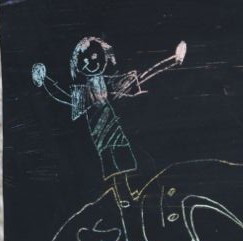
A made a lot of squiggles all over her piece of paper. After all the scribbling, A did draw herself in the corner, which I thought was quite nice.

A drew herself.

A drew herself.

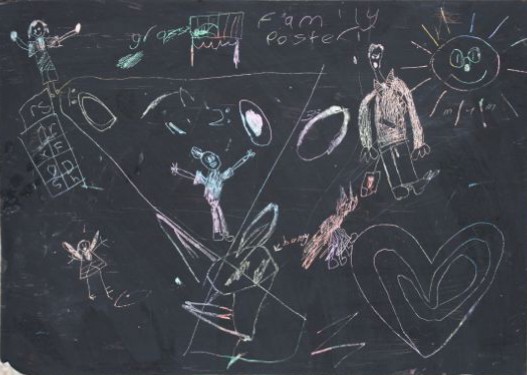
L drew all of the members in our family, and called her picture “Family Poster”. She drew A wearing fairy wings, and Big L wearing a tie. A has fairy wings on a couple of times a week, but I can’t remember the last time Big L wore a tie! She put glasses on the sun, and Baby T is in his cot.

The brightness of the crayons were a bit dulled when the paint was scratched off, so we might need to put the crayon on thicker next time. We could also try using  oil pastels instead of crayons to see if that works.

L drew herself too.

L drew herself too.

I really like these pictures. The kids had fun making the scratch art paper, and then using it to scratch out their pictures. This is something that was fun, and we will do again (though hopefully without the help of our cat).



IMG_0847

Colour Mixing

Standard
Food colouring.

Food colouring.

A and I got talking about colours today, and how some colours can be mixed with others to make new colours. We spoke about the three primary colours, red, blue and yellow. I asked A what she thought would happen if we mixed two of the primary colours together. She wasn’t sure, so we went out to the kitchen and did a little experiment.

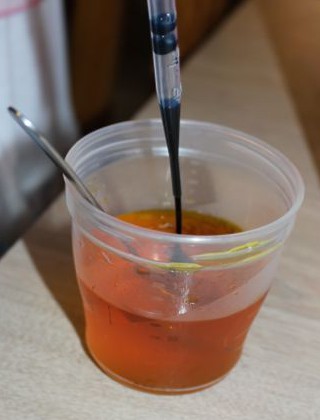
We used food colouring in water. I filled three small cups with water, and then let A use some plastic pipettes to squeeze some food colouring into the water. She placed red food colouring into one cup, blue into one and yellow into one. She mixed the colour into the water with a spoon.

Adding blue to yellow to make green.

Adding blue to yellow to make green.

Then to the cup containing yellow water, she added some blue colouring. She mixed it up and was delighted to see that she had made green water.

Before squirting some yellow dye into the red cup, A accurately predicted that it would make orange. She was very pleased to see that it was indeed orange once she’d mixed it in.

Adding red food colouring to the blue water.

Adding red food colouring to the blue water.

Finally, to the blue cup A added some red food colouring. She had no idea what colour these two would produce, though she hazarded a guess of pink. As these colours are so dark, it was a little hard to see what had happened, until A lifted some of the water out of the cup with the spoon. She broke out with a huge grin when she saw the water had turned purple. It was very exciting for her.

This was a very quick and easy way of showing A how the primary colours mix to make the secondary colours. And it was fun 🙂

A's cups of purple, green and orange water.

A’s cups of purple, green and orange water.