Tag Archives: kids novel

Lulu Bell and the Birthday Unicorn by Belinda Murrell and Serena Geddes

Standard

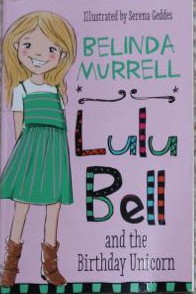
IMG_3813Lulu Bell and the Birthday Unicorn by Belinda Murrell and illustrated by Serena Geddes, paperback chapter book, 86 pages, published by Random House Australia in 2013.

Meet Lulu Bell, a great big sister to Rosie and Gus, best friend to Molly and daughter of the local vet. During the preparations for Rosie’s mermaid themed birthday party, their Dad is called out to capture an escaped pony before it can get hurt. Until its owners can be found, the pony is placed in Lulu’s backyard, where the party is soon to be held. Unfortunately the pony gets up to some mischief, upsetting Rosie. Luckily Lulu has an idea that will help to make Rosie’s party the best ever.

A simple story of family, friends and fun, this chapter book captivated my kindergartner. She enjoyed the storyline, and identified with the family, which were very realistic. She liked the way Gus spoke, and called himself “Bug Boy” and the way that Rosie and Lulu interacted as sisters. The idea of a mermaid party was quite appealing to her also!

For self reading, Lulu Bell and the Birthday Unicorn, would suit a slightly more confident reader than one just starting chapter books. While the chapters were reasonably short, and the black and white illustrations frequent, there is more depth to this story than is usually seen in a first chapter book. The language was very suitable for lower primary school children, and the story easy enough to follow. I read this one to my kindergartner as she’s not yet onto chapter books, and she has already asked for more Lulu Bell!


Winterkill by Kate A. Boorman

Standard

IMG_3715Winterkill by Kate A. Boorman, paperback novel, 344 pages, published by Faber and Faber Limited in 2014.

Strictly ruled by a group of council members, the settlement has been isolated and lost from other people for several generations. It is surrounded by tall walls from which guards watch the surrounding forest through the night, waiting for signs of the malmaci, a dangerous beast that sometimes takes settlement members. It is important that no one leaves the safety of the settlement after dark, and even during the day, no one should stray too far into the woods. Most of the members of the settlement are obedient and adhere to the routines, rules and rituals of their community, but sometimes a member will stray from the path, becoming known as wayward or stained, bringing shame to their families. Another major concern for the settlement is the freezing winter known as the Winterkill which is almost upon them as Emmeline comes of age. As a cripple and a stained person, she is surprised by a marriage proposal, while still trying to figure out her feelings for another boy in the settlement. All the while she is drawn to the woods, curious as to what lies beyond the settlement. Her curiosity may result in dire consequences for herself, and the other members of her community, but without risk, there can not be discovery.

Winterkill reminded me a lot of M. Night Shyamalan’s film The Village. There were many similar points, isolated village, monster lurking in the forest, overbearing and strict leaders. I liked that movie, but I like this book even more. Right from the start I liked Emmeline. She has determination, courage and individuality in a society which promotes conformity and compliance. A very interesting and strong character that jumps from the page, I just wanted everything to work out well for her. I also liked Kane, the boy that Emmeline fancies. He too, was very well written, interesting and somewhat mysterious. The characters and the landscape became increasingly clear to me as I read, or more fell into Emmeline’s world. I felt her isolation, her shame, her disappointment and wariness. And I felt her desire to explore, to love and to make her Pa proud again. This is definitely a story I won’t forget in a hurry.

This young adult novel is suitable for upper primary through high school students. I found Winterkill to be an intriguing and page-turning read that I would recommend for any fan of dystopian fiction. I have read on Kate A. Boorman’s website that this to be the first book of a triology, with the next book to be released later this year. I will be eagerly awaiting the next installment.


Black Ice by Becca Fitzpatrick

Standard

IMG_37131Black Ice by Becca Fitzpatrick, paperback novel, 392 pages, published by Simon & Schuster in 2014.

Britt Pfeiffer has convinced her best friend, Korbie, to backpack through the Teton Ranges in Wyoming for the spring break of their final year of high school. The girls have very little experience hiking through the ranges, but Korbie’s parents’ own a large cabin on the shores of a lake in the mountains, which they can use as a base for their adventure. The weather turns foul as they journey up the mountain, forcing them to abandon their vehicle and seek shelter from the driving snow. Sodden and fatigued they find salvation in a small cabin in the forest, where two young men are also waiting out the storm. For two pretty and exuberant girls, it should be fun to shack up with two handsome lads like Mason and Shaun for the night, but the boys have plans, and the girls are at their mercy. Britt finds herself fighting her way down the mountain through the dark and swirling storm, surrounded by dangers both environmental and human.

Elements of adventure, mystery, suspense, and romance are intertwined in this captivating young adult novel. Black Ice was a sled ride through the mountains, full of twists and dark turns, that kept me guessing. There were some well written action sequences, with plenty of teenage deliberation and introspection, and some non-graphic romantic scenes. It was an exciting read with palpable tension, that I blew through quickly as I needed to know what happened next.

The characters were all rather bratty and entitled, and I greatly disliked Korbie and her brother, Calvin. It seemed incongruous that Britt would be friends with Korbie, but they had been friends for a long time and it is often hard to let those relationships go. I liked the way that Britt developed as a character through the story. From reliance on the men in her life while taking them for granted, she grows to be a more resourceful, strong and independent leading lady. This traumatic experience strengthens rather than unravels her, always good for a female protagonist. Mason was a very complicated, yet intriguing character which many moods and secrets. He could have gone either way for most of the book, while Shaun was obviously derailed and dangerous. The shallowness and selfishness of several of the characters served to highlight the complexity and intensity of Britt and Mason.

Being a young adult novel, plenty of teenage issues were touched upon, relationships, first love, kissing, physical and emotional insecurities. This helps to shape the novel into something that teenagers can relate to, and it seems to be endemic in this genre. While the sexual elements of this book were quite tame, there was violence and death that may disturb more innocent or immature readers.

Black Ice is most suitable for middle to upper high school students and beyond.

Friday Barnes Girl Detective by R. A. Spratt

Standard

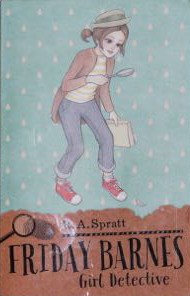
IMG_3690Friday Barnes Girl Detective by R. A. Spratt, paperback novel, 256 pages, published by Random House Australia in 2014.

Friday Barnes Girl Detective is a new series from R. A. Spratt, the creator of the Nanny Piggins series. The story follows Friday Barnes, a rather unusual eleven year old, with an uncanny ability of solving mysteries. She is the youngest daughter of two academics who have not the time nor the inclination to provide their genius daughter with the emotional support and attention that most children experience. They are just a little too preoccupied with their work, which has left Friday to to do much as she pleases. As she mostly likes to learn, experiment and observe, she doesn’t usually get up to too much mischief. After Friday solves a bank robbery case, she uses the reward money to enrol herself at Highcrest Academy, the most exclusive boarding school in the country. As soon as she arrives, Friday realises that beneath the school’s veneer of respectability are mysterious occurrences, learning competitiveness and general rich-kid hi-jinks. She quickly finds herself solving cases of missing homework and false accusations, dealing with a boy in her class who inexplicably appears to hate her, and most interesting of all, the Yeti that has made a home for itself in the school’s swamp.

Friday is a very interesting character. She is intelligent, precocious, peculiar, observant, and yet lacks the ability to correctly decipher social cues, and she dresses terribly! She reminds me a lot of that great and strange detective, Sherlock Holmes, who has been a favourite of mine since childhood. This young detective has definitely got me interested. I was reading this book to my third grader, a few chapters each day, except she liked Friday Barnes so much she sneakily read the rest of it without me!

All the characters were well written, and easily conjured in the imagination. I quite liked Friday’s best friend, the airy Melanie, who fulfilled the faithful sidekick role so well. And of course, our hero must have an arch nemesis, in this case, Ian Wainscott, who has a penchant for mean pranks and snide remarks.

As Friday is a genius this book contained some advanced language and terms that my third grader had not run across previously, mostly regarding her abilities in maths and science. I explained these terms, but they seemed mostly to serve the point of Friday’s extreme intelligence rather than to progress the story, and as such their inclusion did not lessen the enjoyment my third grader gained from the book. She quite happily devoured the story as it should be taken, with great enthusiasm and intrigue.

Suitable for children in middle primary school through to lower high school, Friday Barnes Girl Detective is the start of a great series, sure to entertain young mystery fans. We are now eagerly anticipating reading the second book in the series, Friday Barnes Under Suspicion, which has been recently released in Australia.

The Haunting of Lily Frost by Nova Weetman

Standard

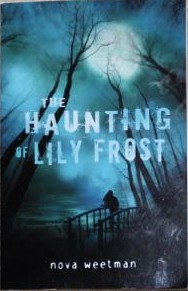
IMG_3158The Haunting of Lily Frost by Nova Weetman, paperback novel, 230 pages, published by University of Queensland Press in 2014.

When Melbourne teenager Lily Frost discovers her parents have decided to suddenly move the family to a small country town two hours out of the city, she is very upset. When she sees the house that her parents have bought in the little town of Gideon, she is even less impressed. It is a large house, but it’s big and spooky, and the attic room seems to be calling her. Lily is ripped away from her safe city life with her best friend, Ruby, and finds herself making friends with a cute boy, Danny, and being haunted by the ghost of a missing girl. Tilly, who disappeared nine months before is trying to tell Lily something, but will anyone believe her, or is she imagining it all?

The Haunting of Lily Frost wasn’t terrifying, but there were some creepy scenes. Reading about the attic room in the big old house, I got a bit of a shiver. The house that I conjured up looked extremely scary, with huge gaping eye windows and a screaming door mouth. Okay, I’ve probably read a few too many spooky house stories, but what can I say, I love them! Also I was reading this book late at night, with only my reading lamp, which added to the atmosphere. All ghost stories should be read at night for the full effect!

As a character, Lily was a little pouty and selfish, but I am seeing her as her parents would see her. For a teenager, I think she was well described and developed, along with the other teenage characters. Danny and his twin sister Julia were interesting characters. Julia was so bitter and mean and very catty towards Lily, without any possible cause, which I think is all too common in high school. Danny was extremely different to his sister, he was sweet and welcoming, though he wasn’t entirely altruistic, he wanted a friend outside of the small group of narrow-minded individuals already attending the school in Gideon. Lily was not used to making friends easily, and this made her wary of Danny’s initial overtures of friendship. These felt like normal and real teenage interactions, which really helped to enliven the story. I also liked Lily’s  little brother, Max, so easy going and a bit of a snitch, just as I imagine younger brothers to be. The teenager angst angle, was good, with Lily’s and Ruby’s relationship and how they interact when separated. How the relationship fared once complicated by boy issues, including Ruby’s reactions to Lily’s jealousy and selfishness had a ring of truth, and assisted in developing the characters even further. The reader was really able to know the characters.

The Haunting of Lily Frost was a fairly standard ghost story suitable for upper primary school and high school children. It contained all the important elements, such as suddenly cold air, moving objects, mystery and the sensation of being touched by something that cannot be seen. Still, I found myself eager to discover what had happened to Tilly, which kept me turning pages. The plot would thicken at just the right moments, and some of the chapters left me hanging, forcing me to read ‘just one more chapter…’. As the story progressed, the tension built, leaving me wondering if Lily was actually losing it. Overall I liked this book, it was very entertaining. I think that children and teenagers interested in ghost stories and mysteries should definitely try it (possibly at night by torchlight!)


Unrequited: Girl Meets Boy Band by Emma Grey

Standard

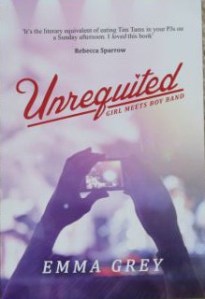
IMG_2538Unrequited: Girl Meets Boy Band by Emma Grey, paperback novel, 233 pages, published in 2014.

Kat is a seventeen year old in Sydney with a passion for music, just not that produced by the biggest boy band in the world, Unrequited. When her mother gets delayed on a work trip, Kat has to escort her younger sisters, who are huge fans, to an Unrequited concert. Kat can think of a million different things she would prefer to be doing, like studying for her final exams or listening to her favourite band, 5 Seconds of Summer. A chance encounter with a cute boy on the train might just make up for the backstage passes to Unrequited, but will she see him again? The lead singer of Unrequited, Angus, seems to be staring at her during the concert. Could he really have noticed her out of the thousands of fans at the concert, and is she interested anyway?

A modern day Cinderella story, Unrequited: Girl Meets Boy Band read like a romantic comedy for teenagers. The hope of love and success and doing what you love, teenage desires finding reality. This was an uplifting read that I will probably indulge in again! If I didn’t have small children, I would have stayed up late to finish Unrequited: Girl Meets Boy Band. I really got into the story and wanted to keep reading without interruption, I wanted to know who Kat would choose and what would happen with her music.

The awkward situation of a love triangle (or quadrilateral) happens often, just not normally with the added complication of a very famous singer. So while this story has a slightly exaggerated fantasy feel to it, it was easy to see parallels to real life situations and people. I especially liked Kat as a character, she was different. A teenager without the conformity of a teenager, unconscious of her own abilities and magnetism, it made her enigmatic and interesting.  Angus, with his fame and money, as well as the ability to choose any of the girls that were throwing themselves at him, finds the one girl that doesn’t seem remotely interested and pursues her relentlessly. At first, I found this to be a bit arrogant, as it felt a bit like Kat would be just a conquest for him. However, I warmed to Angus after a while, though Joel seemed much more like your average Knight in Shining Armour that should win the girl’s heart.

Unrequited: Girl Meets Boy Band is a young adult novel, but I think kids from upper primary would find this a suitable read. I really enjoyed it, though I wasn’t much into pop culture as a teen, and am even less so now. After a few references to 5 Seconds of Summer and Douglas Booth, I realised that they might be real people. I used Google to confirm my suspicions, and then had a few moments of feeling rather old! Still, this book made me feel happy and optimistic.

I picked up a signed copy of Unrequited: Girl Meets Boy Band from Canty’s Bookshop in Fyshwick, Canberra, but it is also available online at Unrequited.com,au. You can read the first few chapters online too.

Airy Fairy: Magic Mess! by Margaret Ryan

Standard

IMG_2455Airy Fairy: Magic Mess! by Margaret Ryan and illustrated by Teresa Murfin, paperback chapter book, 77 pages, published by Scholastic Ltd in 2004.

Airy Fairy is the worst fairy at spells and just about everything else in Fairy Gropplethorpe’s Academy for Good Fairies, but she does try hard. It is Fairy Gropplethorpe’s Rainbow Birthday, and all the little fairies are asked to make her a present. They have also been asked to paint their rooms. Both tasks require creative spell-work, something that Airy Fairy is not very good at. Her attempts are not helped by the meanest and naughtiest fairy at the academy, Scary Fairy, who likes to play rotten tricks on Airy Fairy. Such a small fairy, and such a large mess!

This was an easy read chapter book suitable for lower primary school children. I read it to my preschooler and she really enjoyed it. My second grader liked the story too, but the book was very easy for her. There were black and white drawings scattered through the book. They were a little peculiar, with the characters having quite angled features, but my preschooler liked them. We all laughed when Airy Fairy’s spells went wrong, and scowled when the fault lay with Scary Fairy! It was a fun read that encourages independent reading. There are a few other titles in the Airy Fairy series that we haven’t yet read, but I will be trying to find.

The Giver by Lois Lowry

Standard

IMG_2459The Giver by Lois Lowry, paperback novel, 224 pages, first published by Houghton Mifflin in 1993, this edition published by HarperCollins Children’s Books in 2008.

Jonas lives in the perfect world of the community, where everything is orderly and precise, the rules are strict, and nothing ever changes. There is no inequity or inequality within the community, no diversity, no poverty, no war, no grief, even the family units are assigned by the Elders, nothing is left to chance. It is a community that has been so regulated and controlled that the people cannot imagine any other life could exist or has ever existed.

Upon becoming twelve, the children of the community are assigned their adult roles, in which they will train and then work for the rest of their lives, but Jonas’ assignment is different, he is selected to be the Receiver of Memory, a highly honoured and rare profession that only one member of the community performs. It is a destiny for one with bravery, intelligence and strength, and the “Capacity to See Beyond”. As Jonas embarks upon his training to become the next Receiver, he learns terrible and wonderful things about the world, and the past, that can hardly be believed. It brings him joy and pain and love, emotions that he has not previously experienced. Knowing the truth may prove too much for Jonas to bear.

One of my favourite book genres is dystopian and apocalyptic/post-apocalyptic novels, so I can hardly imagine how such a wonderful book slipped under my radar until now! From the first chapter, I was caught up in the world of the community and in Jonas’ life. I devoured The Giver, experiencing Jonas’ emotions as the life he has always known is exposed as lies, and feeling sorrow, anger and pain with him and for him. The removal of each person’s ability to choose their destiny and life felt like a personal sleight and betrayal, and I became a bit teary when I realised what baby Gabe’s fate would be. Needless to say, I really became immersed within this story, always a sign of a very good book.

I felt that the story ended somewhat abruptly, and unsatisfactorily. I think that was only because I wanted to know more about Jonas’ and Gabe’s lives and what was happening within the community. I wanted to know what happened to Jonas’ family and his friends, but the answers I sought were left to the reader to envisage. I know that this is a common way to end a novel, but sometimes I just really want a concrete finish. However, this tiny disappointment was short-lived, and is the way I often feel when I’ve just finished an excellent book. What can I say, I’m greedy and always want more from my favourite books and authors! It certainly has not dissuaded me from recommending that The Giver be read by everyone, especially those keen on tales of dystopia, and I will definitely be reading his one again.

The Giver is suitable for high school students, and more mature upper primary school students, but adults will also enjoy this book. I have been told there is a movie of The Giver now, but the book is always better, so if you plan to see the film, make sure you read the book first, it is well worth it!
The Barrumbi Kids by Leonie Norrington

Standard

IMG_2443The Barrumbi Kids by Leonie Norrington, paperback novel, 196 pages, first published by Omnibus Books in 2002, this edition published by Omnibus Books in 2014.

Dale and Tomias are best friends living in a remote village in the Northern Territory of Australia. Long Hole and surrounds is Tomias’ ancestral land, and Dale’s ancestors were the first white family to settle in the area. They are part of the land, as the land is part of them, though they are still learning to use and respect it, and all the creatures within it. The boys attend the only school in town, along with their siblings and cousins. The boys spend their last year of schooling in Long Hole learning about themselves, their cultures,  overcoming the school bully and getting into plenty of scrapes along the way.

The Barrumbi Kids is a story of friendship and cultural interaction between aborigines and white people. It is also an insightful view of remote communities, and the people that live there. The realities of bush fires and crocodiles, snakes and floods, rural schooling and harsh weather conditions is a constant theme through the story, which also explores the theme of growing up in, what is, for many, a very different environment to their own.

The speech of the characters and the construction of their sentences has been written to imitate the actual language of the area. I found the small glossary of Mayali language and commonly used words at the back of the book useful, though most of it was explained within the story itself. This use of language definitely gave the story a more authentic and unique feel.

An interesting and different read, The Barrumbi Kids is well written, and suitable for middle to upper primary school children and older. The story was funny at times, especially when the kids explored the chook shed, though also slightly scary when Lizzie was being chased by a crocodile, a highlight of the daily dangers faced by the kids in remote Australia. I liked the relationships between the characters, especially that between Tomias and Dale, who are so different, yet so similar. The elders were portrayed well, and I quite liked old Caroleena. I could picture Mrs Armstrong’s sour face so clearly, and her fit of terror over the snake. That had me laughing too.

I’m happy for my second grader to read this book. I expect plenty of questions as she reads it, since the lives of the children in the story are quite different to her experiences. It is good to read something outside our own little sense of the world, I think reading The Barrumbi Kids will encourage her to want to know more about the outback of Australia and about the first settlers to this beautiful land.


* The Barrumbi Kids was an honours books for the 2003 Children’s Book Council of Australia Book of the Year in the Younger Readers category.

My Life as an Alphabet by Barry Jonsberg

Standard

IMG_1478My Life as an Alphabet by Barry Jonsberg, paperback novel, 256 pages, published by Allen & Unwin in 2013.

Candice Phee is a little odd, a little different, but she has a huge heart. After the death of her sister and the perceived betrayal of her uncle, Candice’s family has been slowly imploding. Her best friend believes he is from another dimension and spends a lot of time trying to return. Her penpal hasn’t replied to her letters, her teacher has a lazy eye, and her fish might be experiencing a theological crisis. All her favourite people and fish are struggling with life, and Candice wants to make them happy. She goes to extraordinary lengths to achieve this.

A heart-warming tale, My Life as an Alphabet, was a joy to read. Candice is a very unusual character, but as she shares her life, I came to like and respect her very much. Some of her antics were extremely funny, and even the way she relates her story is amusing. Jumping off the pier in an attempt to reconcile her father and uncle was probably going a tad too far, but it definitely demonstrated her commitment to improving her family’s relations. I thought her social awkwardness and inability to converse with new people without the use of a notepad gave her an air of mystery. However, her school peers just see her as really weird, and haven’t bothered to uncover the generous and determined girl inside. She is loyal and loving, and extremely quirky. Candice is a very well written character, in an entertaining, interesting and engaging story.

I would prefer my second grader to wait a couple of years before reading this book as some of the themes are more mature than what she has read previously. Themes such as the fallout from the death of Candice’s sister, the estrangement of her father and uncle, and the mental health issues that Douglas from another dimension exhibits. Though it is most suitable for children from upper primary school to high school, I think many adults would also enjoy My Life as an Alphabet.


* My Life as an Alphabet was an honour book for the 2014 Children’s Book Council of Australia Book of the Year in the Younger Readers category.