Author Archives: TodayWeDid

Unknown's avatar

About TodayWeDid

I spend my time sharing my love of reading, arts and crafts with my four children. I also review children's and YA books.

Jeremy by Chris Faille and Danny Snell

Standard

IMG_1357Jeremy by Chris Faille and illustrated by Danny Snell, published by Working Title Press in 2013.

Jeremy is a baby kookaburra that has fallen out of his nest. The family cat brings him home when he is just a wrinkly little pink ball with closed eyes. The nest is too high to return the bird to, so the family look after him, keeping him warm and feeding him. Jeremy grows feathers, and gets bigger and stronger. All too soon he is ready to face the world on his own.

Jeremy is a heart warming tale of survival, that also serves to introduce the reader to the basics of how a kookaburra develops. The story itself is a simple narrative following Jeremy’s progress from ugly newborn to young adulthood, when he is ready to fend for himself.

Inside the front and back covers, lots of facts about kookaburras are presented, considerably increasing the depth of knowledge gained from this book. The illustrations in Jeremy are an asset to this book, as they are wonderfully life-like, and so detailed. They bring Jeremy to life as he grows and changes.

Several times as a child I found a poor baby bird that had fallen or been pushed from its nest, and tried to save it. None of mine were as lucky as Jeremy though. I was pleased that Jeremy grew into a healthy young kookaburra that could be released back into the wild, despite his shaky start. My preschooler was surprised, having never seen a newly hatched bird,  that baby birds have no feathers and are completely defenceless. She enjoyed the extra facts about kookaburras, and I’m pretty sure she learnt some things!  As this book is mostly non-fiction disguised as a picture book, I think it would be an excellent tool to help encourage children into reading more non-fiction. Good for curious kids in primary school and preschool, I enjoyed sharing Jeremy with my daughter very much.


* Jeremy was the winner of the 2014 Children’s Book Council of Australia Book of the Year in the Eve Pownall Award for Information Books category.

The Swap by Jan Ormerod and Andrew Joyner

Standard

IMG_1358The Swap by Jan Ormerod and illustrated by Andrew Joyner, hardback picture book, published by Littler Hare Books in 2013.

Caroline Crocodile is very jealous of her baby brother. Mama Crocodile is always saying how wonderful he is, and giving him big smoochy kisses. Caroline thinks her brother is just a big smelly and drooly mess, and she really wants Mama Crocodile to herself. So when Mama Crocodile asks Caroline to look after her brother while she pops into the hat shop, Caroline decides to trade her brother for a new baby  at The Baby Shop. She tries a baby panda, twin tiger cubs and an elephant, but none of them are quite right. Perhaps her baby brother really is the best brother to have after all?

A beautiful picture book about the love of a sister for her brother, this story touched my heart. My preschooler chose this book to read before bed last night, and it was lovely to share it with her. She has a baby brother of her own, who she thinks is often smelly and dribbly just like Caroline’s little brother. I’m pretty sure my preschooler has considered swapping her brother on occasion (when he threw her toothbrush in the toilet, bit her tummy hard enough to draw blood, emptied a water bottle into her bed…), yet she loves him dearly, and knows that he is her perfect little brother. Baby brothers or sisters often get a lot of attention, but this doesn’t diminish an older sibling’s love or importance, it’s just that babies are so messy and dependent! It can take a while for an older sibling to realise this, just like Caroline. And just like Caroline, sometimes older siblings might be jealous of a baby in their family. My preschooler really related to Caroline Crocodile and laughed a lot when Caroline tried to trade her brother in. She also thought that the antics of the substitute brothers were hilarious. I liked the twin tigers that were “too tiring”, as they quickly destroyed a toy shop and menaced the other children, while my preschooler liked the baby elephant sitting in the fountain. The illustrations in The Swap are colourful and entertaining. There were plenty of things for my preschooler to spot, especially in the town scenes. We enjoyed looking carefully at all the pictures. Caroline Crocodile’s facial expressions are wonderfully realistic and it was easy to see how she was feeling.

Especially good to read to big brothers and sisters, The Swap is a great story for all preschoolers and lower primary school children.


* The Swap was the winner of the 2014 Children’s Book Council of Australia Book of the Year in the Early Childhood category.


Yellow Sensory Tub

Standard

IMG_1314I gathered lots of yellow things from about our house and popped them into one of our sensory tubs yesterday. I was surprised by the amount of yellow things we just had lying about. There was a plate, bowl, spoon and fork, as well as some yellow lids, a silicone chocolate mould, felt shapes, plastic frogs, wooden pegs, a pom pom and pipe cleaner. And of course, the yellow sensory tub wouldn’t have been complete without a banana and a lemon.

Putting yellow things into the bowl.

Putting yellow things into the bowl.

Baby T went straight for the banana (he loves them) and tried to take a bite right through the skin. He was very happy when L peeled it for him, it quickly disappeared and he wasn’t interested in the skin. Then he took everything else out of the tub to look at it carefully. He put everything into the bowl and gave it a mix with the spoon. He tried to spear the pom pom with the fork, and he enjoyed banging the pegs against the plasticware.

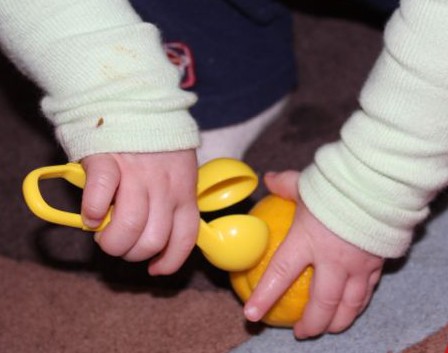
Trying to pick up the lemon with the tweezers.

Trying to pick up the lemon with the tweezers.

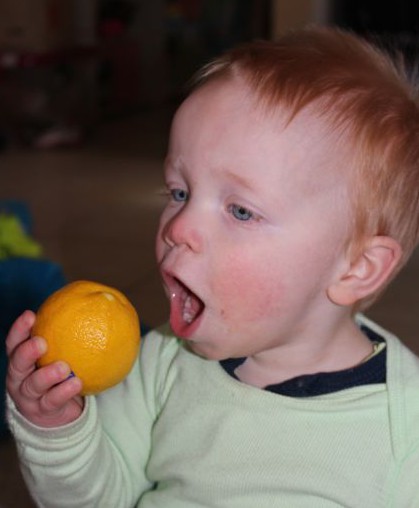
We spoke a lot about the colour yellow, and the textures and shapes of the different items as Baby T explored the tub. L and A tickled him with the pipe cleaner, and pretended to make the frogs jump onto his head. Baby T really liked the lemon and the big plastic tweezer scoop, and spent a lot of time playing with these items. He tried to pick the lemon up with the tweezers many times, but it was far to big. He also took a bite out of the lemon… He wasn’t impressed with the taste, but he still wouldn’t let the lemon go.

Going for a big bite.

Going for a big bite.

The Hunting of Shadroth by Victor Kelleher

Standard

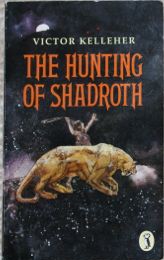
IMG_1356The Hunting of Shadroth by Victor Kelleher, paperback novel, 192 pages, first published by Kestrel Books in 1981, this edition published by Puffin Books in 1983.

Young Tal is a member of the Clan, a people that live simply in cave dwellings overlooking the gentle rolling slopes down to the Greenlands, an area of thick jungle. Living in the Greenlands is the large cat-like creature known as the Feln, a gentle beast, living in peace with the Clan. However, when something kills some of the Clan’s cows, the chieftain, Kulok, blames the Feln and sets out to destroy them. Tal is forced onto the hunt, but cannot bring himself to kill the Feln, and is cast out of the Clan for cowardice. Tal knows that the Feln is not the problem, a malevolent force, known in legend as Shadroth, has risen in the Greenlands. It is up to Tal and his best friend, Lea, to travel beyond the Greenlands to seek help. It will take great courage and persistence to defeat Shadroth and bring peace to the Greenlands and the Clan once more. With the Feln and Lea by his side, Tal must face his fear and fight for all he has ever known.

As a child in primary school I was obsessed with Victor Kelleher, I read as many books by him as I could find, but The Hunting of Shadroth was my favourite, one that I read many times. I hadn’t read it for more than a decade though, until I came across this old copy in a secondhand book shop. I was a bit hesitant to start reading it in case it didn’t stack up to my memories of it, but I needn’t have worried! I found this to be as compelling a read now as it was when I was a child.

While it is a fantasy novel, it draws on many aspects of our own reality and history, and couples this knowledge with descriptive imagery to really bring the story to life. Following Tal and Lea on their adventure, their fight and their friendship with the Feln, I found myself racing through the pages, not wanting to put it down until I knew the outcome. Each time Shadroth appeared, I could image the terror he would induce among the Clan. He is a bit scary, and there are parts of the story that are quite dark. For this reason, The Hunting of Shadroth, while suitable for middle to upper primary school children based on reading and comprehension abilities, there are kids that may find it too frightening to read. Other children may find it more exciting than scary. My second grader has informed me that she will wait until she is a bit older, and that’s fine. While I wait for her to be ready, I will just have to re-read more of the Victor Kelleher books I so loved many years ago.


I’m a Dirty Dinosaur by Janeen Brian and Ann James

Standard

IMG_1307I’m a Dirty Dinosaur by Janeen Brian and illustrated by Ann James, hardback picture book, published by Puffin Books in 2013.

A dinosaur who doesn’t want to wash, splashing in puddles and sliding his tail through the mud. He really is a dirty dinosaur, with dirty feet and dirty tum and dirty snout.

This funny rhyming tale of a dinosaur who loves to get muddy was very well received by my preschooler and toddler. They laughed and pretended to be the dinosaur, they also like to get very dirty and not have a bath! Suitable for preschoolers and early readers with it’s simple language and large text, this is sure to become a quick favourite. I liked the illustrations, which were simple and different, as the illustrator appears to have used actual mud to create the dirt and mud of the story. This technique is very effective. Overall, a good book for young children.


* I’m a Dirty Dinosaur was an honour book for the 2014 Children’s Book Council of Australia Book of the Year in the Early Childhood category.

Goblin in the Snow by Victor Kelleher and Stephen Michael King

Standard

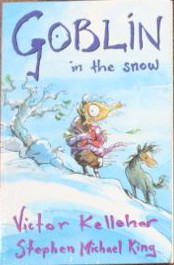
IMG_1310Goblin in the Snow by Victor Kelleher and illustrated by Stephen Michael King, paperback chapter book, 73 pages, published by Random House Australia in 2005.

Gibblewort is an horrible Irish goblin who loves annoying his fellow goblins with pranks and tricks. When they get sick of him, they decide he needs a holiday and suggest he visits the snowy peaks of Austria. Once Gibblewort is inside the post bag they change the address so he goes to Australia, a place he hates with a passion! Here he encounters a dragon, snowboarders and adoring fans, but he’d much rather go home.

This is a very simple story of a grumpy goblin and the adventures he has in the snow of the Australian mountains. It is part of a series of chapter books for lower primary school students, great for children ready to move beyond first readers. The chapters are short with easy language and black and white illustrations on most pages. My second grader really liked Gibblewort, despite his foul demeanour, and is keen to read more of his adventures. As an advanced reader, this was much too easy for her, but she enjoyed the story, and thought it very funny when Gibblewort was mistaken for talking moss.

I liked the idea of a story about a bad-tempered goblin, but this tale didn’t really fulfill my expectations. Gibblewort seemed more unlucky than mean, as he accidentally tumbles down the mountain, accidentally falls in the lake, accidentally gets eaten by a fish. I really thought he would be causing more hilarious havoc! Despite falling short of my expectations of calamitous mischief, the story itself wasn’t bad, and it appealed to my kids, which is what really matters to me.

Upside Down in the Jungle by Helen Phillips

Standard

IMG_1309Upside Down in the Jungle by Helen Phillips, paperback novel, 333 pages, first published under the title Here Where the Sunbeams are Green by Delacorte Press in 2012, this edition published by The Chicken House in 2013.

Mad and Roo have a famous ornithologist for a father, Dr Wade, also known as The Bird Guy. He travels to find rare and important birds regularly, but when he is asked to track and catalogue rare birds in the jungle by an exclusive resort at the base of a volcano, he doesn’t return. His family begin to worry, and then they receive the Very Strange and Incredibly Creepy Letter that appears to be nonsense, but Roo is convinced it’s a coded message. Their mother, Sylvia, thinks that they are being watched, and a colleague of The Bird Guy has started hanging around the family constantly. The whole situation is very odd, and eventually the family flies to the jungle to find Dr Wade, where things only become stranger. With the help of Kyle, the grandson of the owners of the lodge where the family are staying, Mad and Roo are determined to uncover the truth about their father and just what he is doing in the jungle and why he hasn’t come home yet.

Adventure, mystery, first romance and an incredibly rare bird, believed to be extinct in the jungles of South America, are found in this exciting novel for middle to upper primary and lower high school students. Told from the perspective of Mad, a twelve-almost-thirteen year old, who finds herself unwillingly unravelling the mystery of her father’s reluctance to return from the jungle or to communicate with his family, spurred on by her younger sister Roo. They team up with the charming, yet cheeky, Kyle, who is supposed to be teaching them Spanish, but is much more concerned with locating the rare volcano bird that he knows to exist, though it had previously been reported to be extinct. This novel was fast paced and intriguing, with beautiful imagery. I enjoyed reading it, and had difficultly putting it down. I became involved in the fortunes of the characters, and hoped that they would find the bird and solve the mystery. It was very well written, the characters were well developed, and it was easy to conjure their images in my mind. A fantastic book. I look forward to reading more by Helen Phillips in the future.

There’s a House Inside my Mummy by Giles Andreae and Vanessa Cabban

Standard

IMG_1305There’s a House Inside my Mummy by Giles Andreae and and illustrated by Vanessa Cabban, paperback picture book, first published by Orchard Books in 2001, this edition published in 2002.

A young boy is expecting a little brother or sister soon, and he is very excited. He describes what is happening through his experience. He watches his mummy as her tummy grows, when she is tired and sick, and the weird things the baby wants her to eat, as he waits and waits for the baby to arrive.

I first read this book to my eldest child when I was pregnant with my second child. She was only two, and this book was helpful in explaining pregnancy to her. We read it again during my third pregnancy, this time to both my girls. They enjoyed the idea of there being a house inside me where the baby was growing, just like in the story. It described what was happening in a kid-friendly way, with lovely rhyming texts and simple illustrations. It also gave us the opening to talk about pregnancy and how the baby was growing, and what would happen when the baby was ready to be born. The girls asked lots of questions, and asked to read this book repeatedly. Even though their little brother is here now, they still like to read this book sometimes.

There’s a House Inside my Mummy is a unique book about the joyous arrival of a new baby. It is nice to read with expectant big siblings, especially toddlers and preschoolers, in preparation for the baby’s arrival.

Re-usable Icy Pole Pouches

Standard
The packet of Zipzicles.

The packet of Zipzicles.

The kids love icy poles, especially in the summer, but they are usually full of sugar and the plastic wrapping becomes rubbish, so I only buy them sparingly. Our family prefers to use products that are not disposable where possible, such as hankies, cloth nappies, re-usable food pouches and washable dish and cleaning cloths. So when I found some re-usable icy pole pouches, I got excited. The icy pole pouches I bought are called Zipzicles and I purchased them from Apikali, an online modern cloth nappy and eco-wares store. The little collapsible funnel we use to fill the icy pole pouches also came from Apikali. They have a wonderful range of products and excellent customer service.

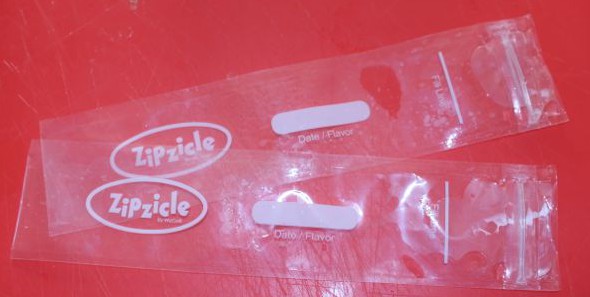
Zipzicles ready for filling.

Zipzicles ready for filling.

A and I could hardly wait to try out our new icy pole pouches, so as soon as they were washed we filled them with flavoured milk. A mixed milk with chocolate Nesquik and then helped me fill up the pouches. Once we had run out of chocolate milk, A mixed up some strawberry Nesquik in milk to fill the remaining pouches. She needed help to get the milk as close to the fill line as possible without overfilling, and then I sealed the pouches.

Using the collapsible funnel to fill the pouch.

Using the collapsible funnel to fill the pouch.

Ready for freezing.

Ready for freezing.

We popped them in the freezer and then waited (rather impatiently) for them to freeze. That took several hours, but when they were finally frozen, A and L both enjoyed them a lot. They have had many icy poles since those first ones, we just wash out the pouches, dry them upside down, and then refill them. They are a little awkward to clean, but we normally rinse them and then use a small bottle brush, and that does the job. To dry them we prop them over the ends of the cutlery in the cutlery rack.

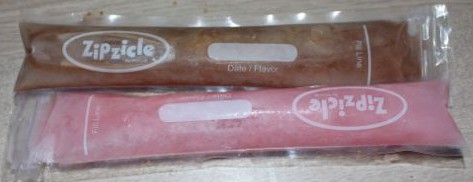
Frozen, ready to eat.

Frozen, ready to eat.

The kids particularly like them filled with milk or juice, but they are also good for cordial, yoghurt and pureed fruit. The kids love them, and I always know what is in them!

Misery Guts by Morris Gleitzman

Standard

Last Import - 1Misery Guts by Morris Gleitzman, paperback novel, 121 pages, first published by Piper in 1991, this edition published by Pan Macmillan Australia in 1996.

Keith and his parents live above their fish and chip shop in London, in a drab building, in a drab street, in a drab city. Keith thinks his parents are a pair of misery guts, depressed and unhappy with life, and all he wants to do is cheer them up. He decides the best thing to do would be to move to Australia, where he believes they will find paradise and happiness. His parents do not want to move to the other side of the world, and they resist Keith’s plan for as long as possible, but finally, after a devastating fire, they agree, and pack up for the long flight to their new home on  the far north coast of Queensland.

A hilarious story of a boy trying his best to make his parents happy, this book made me laugh, both as a child and as an adult. Only a boy could think a smelly, dead rainbow fish would be the perfect cure for depression! But to go all the way to Australia based on nothing more than a fish and a picture takes plenty of courage. Keith works hard to pull it off, including hiding their proximity to the dangerous jellyfish, coconuts and crocodiles that inhabit their new home town. Keith even makes a new friend and ropes her into his plans for his parents’ happiness. Suitable for primary school students, Misery Guts is a heartwarming tale of a boy’s love for his parents, and the lengths he will go to make them happy. Well worth the read.