Author Archives: TodayWeDid

Unknown's avatar

About TodayWeDid

I spend my time sharing my love of reading, arts and crafts with my four children. I also review children's and YA books.

Rainbow Milk

Standard

When I was in school, we did an experiment with milk and food colouring that was really cool. I couldn’t remember exactly what went into the milk, so I had a look about the internet, and found the experiment I was thinking of over at DLTK’s Crafts for Kids, and they even had a video showing how it’s done!

Food colouring and milk in the tin.

Food colouring and milk in the tin.

This experiment is really easy, yet so amazing! We placed a shallow layer of milk into a cake tin. We only had light milk, so that’s what we used, and it worked just fine. A used a pipette to place some red, yellow and blue food colouring at roughly evenly spaced intervals around the edge of the tin. Once the food colouring was in, I placed a squirt of dish washing liquid into the centre of the tin, and we watched eagerly to see what would happen.

A few moments after the dish washing liquid was added.

A few moments after the dish washing liquid was added.

The dish washing liquid doesn’t mix with the milk, so it spreads out across the surface of the milk. The food colouring gets caught in the movement of the dishwashing liquid, and causes the colours to move and mix. We got a rainbow! The reaction can continue for a while, making new colours and awesome patterns. There’s no need to mix or move it for the colour mixing to continue. After about ten minutes, A wobbled the tin a little to see what would happen. It made the colours mix even more.

After a few minutes.

After a few minutes.

After about 10 minutes.

After about 10 minutes.


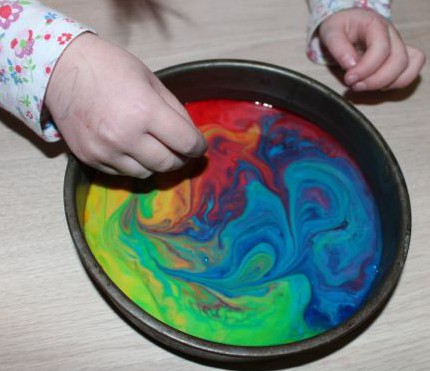
A thought this experiment was so incredible, she asked to repeat it once L and Big L were home. L put a lot of dish washing liquid into the milk, and the reaction happened much more quickly than our earlier attempt. As the colours mixed, Baby T was completely mesmerised by the movement of the colours. This time, after the colour mixing had begun, we let the kids have a toothpick to drag through the colours to make even more interesting patterns. They enjoyed doing this, and kept doing it until the colours had mixed so much it was a murky brown colour. Science is pretty cool 🙂
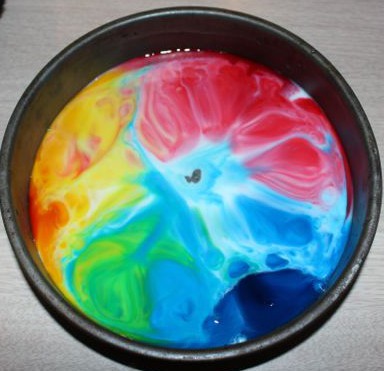
A few minutes into the second experiment. The spot in the middle is the dish washing liquid.
A few minutes into the second experiment. The spot in the middle is the dish washing liquid.

Using a toothpick to make new patterns.
Using a toothpick to make new patterns.
Rising Colours

Standard
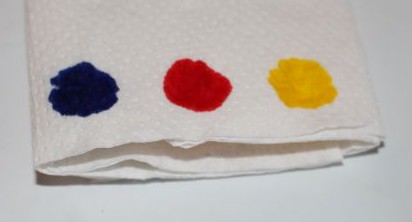
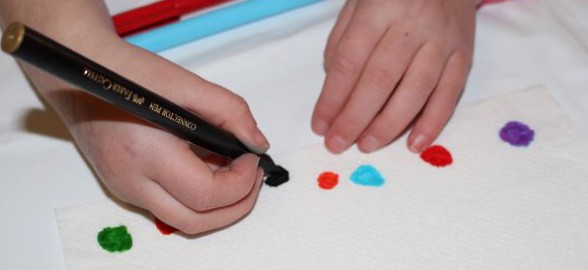
Primary colours on paper towel.

Primary colours on paper towel.

We were talking about primary colours yesterday, and I thought we could try a little experiment with paper towel.

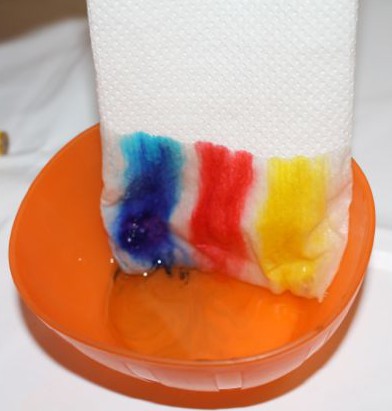
A and I made some coloured spots with markers on paper towel and placed it in water to see what would happen. As the paper towel sucked up the water, it took the colours with it, making them rise up the paper towel. A was amazed and excited by this.

Colours rising up the paper towel.

Colours rising up the paper towel.

A colouring in her spots.

A colouring in her spots.

A used markers to make more coloured spots on another piece of paper towel and placed it in some water on a plate. She let the paper towel lay flat, rather than upright. The colours spread out on the paper towel as the water was absorbed.

The colours spreading out.

The colours spreading out.

We also tried drawing the primary colours on top of each other before placing the paper towel in the water. The yellow rose up into the red, then both of them into the blue. Up went the water, and up went the colours, mixing together to make some orange, and purple and brown.

The colours stacked on top of each other.

The colours stacked on top of each other.

The colours rising into each other.

The colours rising into each other.

This was fun and easy, and I loved watching A’s eyes light up when she saw what was happening.

Button Hair Bands

Standard

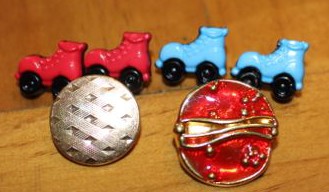
IMG_0943IMG_0936A found some cute buttons in our button collection, including some really cool roller skate buttons. She wanted to wear them in her hair, so we had a go at making them into hair bands.

IMG_0938

Button loops.

The roller skate buttons had reasonably large loops on the back, so it was easy to pass the folded hairband through the loop. The other buttons had smaller loops, so I had to find some little bands, and it was more fiddly to get the band through.

Band through the button loop.

Band through the button loop.

Bands tied through the loops.

Bands tied through the loops.

Once the band was through, I looped one end through the other and tightened the band. I also added a spot of hot glue to the bands on the back of the each button so that the band was held in place.

A was very pleased with her new hair bands, and immediately wanted one in her hair.

A's new hair band in her hair.

A’s new hair band in her hair.


Don’t Wake the Troll by Ben Kitchin and Ben Redlich

Standard

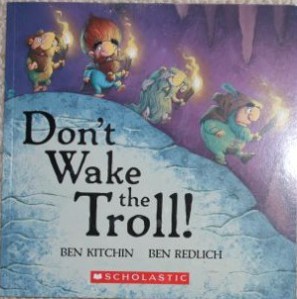
IMG_0859Don’t Wake the Troll by Ben Kitchin and illustrated by Ben Redlich, paperback picture book, published by Scholastic Australia in 2013.

A group of dwarves make a plan to creep deep into the mountain to steal back their treasure from a giant troll. They wait until the troll is sleeping and down the tunnel they go, they have to be very careful not to wake up the troll. As they tip-toe along, there comes a noise, kerlunk, kerlunk. It is their shields banging into their armour, so they ditch the shields, the noise might wake the troll, and on they sneak. But then there is another noise….

A wonderful and amusing adventure with treasure and a big smelly troll. The story is clever and exciting. I just love the illustrations too! There are some very funny pictures that made both my preschooler and second grader laugh out loud. The dwarves look so funny, especially as they start to leave their armour and weapons behind. The troll is very well drawn, covered in hair with great dirty nails, a big warty nose, and flies surrounding his stench, he is funny, yet a little scary at the same time. My kids really got into this book. My preschooler wanted to make all the sounds as the dwarves move down into the troll’s lair. Don’t Wake the Troll also has a very fitting ending. This is a book to be read and read again, especially with preschoolers and children in lower primary school.


Scratch Art

Standard

IMG_0845Scratch art seems to be very popular with the kids at the moment, and I’ve been asked on numerous occasions to buy some of the scratch art card. I remember making our own scratch art paper when I was in primary school, so I thought the kids might like to try this at home.

A colouring in her paper.

A colouring in her paper.

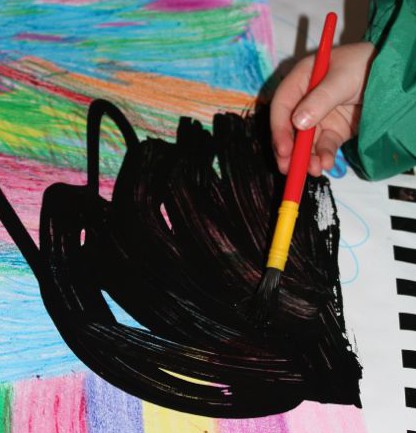
A adding black paint.

A adding black paint.

We coloured in some sheets of paper using crayons, so that the whole page was covered in crayon. We used a rainbow of colours in no particular pattern. A just scribbled all over her piece of paper until it was mostly covered, and then I helped her fill in the edges. Once the colouring in was done, we used thick black paint to cover the paper, covering up the crayon rainbows. We left it to dry.

There was a shaft of sun coming in our lounge room window, so we positioned the paper on the floor in the sun to help them dry a little more quickly. There were still a few wet patches, when ,unfortunately, our cat came inside. I didn’t expect him to decide, not only to walk through the wet paint, but to lay down for a snooze in the sun, right on top of one the black pieces of paper! I have never been so pleased to own a mostly black cat before. When I shooed him off, he trod a bit of paint along the floor, which I had to clean up, but he took care of the rest himself (no need for a bath, luckily!) And what have I learnt from this? Well, for starters, I’ll make sure I shut the cat outside next time we decide to paint on the floor 🙂

L using a toothpick to scratch out her picture.

L using a toothpick to scratch out her picture.

So eventually, the paint was completely dry, and L and A were able to set about scratching the black paint off to reveal the crayon beneath. They tried a few different items to scratch the paint with, including the end of a spoon, a matchstick, and some toothpicks. They both agreed that the toothpicks worked the best.

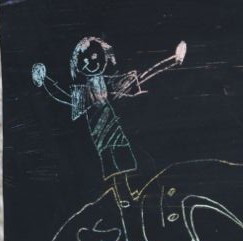
A made a lot of squiggles all over her piece of paper. After all the scribbling, A did draw herself in the corner, which I thought was quite nice.

A drew herself.

A drew herself.

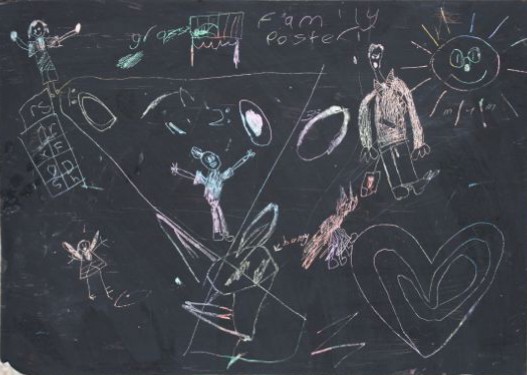
L drew all of the members in our family, and called her picture “Family Poster”. She drew A wearing fairy wings, and Big L wearing a tie. A has fairy wings on a couple of times a week, but I can’t remember the last time Big L wore a tie! She put glasses on the sun, and Baby T is in his cot.

The brightness of the crayons were a bit dulled when the paint was scratched off, so we might need to put the crayon on thicker next time. We could also try using  oil pastels instead of crayons to see if that works.

L drew herself too.

L drew herself too.

I really like these pictures. The kids had fun making the scratch art paper, and then using it to scratch out their pictures. This is something that was fun, and we will do again (though hopefully without the help of our cat).


IMG_0847

Colour Mixing

Standard
Food colouring.

Food colouring.

A and I got talking about colours today, and how some colours can be mixed with others to make new colours. We spoke about the three primary colours, red, blue and yellow. I asked A what she thought would happen if we mixed two of the primary colours together. She wasn’t sure, so we went out to the kitchen and did a little experiment.

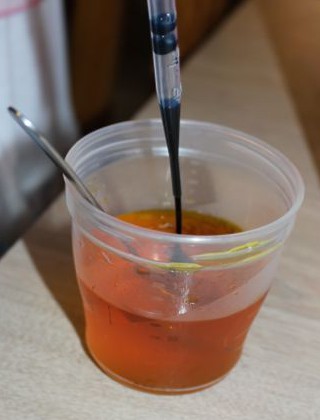
We used food colouring in water. I filled three small cups with water, and then let A use some plastic pipettes to squeeze some food colouring into the water. She placed red food colouring into one cup, blue into one and yellow into one. She mixed the colour into the water with a spoon.

Adding blue to yellow to make green.

Adding blue to yellow to make green.

Then to the cup containing yellow water, she added some blue colouring. She mixed it up and was delighted to see that she had made green water.

Before squirting some yellow dye into the red cup, A accurately predicted that it would make orange. She was very pleased to see that it was indeed orange once she’d mixed it in.

Adding red food colouring to the blue water.

Adding red food colouring to the blue water.

Finally, to the blue cup A added some red food colouring. She had no idea what colour these two would produce, though she hazarded a guess of pink. As these colours are so dark, it was a little hard to see what had happened, until A lifted some of the water out of the cup with the spoon. She broke out with a huge grin when she saw the water had turned purple. It was very exciting for her.

This was a very quick and easy way of showing A how the primary colours mix to make the secondary colours. And it was fun 🙂

A's cups of purple, green and orange water.

A’s cups of purple, green and orange water.


Horrible Histories: Angry Aztecs by Terry Deary and Martin Brown

Standard

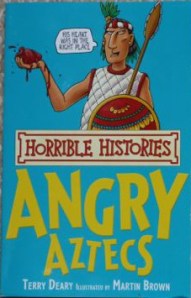
IMG_0855Horrible Histories: Angry Aztecs by Terry Deary and illustrated by Martin Brown, paperback non-fiction novel, 138 pages, first published by Scholastic Ltd. in 1997, this edition published in 2008.

This is a book that tackles the perception of history being boring, and re-invigorates it in a format perfect for children thirsty for knowledge. I thoroughly enjoyed this informative look at the Aztecs, how they lived and how they died, including all the nasty bits, such as human sacrifices, violent ball games and dogs for dinner. There was information on the Aztecs’ neighbours, enemies and the Spanish Conquistadors, their diets, priests and marriages.

Angry Aztecs is full of historical facts that were easy to understand, and presented alongside amusing black and white drawings. As well as allowing easier visualisation of parts of the Aztecs’ history, the illustrations included some comics to help elucidate various points being made in the text. There were also engaging quizzes that assisted in consolidating the knowledge acquired throughout the book

A very definitely not boring insight into the peoples of this interesting empire of the Americas, this is a good read for middle and upper primary school children, especially those interested in history or other cultures. It is on my second-grader’s ‘to read’ list, along with many other titles from his fantastic series. Everyone needs some Horrible Histories in their lives!

Little Lost Unicorn by Lorna Hussey

Standard

IMG_0832Little Lost Unicorn by Lorna Hussey, hardback picture book, published by Hinkler Books in 2009.

Little Unicorn goes exploring in the forest and gets lost. Some little forest animals befriend him and they have a lovely time playing together until baby rabbit falls into the stream. Little Unicorn must be brave to help baby rabbit.

This is a magical story of friendship and courage with beautiful illustrations on embossed pages. There are unicorns hiding on every page, which my preschooler loved! She spent a lot of time poring over the pages looking for them, and running her hands over the embossing. She is a big fan of unicorns and this is the best unicorn story book we have read so far. It was very engaging for my preschooler, and I enjoyed her enthusiasm for the book. Perfect for every little unicorn lover, this is a great book for sharing with your preschooler, or for lower primary school students.  Personally, I liked this story, and I was very impressed with the lovely illustrations, and ingenuity of the hidden unicorns.

Bumface by Morris Gleitzman

Standard

IMG_0856Bumface by Morris Gleitzman, paperback novel, 182 pages, published by Penguin Books in 1998.

Angus is only eleven, but after school he has to look after his brother, Leo, who is five and his baby sister, Imogen. Everyday he picks them up from school and daycare, he gives them dinner, bathes them, puts them to bed, and reads them a story. Every day. His mum is an actress in a famous serial, she never gets in before late, and is happy leaving the parenting to Angus. Each of the kids have a different father, all three of which are in show business and are unreliable, and not really dad material. So Angus has had to grow up fast, but all he really wants to do is act as Bumface the Pirate in the school play.

Angus becomes concerned that his mum might have another baby with number 4. Realising that that would mean another baby for him to look after, Angus sets out to find a way of preventing another pregnancy. While looking for a solution, he meets Rindi, a girl who is only his age, but she is soon to be shipped off to India to marry a man twice her age in an arranged marriage. Angus and Rindi become firm friends, and try to help each other.

Morris Gleitzman is one of my favourite authours from my childhood, and this book doesn’t disappoint. Bumface is well written, entertaining, and deals with some serious issues with humour and compassion. A story about friendship, responsibility and letting kids be kids. Both Angus and Rindi have been asked to act as adults years in advance of the norm in Australia, and this binds them in a special friendship. Rindi comes from a loving  family who think they are doing the right thing by their daughter, while Angus is taken for granted and neglected by his parents. Both of their situations are sad and in a perfect world wouldn’t happen. They should just get to be kids with kid concerns, not kids in such adult predicaments.

Bumface is better for more mature children in middle to upper primary school because the story does spend a lot of time dealing with contraceptives and the prevention of pregnancy. Before reading this book, I think it would be best that children know the facts of life and what contraceptives are for. There is also the theme of children brides. These young brides are expected to have sexual intercourse with their much older husbands, and to provide them with babies at a young age. For most Australian children, it is unthinkable to be married before they have even started high school, and this may require some discussion with an adult. For these reasons I will be holding off on letting my second grader read this book for a little while.


Horrible Histories: Terrible Trenches by Terry Deary and Martin Brown

Standard

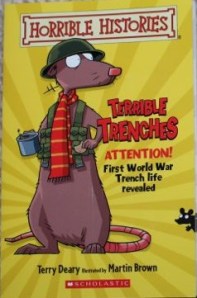
IMG_0831Horrible Histories: Terrible Trenches by Terry Deary and illustrated by Martin Brown, paperback non-fiction, 93 pages, this edition published by Scholastic Australia in 2014.

This book is packed full of facts about living through the First World War, presented in an interesting and engaging fashion. The illustrations are illuminating, and often amusing, while educating young minds as to the life soldiers faced in the trenches. The book was divided into two sections, covering both sides of the war. The first section is about the British soldiers, and the second about the German soldiers. It was nice to have both sides presented without the bias often seen in other history texts.

This was a very appealing non-fiction title suitable for primary age school children. History can often be presented in a bland and boring way to children, but this Horrible Histories book is certainly neither of those. Lots of black and white illustrations and comic scenes entertain and educate, as well as lightening the subject matter, and dispersing the text, making it easier for younger kids to read.

I enjoyed reading this book and learning from it. Reading about the different weapons, the uniforms, food and slang used in the trenches was very interesting and enlightening. My second-grader is also enjoying this book. We will definitely be looking for more Horrible Histories titles to read soon!