Category Archives: Investigations

Creating a Terrarium

Standard

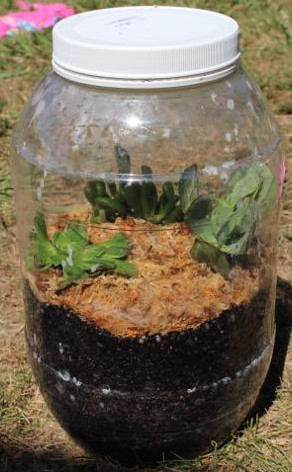
IMG_4033Terrariums can be lovely mini gardens, perfect for sitting on the table and brightening up the house. Any clear container can be used for a terrarium, but it’s nice to find an unusual shape. We started with a big plastic tub that used to hold mini-pretzels.
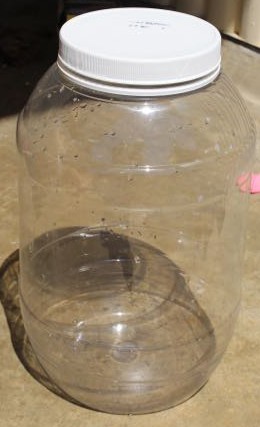
Our plastic container.

Our plastic container.

The kids collected some gravel from our front garden beds to place in the bottom of the container for drainage. You can buy decorative pebbles or gravel for this. Using different coloured materials will create a pretty layering effect on the side of the terrarium. We just used what we had available to reduce costs.

Adding gravel.

Adding gravel.

As we wanted to plant succulents into our terrarium we did buy proper cacti and succulent potting mix. We used this to fill the container up to about half-way. Both L and A had a go at putting the potting mix into the container, but quite a lot of it got spilt! Once the dirt was in, we tapped the container down gentled to help the soil settle.

Then it was time to add the plants. We used three small succulents, which the kids chose from Bunnings. I removed some leaves from each of the plants to use for propagating new succulents before I planted them in the terrarium. I carefully placed each succulent roughly equidistant around the container, patting the soil down gently and then watering them in.  We added moist sphagnum moss as the top layer, carefully placing it around the plants, but not too close to the stems to avoid rot. This will help to retain moisture. Alternately we could have used small pebbles or rocks to finish off (we already had the moss for our carnivorous plants).
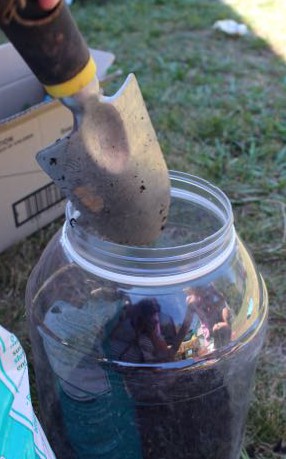
Getting the potting mix in the container.

Getting the potting mix in the container.

The succulents we chose are all different shades of green. Choosing plants with different coloured foliage can increase the aesthetics of the terrarium, and of course, there are many plants that do well in terariums aside from succulents. I think our next one will have to contain some ferns.

When the lid to the container is placed on the top, the moisture is trapped inside the terrarium, causing condensation on the plastic. This keeps the terrarium moist without watering very often, though it also obscures the plants. The plants have everything they need within the closed terrarium, but if it is too wet inside, you can remove the lid for a day or two or as long as needed. Or you can leave your terrarium open if you prefer, and treat it more like your average indoor plant.

Looking from above.


UPDATE 19/3/15: L dropped the terrarium! Luckily the container is plastic, so it bounced, but one of the plants catapulted right out the top (I had the lid off allowing the soil to dry a bit), along with a good chunk of the moss. So the poor plant lost all but two of its leaves. We have replanted it in the hopes that succulents are so hardy it will survive, but it looks a little sad at the moment. I have just left the soil bare and the lid off as the weather is beginning to cool a little and is more humid, so it is less likely to dry out too much. L felt so bad about dropping the terrarium, but these things happen! The other two plants are doing very well and we are seeing new growth.
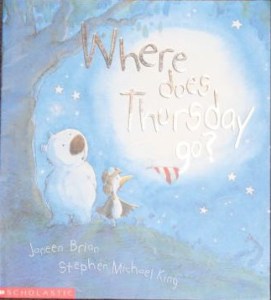
Where Does Thursday Go? by Janeen Brian and Stephen Michael King

Standard

IMG_3826Where Does Thursday Go? by Janeen Brian and illustrated by Stephen Michael King, paperback picture book, published by Margaret Hamilton Books in 2001.

What a good question! Just where does Thursday go before Friday arrives? Friends Splodge and Humbug go exploring under the stars on Thursday night to see if they can find out.

With its distinctive and gentle illustrations and a unique story, this beautiful tale celebrates the curiosity of children. My children ask what seems like thousands of questions every day, and I don’t always know the answers, but that never deters them! So Where Does Thursday Go? appealed to their curious minds, and satisfied their love of reading. This is a nice book to share, and we enjoyed talking about what we thought Thursday would look like, and whether it would look different to the other days of the week.

Where Does Thursday Go? is most suitable for preschoolers and  children in lower primary school, but is loved by all of my children.

Slime

Standard
Packets of cornflour.

Packets of cornflour.

This is the easiest way to make slime, and requires only cornflour and water. I usually add some food colouring to the mix too, for a bit of extra fun. Green is our favourite slime colour. I once made it red, and it stained everything it touched, including our skin, so no more red slime for us!

I used a kilogram of cornflour in each tub, and roughly the equivalent in water. I normally just add water while mixing until I get to a consistency that I like. Less water makes it firmer, more water makes it runnier. I tend to lean towards firmer to start, as inevitably, the kids want to add water to the mix at some point while playing with it. The food colouring can be added to the water as you mix it in, or to the already mixed slime (it’s easier to do it while mixing in the water).

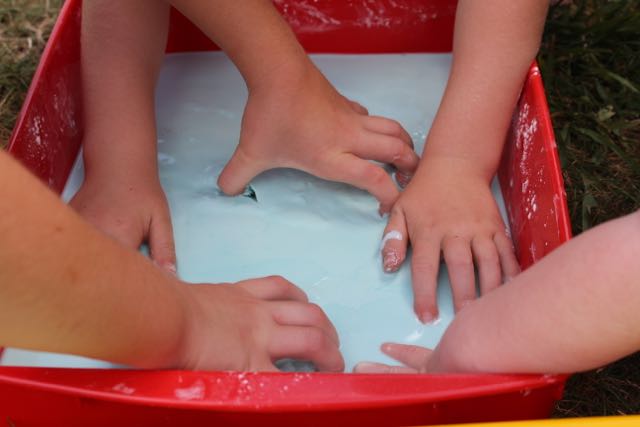
The first touch.

The first touch.

Getting our hands slimy.

Getting our hands slimy.

Past experience told me to get the kids into swimmers and take this activity outside. It is very messy. Afterwards I can hose the kids down, hose out the tubs and hose the mess from the grass too. Luckily it was really hot so we enjoyed playing with the hose once we were finished with the slime.

Letting her hands sink into the slime.

Letting her hands sink into the slime.

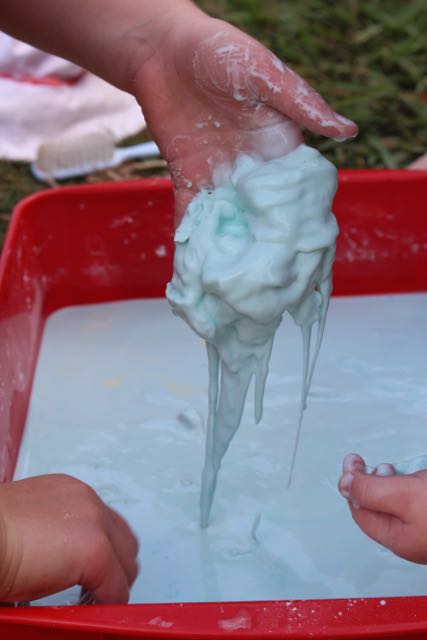
Oozing slime.

Oozing slime.


Previously we have used various plastic animals, cups, scoops, spoons, tongs and funnels with the slime, but the kids have just as much fun without any extra play items. It is a fascinating substance that keeps the kids entertained for ages. It is lots of fun to scoop up in our hands, squish it between our fingers, and let it ooze back into the tub. We talked about its liquid and solid properties and looked at ways of changing the pressure on the slime to cause it to solidify or to liquify. The kids tried pressing it quickly or letting their hands slide into it. And of course, eventually one of them stood in it, and then sat in it. Baby T was particularly pleased with the way it squelched up between his toes.

Baby T dropping slime on L's head.

Baby T dropping slime on L’s head.

Optical Illusions by Dr Gareth Moore
Standard

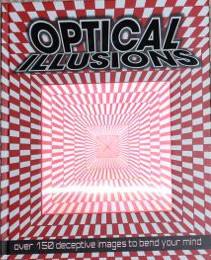
IMG_2514Optical Illusions by Dr Gareth Moore, hardback non-fiction, 96 pages, published by Parragon Books Ltd in 2013.

Optical Illusions presents more than 150 different images with explanations of these truly amazing illusions. The book was broken up into sections containing different types of illusions, such as perspective illusions, movement illusions, and colour illusions.

Both my daughter and myself pored over this book for hours allowing our minds to be tricked by the images. Some of them we had to move closer or further away to experience the illusion, and a few I couldn’t see at all, but most of them were very obvious. Even knowing that it was an illusion, it was incredibly difficult, if not impossible, to ignore the trick and see the image for what it really was. I loved trying though!

There was a handy little visual interpreter card inside the front cover that could be used to remove the illusion. Throughout the book, if an image could be decoded using the visual interpreter, there was a coloured circle besides the illusion indicating which part of the visual interpreter to use. This made checking whether lines were really straight or areas were the same colour much easier. My second grader liked using this visual interpreter to help her to see the reality of the image.

Optical Illusions is a very entertaining book that really has to be seen to be believed!


Body Measurements

Standard

To practice using rulers and tape measures (and reading them accurately!) we spent an hour or so measuring different parts of our bodies.

L marking out her foot to measure it.

L marking out her foot to measure it.

Measuring A's hand with the ruler.

Measuring A’s hand with the ruler.

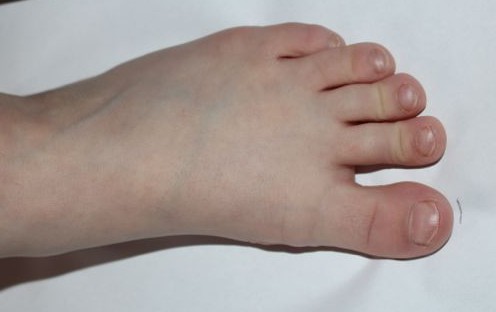
Both L and A stood on a sheet of paper and placed a mark along the back of their heel, and at the top of their big toes. They then used a ruler to measure how long their feet are. Both of them found their left feet to be slightly longer than the right. They also used the rulers to measure the length of their hands, from the circlet of wrinkles at the wrist to the end of the middle finger. L drew around her hand carefully and then measured the length of each of her fingers.

L tracing around her hand.

L tracing around her hand.

L measuring around her waist.

L measuring around her waist.

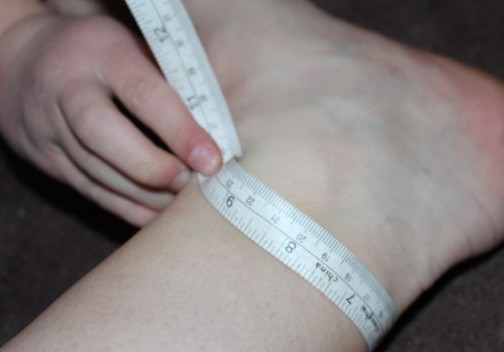
Measuring my ankle.

Measuring my ankle.


L used a tape measure to measure around her waist, but the first few times she read off the inches side, and had to try again to get centimetres. They also used the tape measure to measure around our ankles, wrists, upper arms and heads. They compared all of the measurements. They were quite amazed that the left side of the body can be different to the right side. They also discovered that my head isn’t that much bigger than L’s!

Even the bunny got in on it!

Even the bunny got in on it!

This was a simple activity that needed no preparation to organise, but it gave the kids plenty of practice measuring things. Being able to measure accurately and consistently is an important skill, and we will be practicing it more in the future.

Treasure Bottle

Standard
The shaken bottle.

The shaken bottle.

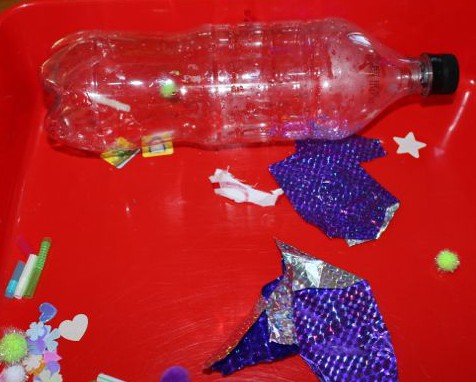
One of the preschool classes at school made some pirate treasure bottles as part of their pirate theme. A was intrigued by the treasure bottles, and wanted to make one at home. The bottle contained a variety of items, including sand, coloured water, glitter, beads, pebbles and other crafty materials.

The bottle and some of the treasures.

The bottle and some of the treasures.

We used a clear plastic bottle to place our treasures in. Some of the treasures included plastic beads, coloured plastic, sparkly pom poms, cut up plastic straws, some broken loom bands, and lots and lots of glitter. The kids took turns adding treasures to the bottle, then I used a funnel to add silver and gold glitter. Once all our treasures were in the bottle, I filled it with water and tightened the lid. For bottle crafts like this, I normally add glue to the thread of the lid before screwing it back on too, so that the lid doesn’t accidentally come off and result in a huge mess.

Tipping the bottle upside down.

Tipping the bottle upside down.

Watching the contents settle.

Watching the contents settle.


The kids squeezed the bottle, tipped it upside down, and shook it. They watched to see what sank and what floated. They watched as the contents settled and swirled. They were mesmerised.

Shaving Cream Play

Standard
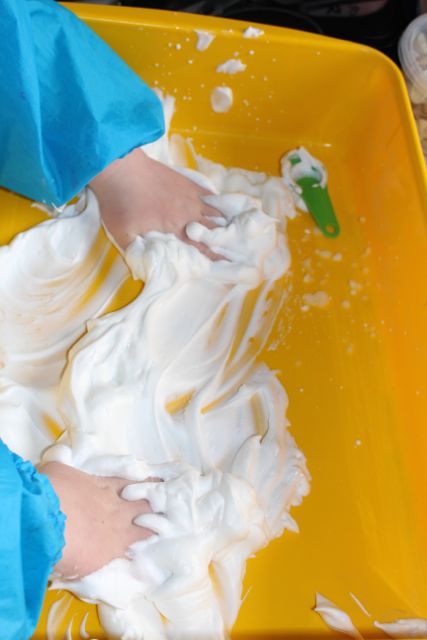
Shaving cream in a tray.

Shaving cream in a tray.

A very easy activity for kids is letting them play with shaving foam. It’s easy to clean up with water and is lots of fun. It’s not good to eat though, so I prefer not to let Baby T near it, but L and A love squishing their hands into it.

Squishing and squashing.

Squishing and squashing.

Whisking.

Whisking.

We used a couple of plastic trays on top of a muck mat, in an attempt to contain the shaving foam. It’s nice to do this outside if the weather permits, where we can just hose the area down. L and A each had a tray with shaving cream in it. They used various utensils to mix and scoop it, but mostly they just liked to feel it, squish it and squeeze in through their fingers.

Mixing and spreading.

Mixing and spreading.

L pretended the shaving cream was part of her cafe and she made me a smoothie. A whipped her shaving cream up with a whisk, and somehow managed to get shaving cream all the way up her arms and on her face.

We have previously used shaving cream to practice writing spelling words in too. We just smooth a layer of shaving cream in the bottom of a tray, and then write the words using a finger to form the letters.

Messy fun!

Messy fun!


Yellow Sensory Tub

Standard

IMG_1314I gathered lots of yellow things from about our house and popped them into one of our sensory tubs yesterday. I was surprised by the amount of yellow things we just had lying about. There was a plate, bowl, spoon and fork, as well as some yellow lids, a silicone chocolate mould, felt shapes, plastic frogs, wooden pegs, a pom pom and pipe cleaner. And of course, the yellow sensory tub wouldn’t have been complete without a banana and a lemon.

Putting yellow things into the bowl.

Putting yellow things into the bowl.

Baby T went straight for the banana (he loves them) and tried to take a bite right through the skin. He was very happy when L peeled it for him, it quickly disappeared and he wasn’t interested in the skin. Then he took everything else out of the tub to look at it carefully. He put everything into the bowl and gave it a mix with the spoon. He tried to spear the pom pom with the fork, and he enjoyed banging the pegs against the plasticware.

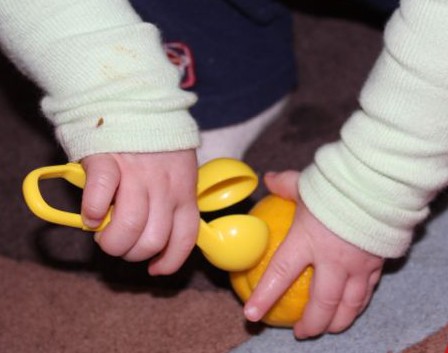
Trying to pick up the lemon with the tweezers.

Trying to pick up the lemon with the tweezers.

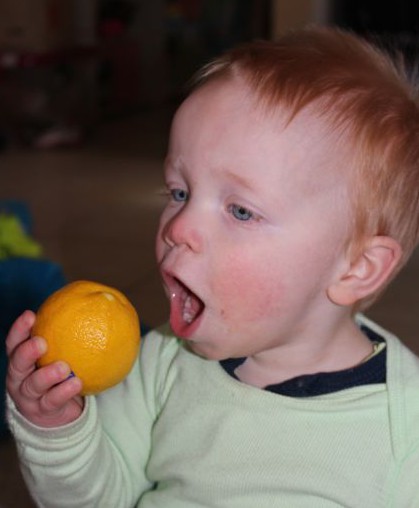
We spoke a lot about the colour yellow, and the textures and shapes of the different items as Baby T explored the tub. L and A tickled him with the pipe cleaner, and pretended to make the frogs jump onto his head. Baby T really liked the lemon and the big plastic tweezer scoop, and spent a lot of time playing with these items. He tried to pick the lemon up with the tweezers many times, but it was far to big. He also took a bite out of the lemon… He wasn’t impressed with the taste, but he still wouldn’t let the lemon go.

Going for a big bite.

Going for a big bite.

Hand Shadow Show

Standard

One night last week we had a blackout after dinner. The kids were a little frightened to start with, but then we pulled out torches and candles. This led to the kids putting on a shadow puppet show to pass the time.

A shadow bunny.

A shadow bunny.

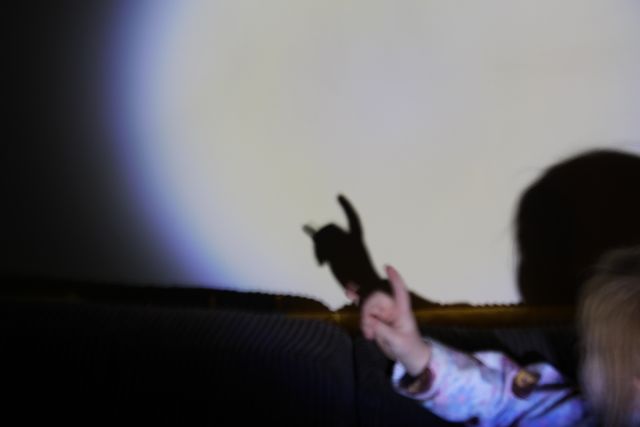
We set up one of the big torches aimed at a clear space on the lounge room wall. The kids stood off to one side and used their hands and arms to make different shadow shapes on the wall. They mostly made animals, adding sound effects, and telling some short stories. Big L made some shadows too. They had lots of fun performing their shadow show, and sooner than they would have liked the lights came back on.

A making a shadow dog.

A making a shadow dog.

L making a shadow animal.

L making a shadow animal.

Catching a Rainbow

Standard

With a glass of water and a sheet of white paper on a sunny day, we caught a rainbow!

IMG_0930

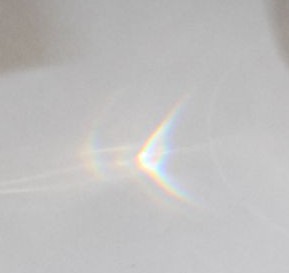
We held the glass above the paper in the bright sun shining in through our window. The light hits the water in the glass and bends (refraction), causing the white light to split into its component colours, forming a rainbow. We caught the rainbow on the white paper, behind and below the glass. It was a little hard to see in the bright sun, but when L placed her arm in front of the window to create a shadow on the paper where the rainbow was falling, it clarified it.

The rainbow in the shadow of L's arm.

The rainbow in the shadow of L’s arm.

When we placed the glass of water onto the paper we could see a rainbow in the bottom of the glass. The kids thought this was a wonderful and fascinating little experiment.

The bottom of the glass.

The bottom of the glass.

More rainbows in the glass.

More rainbows in the glass.