Category Archives: Nature

Cardboard Roll Trees

Standard

Making play trees is quite easy using some simple materials, such as cardboard rolls, tissue paper and streamers. Using cardboard rolls of different length or width can make an even more interesting forest of play trees.

IMG_1678

We made four different trees to play animals and dinosaurs with.  A chose to make our play trees green because “trees are meant to be green mummy!”, but I think we could have made trees in other colours to play with. I like the idea of a magical forest of pink and purple trees to play with our fairies and unicorns!
IMG_1658

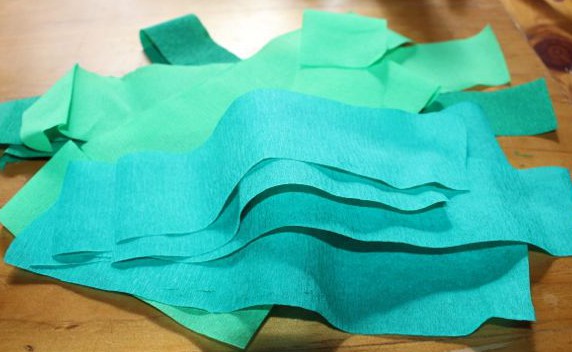
Strips of streamers.

Strips of streamers.

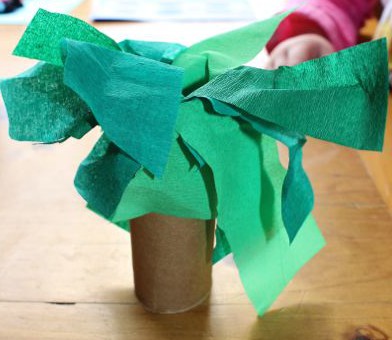
The first tree uses green streamers as the leaves. We had streamers in a few shades of green, so we used strips of each on our tree, but one colour would have been fine also.

The strips taped together.

The strips taped together.

We cut the streamers into strips, and laid them in a pile. Then A twisted the end of the pile together and used sticky tape to secure it. She placed the bundle of streamers into one end of a cardboard roll and taped it down. She fluffed out the streamers in all directions to create the top of the tree. A has been referring to this tree as her “jungle tree”.

IMG_16690

Taping on the tissue paper circle.

Taping on the tissue paper circle.

Adding more layers of tissue paper.

Adding more layers of tissue paper.

The second tree used tissue paper circles for the foliage. A placed a cardboard roll onto the centre of a circle of tissue paper and taped it down. Then she turned it up the right way and used a dot of glue in the centre of the tissue paper circle to attach another circle to the first, and then a third one on top of that. We used four or five pieces of tissue paper, but adding more would have made a puffier tree. Once the glue had dried, we were able to shape the tissue paper to create layers of foliage.
IMG_1668

A cut strip of paper.

A cut strip of paper.

The first leaf attached.

The first leaf attached.

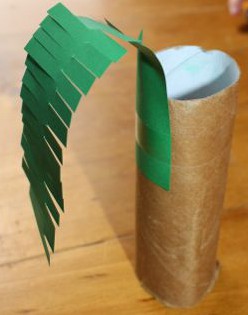
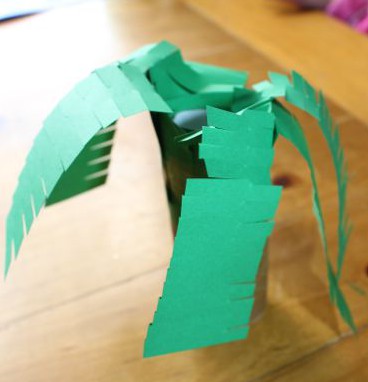
The next tree has foliage made from sheets of green paper. We cut the paper into strips, and then placed small cuts into both sides of these strips to create leaves that A thought look like palm leaves. The key is not to cut right through the strip, though A had a little trouble with this and we ended up with a few short leaves! We left a section at one end of each leaf uncut, where we could attach each leaf to a cardboard roll. A taped the leaves to the outside of the roll, and then let the leaves flop outwards and down. This was her favourite tree.
IMG_1663

Putting the tissue paper into the cardboard roll.

Putting the tissue paper into the cardboard roll.

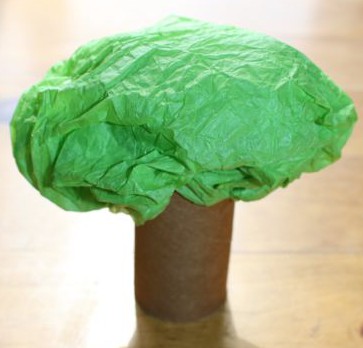
The last tree was the simplest of all. A loosely rolled one end of a sheet of tissue paper and inserted it into a cardboard roll. She used a piece of tape to secure it, and then scrunched and shaped the tissue paper into a ball shape to create the tree’s leaves. She added a few pieces of tape to keep the tissue paper attached to the cardboard roll.

A was very happy with her cardboard roll trees, and used them to create fun play scenes with her animal and dinosaur figurines.
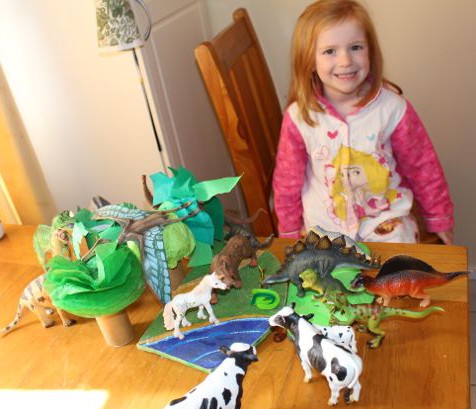
A very happy girl with her new trees and her animals.

A very happy girl with her new trees and her animals.
Tissue Paper Flower Art

Standard

IMG_1682

Sheets of tissue paper.

Sheets of tissue paper.

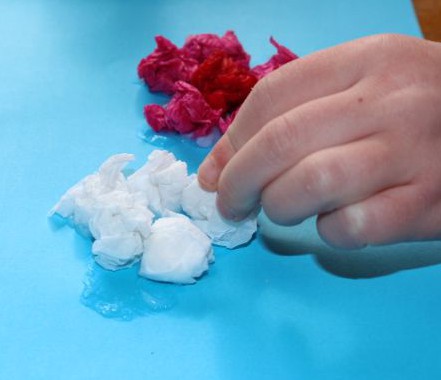
Spring has sprung, and A is feeling like doing lots of flowery arts and crafts at the moment. She made this delightful picture by scrunching up circular sheets of tissue paper into small balls and gluing them onto a sheet of blue paper.

Gluing down the tissue paper balls.

Gluing down the tissue paper balls.

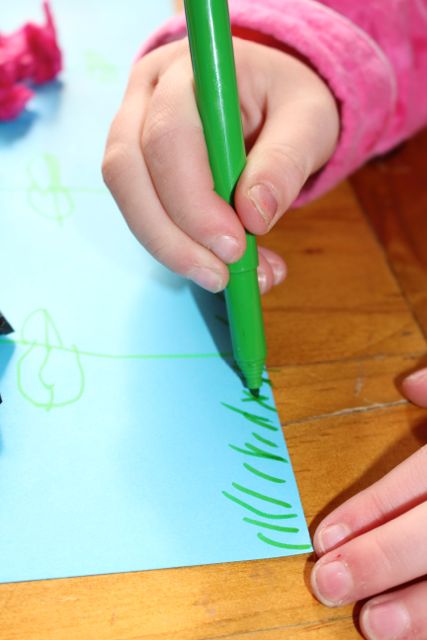
Every time she scrunched up a piece of tissue paper, she said “Scrunching it up like I don’t want it any more.” And then she would stick it down using Clag glue. She even put a sun up in the corner to help the flowers grow. The stems, leaves and grass, she drew using green markers.

Adding grass.

Adding grass.

Tissue Paper Roses

Standard

I like having flowers on the table, it makes the house feel cheery. But then I get a bit sad when they start to wilt and go brown. Luckily, craft flowers don’t die off, so we can keep lovely bright flowers on the table at all times!

IMG_1642

Tissue paper circles.

Tissue paper circles.

A and I made some roses using tissue paper circles. I bought these circles in a rainbow pack, so there were lots of colours to choose from. We combined different coloured circles to make multi-coloured flowers. Each flower used five or six sheets of tissue paper.

The end of the pipe cleaner in the centre of the flower.

The end of the pipe cleaner in the centre of the flower.

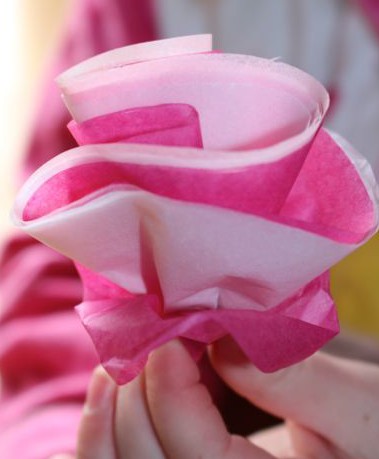
The stems are half a green pipe cleaner (chenille stick). I poked the end of the pipe cleaner through the centre of the stack of tissue paper. I twisted the end of the pipe cleaner to keep it in place. Then A pushed and folded the tissue paper into a flower shape, upwards and away from the pipe cleaner stem. She twisted the base of the flower, and used sticky tape to attach it to the stem, and to keep it scrunched up in shape. We rearranged the petals of each flower to show off the different colours, and create a layered effect, like that seen on real roses.

Shaping a rose.

Shaping a rose.

Once we had a bunch of these roses, A used a cardboard roll as a makeshift vase. They look lovely sitting in the centre of our table.

Two of our roses.

Two of our roses.

Roses in a makeshift vase.

Roses in a makeshift vase.

Kissed by the Moon by Alison Lester

Standard

IMG_1393Kissed by the Moon by Alison Lester, hardback picture book, published by Penguin Group (Australia) in 2013.

The wishes of a mother for her child. From waking to birdsong, experiencing the great variety of nature, and drifting into dreams, Kissed by the Moon, reads like a lullaby of love between mother and child.

This heart-warming book captures the beauty of the mother and child relationship. For her child she would like the simple pleasures of love, happiness, contentment, safety and experiencing nature in all its forms, things that many parents want for their own children. It is also beautifully and brightly illustrated, a pleasure to see. Kissed by the Moon is a lovely book to read to children before bed, from toddler through primary school, it will remind them of their parents’ love and help them to settle down for a peaceful sleep.


Jeremy by Chris Faille and Danny Snell

Standard

IMG_1357Jeremy by Chris Faille and illustrated by Danny Snell, published by Working Title Press in 2013.

Jeremy is a baby kookaburra that has fallen out of his nest. The family cat brings him home when he is just a wrinkly little pink ball with closed eyes. The nest is too high to return the bird to, so the family look after him, keeping him warm and feeding him. Jeremy grows feathers, and gets bigger and stronger. All too soon he is ready to face the world on his own.

Jeremy is a heart warming tale of survival, that also serves to introduce the reader to the basics of how a kookaburra develops. The story itself is a simple narrative following Jeremy’s progress from ugly newborn to young adulthood, when he is ready to fend for himself.

Inside the front and back covers, lots of facts about kookaburras are presented, considerably increasing the depth of knowledge gained from this book. The illustrations in Jeremy are an asset to this book, as they are wonderfully life-like, and so detailed. They bring Jeremy to life as he grows and changes.

Several times as a child I found a poor baby bird that had fallen or been pushed from its nest, and tried to save it. None of mine were as lucky as Jeremy though. I was pleased that Jeremy grew into a healthy young kookaburra that could be released back into the wild, despite his shaky start. My preschooler was surprised, having never seen a newly hatched bird,  that baby birds have no feathers and are completely defenceless. She enjoyed the extra facts about kookaburras, and I’m pretty sure she learnt some things!  As this book is mostly non-fiction disguised as a picture book, I think it would be an excellent tool to help encourage children into reading more non-fiction. Good for curious kids in primary school and preschool, I enjoyed sharing Jeremy with my daughter very much.


* Jeremy was the winner of the 2014 Children’s Book Council of Australia Book of the Year in the Eve Pownall Award for Information Books category.

Upside Down in the Jungle by Helen Phillips

Standard

IMG_1309Upside Down in the Jungle by Helen Phillips, paperback novel, 333 pages, first published under the title Here Where the Sunbeams are Green by Delacorte Press in 2012, this edition published by The Chicken House in 2013.

Mad and Roo have a famous ornithologist for a father, Dr Wade, also known as The Bird Guy. He travels to find rare and important birds regularly, but when he is asked to track and catalogue rare birds in the jungle by an exclusive resort at the base of a volcano, he doesn’t return. His family begin to worry, and then they receive the Very Strange and Incredibly Creepy Letter that appears to be nonsense, but Roo is convinced it’s a coded message. Their mother, Sylvia, thinks that they are being watched, and a colleague of The Bird Guy has started hanging around the family constantly. The whole situation is very odd, and eventually the family flies to the jungle to find Dr Wade, where things only become stranger. With the help of Kyle, the grandson of the owners of the lodge where the family are staying, Mad and Roo are determined to uncover the truth about their father and just what he is doing in the jungle and why he hasn’t come home yet.

Adventure, mystery, first romance and an incredibly rare bird, believed to be extinct in the jungles of South America, are found in this exciting novel for middle to upper primary and lower high school students. Told from the perspective of Mad, a twelve-almost-thirteen year old, who finds herself unwillingly unravelling the mystery of her father’s reluctance to return from the jungle or to communicate with his family, spurred on by her younger sister Roo. They team up with the charming, yet cheeky, Kyle, who is supposed to be teaching them Spanish, but is much more concerned with locating the rare volcano bird that he knows to exist, though it had previously been reported to be extinct. This novel was fast paced and intriguing, with beautiful imagery. I enjoyed reading it, and had difficultly putting it down. I became involved in the fortunes of the characters, and hoped that they would find the bird and solve the mystery. It was very well written, the characters were well developed, and it was easy to conjure their images in my mind. A fantastic book. I look forward to reading more by Helen Phillips in the future.

Button Flower Art

Standard

IMG_0260

Placing buttons.

Placing buttons.

These old buttons have been made into flowers by A. She chose a centre for each flower, and then surrounded it with other buttons for the petals. Once the buttons were placed just right, I helped her to glue them down.

Drawing flower stems.

Drawing flower stems.

A used crayons to draw flower stems and leaves and grass. She wanted lots and lots of wild grass, and ended up drawing so much the flower stems were lost a bit, but she was happy. The top of the page looked a bit bare then, so I suggested some clouds. A decided that if there were to be clouds there should also be rain, and a sun. She told me that it needed a sun to be happy, but she also wanted it to be a rainy picture.

Button flowers stuck down.

Button flowers stuck down.

Flower Bouquet

Standard
IMG_9918

L’s bouquet.

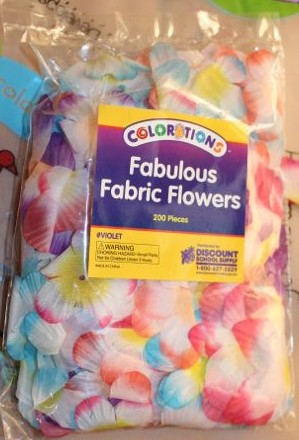
Fabric flowers.

Fabric flowers.

I bought these fabric flowers on a bit of a whim, with no idea what we might use them for, I just liked the look of them. Seeing all the flower bouquets in the lead up to Mother’s Day made me think of our fabric flowers, and how we could use them to make our own bouquets.

Two flower shapes on one stem.

Two flower shapes on one stem.

Each of the flower shapes have a little hole in the centre of them, just perfect for threading onto pipe cleaners. We cut some green pipe cleaners in half, and used these as the flower stems. There were three sizes of flowers in the pack, and the kids used these layered from largest to smallest on their stems. Some of their flowers had only one flower shape, while others had three layered on each stem. We twisted the end of the pipe cleaner over on itself at the centre of the flowers to prevent the flowers from coming off their stems.

Placing the flower shapes onto a stem.

Placing the flower shapes onto a stem.

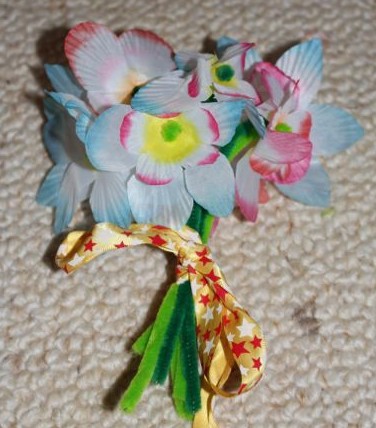
Once they had finished making their flowers, they bundled them together, re-arranging them into a bouquet with all the flowers facing out or up. We bent some of the pipe cleaner stems to help shape the bouquets. Once they were happy with their bouquets, we tied them up with ribbons.

A's bouquet.

A’s bouquet.

L and A combined their flowers into a vase for the dining room table, where they look very pretty.


Propagating Succulents

Standard

After painting their terracotta pots, the kids wanted to plant something in them. We have a single succulent plant growing out by our letterbox that seems pretty hardy, and I thought it would be fun to try to propagate some new plants from it’s cuttings.

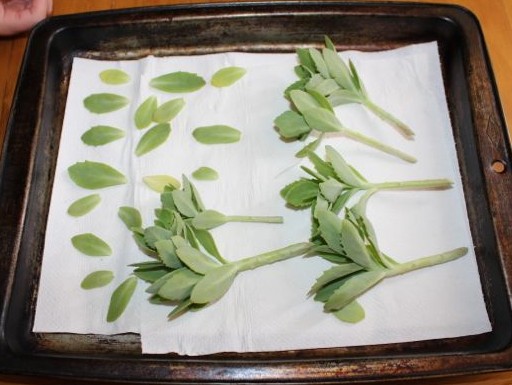
Cuttings drying out.

Cuttings drying out.

The succulent in our garden is a good size, so we were able to take several stem cuttings. We removed the lower leaves from the bottom of each stem. We left the leaves and the cuttings to dry out for a few days.

Succulents generally like well-drained soil, so L collected some red gravel from one of our garden beds to place in the bottom of each pot to improve drainage. She then filled each pot with some cacti and succulent potting mix. My mother had told me to try dipping the base of the cuttings into honey prior to planting them. This is supposed to kill any bacteria on the cutting, and improve growth. I’d never tried this before, but we pulled out some honey and dipped each cutting in. It’s hard to know whether it worked, but all of our cuttings survived, and had new growth on them, so I think we will use honey on our cuttings again in the future. L placed a single stem cutting into each pot, patted the soil down and gently watered them in.

Gravel used for drainage.

Gravel used for drainage.

Adding soil.

Adding soil.


Placing the cuttings into the soil.

Placing the cuttings into the soil.

Patting the soil down around the cutting.

Patting the soil down around the cutting.


We placed them in a sunny spot, and checked on them every day, keeping the soil moist, but not too wet. After a week or so, we noticed some of the cuttings had produced some new leaves, and some little roots had appeared near the base of the stems.

All of these succulents in their decorated pots were given away as Christmas presents, mostly to their teachers. The kids were so proud to show off the pots that they painted and the plants that they had grown. They made unique gifts that were well received and appreciated.

Watered in and ready to grow.

Watered in and ready to grow.

As we began to clean out the laundry this week, in preparation for painting, we discovered some unused pots under the laundry tub. These will make excellent vessels for our next round of succulent growing. I would like to try propagating some cuttings from other types of succulents too.

Flower Picture

Standard

A few weeks back at playgroup the craft activity was making a banner of flowers. The stems and leaves were drawn on in crayon, and the flowers were patty pan and muffin cases. Today A made a smaller version of this flower picture at home, with the addition of some muffin case leaves.

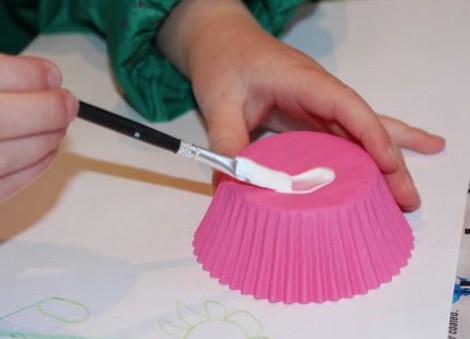
Adding glue.

Adding glue.

Placing the muffin cases.

Placing the muffin cases.

A drew some stems on where she wanted her flowers to be, and then she began adding the muffin cases. We had a mix of red, blue, yellow and green cases. Some of the cases were glued to the stems whole to represent open flowers, while others were folded in quarters as budding flowers.

The open flowers received a pom pom centre and the green cases were folded into eighths to make leaves. A glued these onto some of the stems. She also added some crayon grass to the bottom of the picture to complete the scene.

Finished flowers.

Finished flowers.