Category Archives: People/The Body

Kitty Conquers the Big Bully by KayeC Jones

Standard

Kitty'scoverKitty Conquers the Big Bully by KayeC Jones, picture e-book, 32 pages, published in 2016.

Kitty is having fun playing on her own as a knight when a big bully called Ronnie comes along. He tells her girls can’t be knights and pushes her in the mud. Kitty has an excellent way of overcoming the bully. She picks herself up and imagines all the things that she can become if she wants to, no matter if other people say negative things to her.

This is a delightful and unique book. It screams ‘girl power’ but the main message is good for both girls and boys. Believe in yourself and don’t let the bullies win! Kitty doesn’t retaliate with violence, nor does she stoop to the same level as Ronnie. She is better than that, and stronger. She conquers him in the best way possible, by ignoring his rude and ignorant comments and being herself and knowing that she can achieve whatever she wants.

The story was mostly rhyming, and was good to read aloud, though there were a few words that I had to explain to the kids. I’m not actually sure what a ‘flim-flam’ is myself, or why ladies would need saving from them! The text itself was large, clear and easy to read. Each letter ‘i’ was capped with a little heart where the dot goes. My six year old thought that was pretty neat!

Every page has clear, bright illustrations. I liked that Kitty’s friends, the teddy and bunny, accompany her through each of her ideas of what she could do. Kitty has pretty awesome hair, I especially like it when she is composing music. Ronnie is suitably scary and sour looking!

Kitty Conquers the Big Bully is suitable for preschool and primary school children.


*I received this book as a digital copy from the author, who asked me for an honest review of this book. I did not receive any other remuneration, and the review is composed entirely of my own opinions.

Weeds in Nana’s Garden by Kathryn Harrison

Standard

weedsinnanasgardencoverWeeds in Nana’s Garden by Kathryn Harrison, picture book, published by Flipturn Publishing in 2016.

Nana’s garden is a special place, full of blooms, lush greenery and fairies. A young girl enjoys time with her Nana in the garden throughout the year, until one summer she discovers weeds choking the garden beds. She has never seen weeds like that in Nana’s garden, and she doesn’t know how or why her Nana would let the garden get like that. Her mother explains that Nana has Alzheimer’s Disease, and her brain is developing more and more tangles that make it hard for her to think and remember, a bit like how the weeds in the garden were making it hard for the plants to grow properly.

Weeds in Nana’s Garden is a lovely picture book designed to help explain Alzheimer’s Disease and other dementias to young children through a garden analogy. The weeds in the garden are like the tangles growing in Nana’s mind, causing her confusion, frustration and forgetfulness. It is sad to experience a loved one being claimed by dementia, and it can be very difficult to explain the process to children. This book will make it much easier for children to understand what is happening.

Each page is executed with colourful illustrations. Can you find the cat and fairies in each picture? The text is simple and easy to read, and the story is not too long. It is well written for the intended audience.

I think this book would be an excellent resource for families dealing with the onset of dementia in their loved ones. There is a question and answer section at the back that answers some of the common questions that children might ask. This will help parents to explain this disease in simple terms to their children.

Weeds in Nana’s Garden is suitable for preschoolers to primary school children. Sales of this book will also help the Alzheimer Society of Canada, with $1.00 from each book sold being donated to them.


*I received this book as a digital copy from the author, who asked me for an honest review of this book. I did not receive any other remuneration, and the review is composed entirely of my own opinions.


Hand-print Bookmarks

Standard

IMG_4472For Mother’s Day this year we made bookmarks using the hand-prints of the kids. I found some old scrapbooking papers that had pink or blue heart patterns on them to use as our base for the hand-prints.

Using the paint pad.

Using the paint pad.

A's hand-prints.

A’s hand-prints.

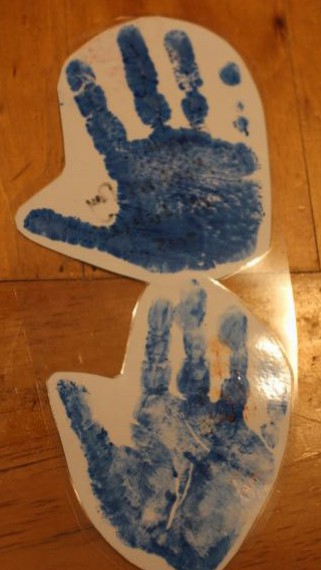
Each child chose the background paper to use, and the colour of paint for their hand-print. Predictably A chose pink on pink for her bookmarks. L used the rainbow paint pad for her hand-prints on the back on the blue paper.  Unfortunately the rainbow paint didn’t come out as clearly as the other paint, but L liked it as it was. The boys used blue paint on blue paper. Using paint pads for hand-prints makes it easy to get a good amount of paint on the hand, and is much less messy than using conventional paint.

Hand-prints.

Hand-prints.

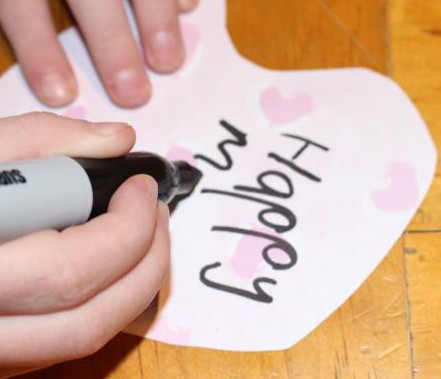
After the hand-prints were dry, I carefully cut around each hand. The kids wrote some lovely messages on the back of one of their hands using a marker. A pushed down her marker quite hard, and the ink is visible through the hand-print. She also drew a lot of love hearts! I love it because it is so unique.

Writing a message on the back of the hand-print.

Writing a message on the back of the hand-print.

To finish the bookmarks I laminated the hand-prints. I arranged the hand-prints so that A’s hands and Baby T’s hands were together to make a bigger bookmark each, while L’s hand-print was big enough as one. I also did a single print of my hand to make a bookmark for my mum. Once laminated, I carefully cut around the hand-prints so that there was a small amount of plastic laminate around each one. The kids were happy with their bookmarks.

One of the boy's bookmarks.

One of the boy’s bookmarks.

A hand-print bookmark in my latest read.

A hand-print bookmark in my latest read.

Bone Collection: Animals by Rob Colson

Standard

IMG_4093Bone Collection: Animals by Rob Colson and illustrated by Sandra Doyle, Elizabeth Gray and Steve Kirk, paperback non-fiction, published by Scholastic Australia in 2013.

Explore the animal world through their skeletons. Bone Collection: Animals covers a range of animals from fish and frogs to apes and humans. First it looks at the skeleton of a specific animal, then follows this with facts about similar animals. At the end of the book, there was a double page with a lion’s skeleton separated with the major bones named. There were also some general bone facts, and a glossary to help with some of the terms found within the text that may be unknown to a young reader.

A combination of illustrations, photos and diagrams alongside fascinating facts about a wide variety of creatures make this an excellent non-fiction text for primary school students. The illustrations of the skeletons throughout this book are exquisitely detailed. The depth of information is good for this age group, whilst also being interesting and presented in an appealing style.

My third grader read this book to me, and we both learnt quite a few things! She just wanted to keep reading until we were finished, as she was finding it so entertaining and enlightening. We liked that each page had a little diagram showing the relative size of the creature to an adult human. Her favourite animal was the three-toed sloth with its long arms and claws, while I found the blue whale’s humungous jaw bones very interesting.

The Very Best of Friends by Margaret Wild and Julie Vivas

Standard

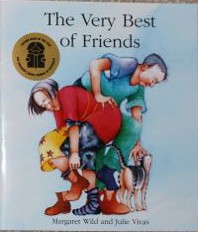
IMG_3948The Very Best of Friends by Margaret Wild and illustrated by Julie Vivas, paperback picture book, first published by Margaret Hamilton Books in 1989, this edition published by Scholastic Australia Pty Limited in 2004.

James and Jessie live on a farm with lots of animals, but only one cat, William. As James goes about his jobs on the farm, William goes with him, he curls up on his lap in the evenings and on the bed at night. And then James dies suddenly and Jessie falls deep into grief, shutting William out, letting him run wild and become mean, something he never was with James. To move forwards, Jessie must work on her friendship with William and regain his trust.

A poignant tale of friendship and loss, beautifully spun for younger children, The Very Best of Friends will touch your heart. It is a reminder that all relationships need work, and if you fail to tend them, they will wither, but with a little love, kindness and attention they might thrive again.

While the story is beautiful, the illustrations are distinctive and just gorgeous. I love the way that William is depicted, and how he changes from the well-tended cat to the wild thing he becomes after James dies.

The Very Best of Friends is suitable for primary school children. It is a book I read as a young child,  and I am now sharing it with my own children. This wonderful picture book can be used to start a discussion on the complicated issues of loss and grief, and that life must go on. Though something sad happens, the friendship that blooms between Jessie and William is lovely and inspiring. It is important to keep living your life even when you have lost someone, and I found this book to be helpful in explaining that to my children.


* The Very Best of Friends won the 1990 Children’s Book Council of Australia Book of the Year in the Picture Book category.


Freaky Phobias by Joel Levy

Standard

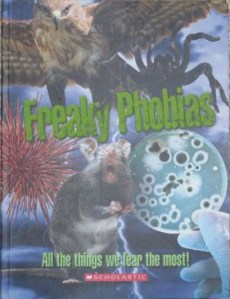
IMG_2519Freaky Phobias by Joel Levy, paperback non-fiction, 80 pages, published by Scholastic Australia in 2011.

This book is a fascinating insight into a range of phobias. It covers the most common ones, such as arachnophobia and claustrophobia, alongside some extremely unusual phobias. I never knew there was a word for the fear of otters or knees or kissing, but there is! And there are many other phobias that I had never considered, but discovered in Freaky Phobias.

Freaky Phobias is an informative and interesting book for primary aged children. I learnt quite a lot whilst reading Freaky Phobias, as did my second grader. It had a good depth of information for children, and plenty of fun facts to engage the reader. The photography depicted all of the terrors contained within the book with such clarity that my second grader wanted to skip some of the pages because she felt anxious.

Freaky Phobias contains an A-Z of Phobias, providing the names and descriptions of quite a few phobias. I think this glossary could have been enhanced by including the phonetic spelling of the names, as some of them are quite long and complicated words, which I had difficulty pronouncing.

This is quite a good non-fiction title for young learners (and big ones too!)


Body Measurements

Standard

To practice using rulers and tape measures (and reading them accurately!) we spent an hour or so measuring different parts of our bodies.

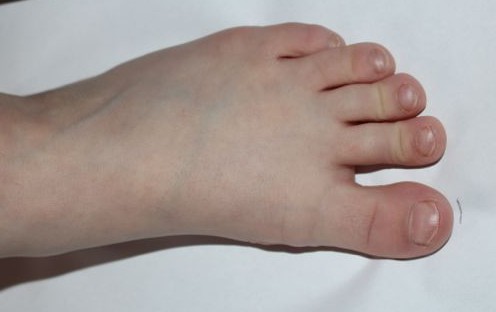
L marking out her foot to measure it.

L marking out her foot to measure it.

Measuring A's hand with the ruler.

Measuring A’s hand with the ruler.

Both L and A stood on a sheet of paper and placed a mark along the back of their heel, and at the top of their big toes. They then used a ruler to measure how long their feet are. Both of them found their left feet to be slightly longer than the right. They also used the rulers to measure the length of their hands, from the circlet of wrinkles at the wrist to the end of the middle finger. L drew around her hand carefully and then measured the length of each of her fingers.

L tracing around her hand.

L tracing around her hand.

L measuring around her waist.

L measuring around her waist.

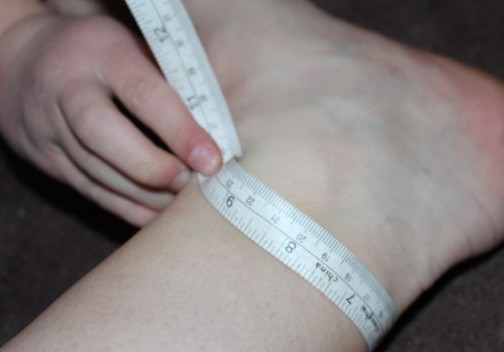
Measuring my ankle.

Measuring my ankle.


L used a tape measure to measure around her waist, but the first few times she read off the inches side, and had to try again to get centimetres. They also used the tape measure to measure around our ankles, wrists, upper arms and heads. They compared all of the measurements. They were quite amazed that the left side of the body can be different to the right side. They also discovered that my head isn’t that much bigger than L’s!

Even the bunny got in on it!

Even the bunny got in on it!

This was a simple activity that needed no preparation to organise, but it gave the kids plenty of practice measuring things. Being able to measure accurately and consistently is an important skill, and we will be practicing it more in the future.

There’s a House Inside my Mummy by Giles Andreae and Vanessa Cabban

Standard

IMG_1305There’s a House Inside my Mummy by Giles Andreae and and illustrated by Vanessa Cabban, paperback picture book, first published by Orchard Books in 2001, this edition published in 2002.

A young boy is expecting a little brother or sister soon, and he is very excited. He describes what is happening through his experience. He watches his mummy as her tummy grows, when she is tired and sick, and the weird things the baby wants her to eat, as he waits and waits for the baby to arrive.

I first read this book to my eldest child when I was pregnant with my second child. She was only two, and this book was helpful in explaining pregnancy to her. We read it again during my third pregnancy, this time to both my girls. They enjoyed the idea of there being a house inside me where the baby was growing, just like in the story. It described what was happening in a kid-friendly way, with lovely rhyming texts and simple illustrations. It also gave us the opening to talk about pregnancy and how the baby was growing, and what would happen when the baby was ready to be born. The girls asked lots of questions, and asked to read this book repeatedly. Even though their little brother is here now, they still like to read this book sometimes.

There’s a House Inside my Mummy is a unique book about the joyous arrival of a new baby. It is nice to read with expectant big siblings, especially toddlers and preschoolers, in preparation for the baby’s arrival.

I Love You, Nose! I Love You, Toes! by Linda Davick

Standard

Photos - 15525I Love You, Nose! I Love You, Toes! by Linda Davick, hardback picture book, published by Beach Lane Books in 2013.

This is a wonderful rhyming book that celebrates the body and all the parts that make it up. These children love their bodies, no matter the shape, size, colour or even if it’s bruised or scratched. And you can too!

This was a fun book that we shared, bringing our attention to different parts of the body. As we read , my preschooler pointed to each part on her own body, and made some comments, like ‘My hair is red!’ and ‘That girl’s reading a book on the potty!’ My preschooler loved the rhyming cadence and the clear illustrations. She laughed most at the picture of a girl sneezing with lots of green stuff coming out of her nose! The part about not quite being able to hug the back, got my preschooler trying to hug her back like the children in the picture, it was quite funny. I really liked that this book got my preschooler thinking about her body and just how wonderful it really is.

My Body by Bloomsbury Discovery

Standard

IMG_1196My Body by Bloomsbury Discovery and illustrated by Joelle Dreidemy, large format non-fiction boardbook with flaps, published by Bloomsbury Publishing Plc in 2014.

Most children love lift-the-flap books, and this one has dozens of flaps that open to reveal lots of fun facts and information about the body. A wonderfully engaging book for preschoolers and children in lower primary, My Body covers human evolution and the various body systems in a detail appropriate for this age group. The main illustrations were plentiful, detailed and clear, showing a good life-like representation of the human body. There were also lots of other illustrations on every page with more facts, and these had more of a cartoon quality about them.

The flaps were a big attraction for my preschooler, but once we started reading, she really got into the information too. She asked a lot of questions while we were reading, she came back to the book later to look through it again herself, and asked me to re-read a few sections to her. We ended up reading the whole book in one sitting as she was enjoying it so much. The information contained within this book was detailed enough that my second grader also found it useful and enlightening. I have heard my preschooler repeat several facts she learnt from My Body, especially that people shouldn’t eat snot because it contains germs!