Tag Archives: craft

Tissue Paper Roses

Standard

I like having flowers on the table, it makes the house feel cheery. But then I get a bit sad when they start to wilt and go brown. Luckily, craft flowers don’t die off, so we can keep lovely bright flowers on the table at all times!

IMG_1642

Tissue paper circles.

Tissue paper circles.

A and I made some roses using tissue paper circles. I bought these circles in a rainbow pack, so there were lots of colours to choose from. We combined different coloured circles to make multi-coloured flowers. Each flower used five or six sheets of tissue paper.

The end of the pipe cleaner in the centre of the flower.

The end of the pipe cleaner in the centre of the flower.

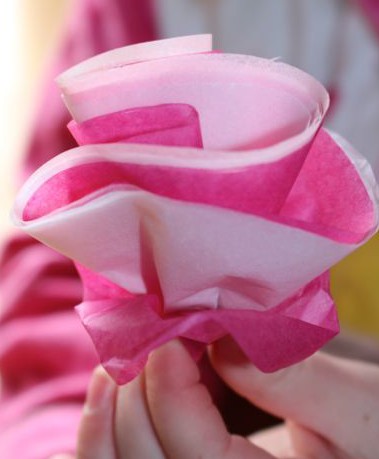
The stems are half a green pipe cleaner (chenille stick). I poked the end of the pipe cleaner through the centre of the stack of tissue paper. I twisted the end of the pipe cleaner to keep it in place. Then A pushed and folded the tissue paper into a flower shape, upwards and away from the pipe cleaner stem. She twisted the base of the flower, and used sticky tape to attach it to the stem, and to keep it scrunched up in shape. We rearranged the petals of each flower to show off the different colours, and create a layered effect, like that seen on real roses.

Shaping a rose.

Shaping a rose.

Once we had a bunch of these roses, A used a cardboard roll as a makeshift vase. They look lovely sitting in the centre of our table.

Two of our roses.

Two of our roses.

Roses in a makeshift vase.

Roses in a makeshift vase.

Button Photo Frame

Standard

IMG_1507

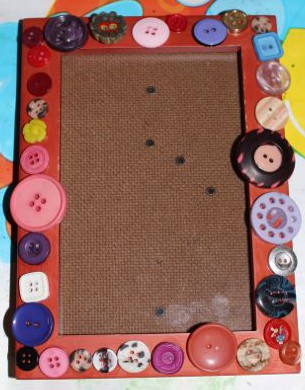
The photo frame.

The photo frame.

Last week I picked up a cheap wooden photo frame from the local second hand shop. It was very plain, but in good condition. A jazzed it up for me using a selection of buttons from our button jar.

A spread all the buttons out on the table so that she could select the ones she wanted to use. In order to stick to the frame, the buttons needed to have a flat back. Then she added some glue and started sticking buttons all around the frame.

Gluing on buttons.

Gluing on buttons.

Once it was dry we put a photo of the kids with their great grandmother into the frame, and it is sitting on our dining table.

Cardboard Roll Sheep

Standard

A loves sheep, and spends a lot of time playing with her sheep figurines. She also likes to draw and make sheep. This sheep was made with a cardboard roll and some cotton balls.

IMG_1500

Matchstick legs.

Matchstick legs.

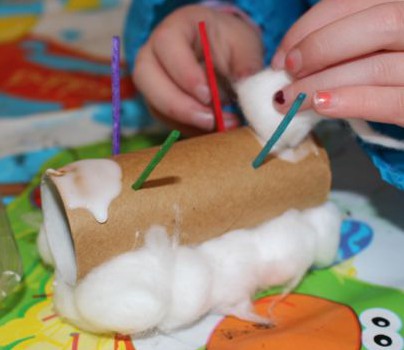
We added legs to the cardboard roll first. I made some small holes and A poked a coloured matchstick into each one. Then she got to gluing on the wool, which was lots of cotton balls. She added so many cotton balls that the sheep became a little heavy for its legs! Next time I think we might need to use popsticks or something else a little sturdier for legs. Either that, or we make the sheep less woolly.

Adding wool.

Adding wool.

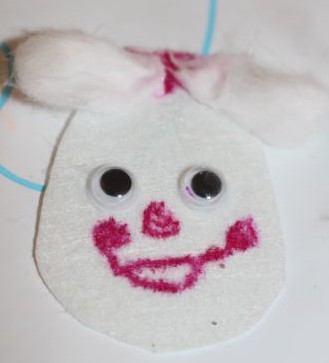
For the face, we used a piece of white felt. A decorated it with a mouth and nose and some googly eyes. She used a little bit of the cotton wool to make two droopy ears, and glued them to the top of the the head. Then she used some craft glue to stick the face to the body, and she had her sheep.

The sheep's head.

The sheep’s head.

A insisted it was just a baby lamb, but I think it looked more like a sheep that hadn’t been shorn for about three years!

A very woolly sheep.

A very woolly sheep.

Treasure Bottle

Standard
The shaken bottle.

The shaken bottle.

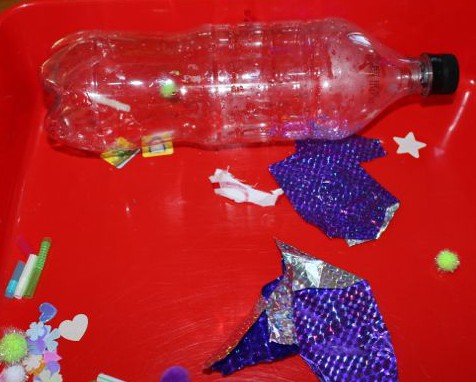
One of the preschool classes at school made some pirate treasure bottles as part of their pirate theme. A was intrigued by the treasure bottles, and wanted to make one at home. The bottle contained a variety of items, including sand, coloured water, glitter, beads, pebbles and other crafty materials.

The bottle and some of the treasures.

The bottle and some of the treasures.

We used a clear plastic bottle to place our treasures in. Some of the treasures included plastic beads, coloured plastic, sparkly pom poms, cut up plastic straws, some broken loom bands, and lots and lots of glitter. The kids took turns adding treasures to the bottle, then I used a funnel to add silver and gold glitter. Once all our treasures were in the bottle, I filled it with water and tightened the lid. For bottle crafts like this, I normally add glue to the thread of the lid before screwing it back on too, so that the lid doesn’t accidentally come off and result in a huge mess.

Tipping the bottle upside down.

Tipping the bottle upside down.

Watching the contents settle.

Watching the contents settle.


The kids squeezed the bottle, tipped it upside down, and shook it. They watched to see what sank and what floated. They watched as the contents settled and swirled. They were mesmerised.

Shell Photo Frames

Standard
L's frame.

L’s frame.

IMG_1453

A’s frame.


It’s nice to have photos displayed around our home, but most of our frames are a little boring. I picked up some plain wooden photo frames in Bunnings that we could decorate any way we pleased. We made them into shell frames.

Painting the frame white.

Painting the frame white.

First we gave the frames an undercoat of white acrylic paint. Both L and A got white paint everywhere, so I was glad we had the muck mat down. Painting the frames wasn’t vital, but I thought it would look better than the plain wood.

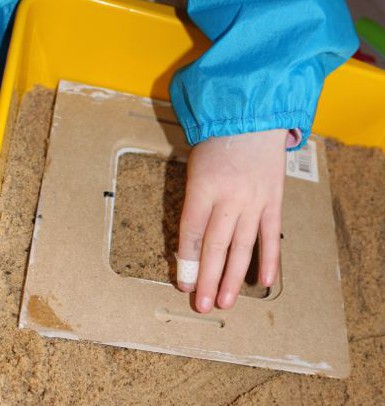
Pressing the gluey frame into the sand.

Pressing the gluey frame into the sand.

Once the paint was dry, the kids painted on a thick layer of PVC glue all over the front of the frame. I had placed some clean sand (sandpit sand from Bunnings) into a tray big enough for the frames to be placed face-down into the sand. The kids took turns to put their glue-covered frames into the sand. Just pressing the frame down into the sand was quite effective at getting the sand to stick to the glue. There was the occasional patch that didn’t have sand, but the kids just added a bit more glue and then sprinkled sand onto these places, and pressed the sand down.

Adding glue to a shell.

Adding glue to a shell.

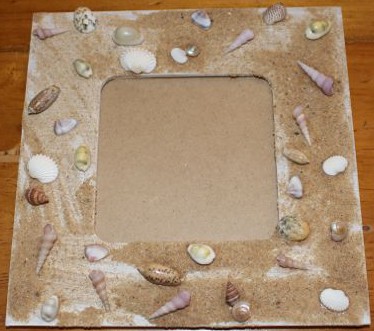
We left the sandy frames to dry for long time (due to damp weather), and then we shook off any excess sand that wasn’t stuck down. Now we used PVC glue to add some small sea shells to the frames.  A put all of her shells together in one corner. She used so much glue to place her shells, it took several days to dry completely. L placed just a few shells down two sides, while I added shells randomly all over the frame I decorated.

Sticking shells down.

Sticking shells down.

These frames look very impressive, and they were fun to make. They will look even better once we get photos into them!

My shell frame.

My shell frame.


Cloth Wipes Dispenser

Standard

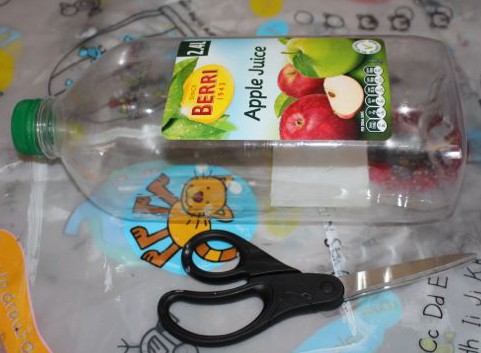
We have used cloth nappies and cloth wipes with all of our children. We keep a shelf of cloth wipes above the change table for nappy changes, and we also keep a pile in the bathroom. I normally sit them on the edge of the bath, but now Baby T is so mobile, he keeps toddling into the bathroom and knocking the wipes into the bathtub. I really needed something to keep them out of his reach, so I had a go at making my own cloth wipes dispenser out of a juice bottle.

Juice bottle washed and  ready for cutting.

Juice bottle washed and ready for cutting.

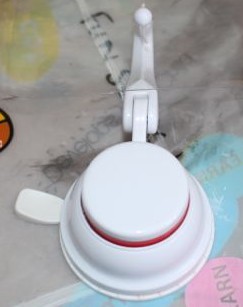
The hook.

The hook.

I washed the bottle and let it dry completely before cutting off the top of the bottle. I used the sharp point of a knife to pierce the plastic, and then used the scissors to cut where I needed to. I also cut a slot out near the base of the bottle where the wipes could be pulled out of.

The slot at the base of the dispenser.

The slot at the base of the dispenser.

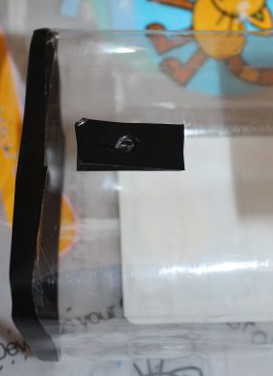
They edges of the cut plastic were a bit sharp, so I covered them with electrical tape to prevent us from getting cut when removing the wipes or re-filling the dispenser. The kids helped me place the tape on the bottle.

The edges smoothed under electrical tape.

The edges smoothed under electrical tape.

To hang the dispenser up, I used a big suction cup hook suitable for bathroom usage. I made a hole big enough for the hook in the back of the bottle, and then used some electrical tape to smooth the edges of the hole. I placed the hook through the hole and then it was ready to hang up. I find that the suction cup hooks tend to un-suction themselves fairly regularly no matter how clean and dry the surfaces are when placing the suction cup. It’s a bit annoying, but I didn’t have any other hooks to use, so this will do until I can replace it with something more permanent. Every time I go into the the bathroom I push the suction cup back down to help it suctioned.

Now our cloth wipes are out of Baby T’s reach, and the kids can still reach them from the toilet, it nice and easy to access the wipes, and I no longer have to pick them up out of them tub everyday. Having a cloth wipes dispenser in the bathroom has been very handy.

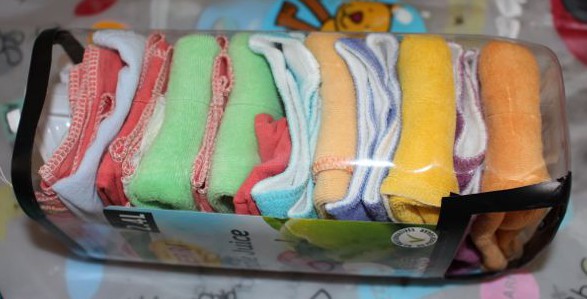
Full of cloth wipes ready for hanging.

Full of cloth wipes ready for hanging.

Hanging in the bathroom.

Hanging in the bathroom.

Sailboat

Standard

A few weeks back Big L brought home some Mexican take away, and the quesadillas came in these wonderful cardboard containers, lined with foil, so no food had touched the cardboard. I immediately saw a boat in these containers, and put them away in the craft box for another day.

The base of the take away container.

The base of the take away container.

A and I pulled them out during the week and removed the lid from one of the containers and turned the base into a sailboat.

Placing the mast.

Placing the mast.

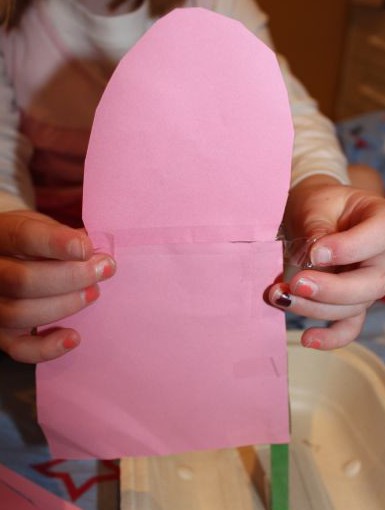
A joined two pop-sticks together end to end to form a mast. I made a small hole in the base of the cardboard boat to insert the mast. A then used tape to secure the mast to the base. She cut out some pink paper for her sail and taped it to the mast. I had been thinking we would just cut one of the paper squares in half diagonally to make a triangular sail, but A had other ideas, and made her own unique sail from two pieces of pink paper.

Adding the sail.

Adding the sail.

Taping on some water.

Taping on some water.

Around the outside of the base we added a layer of blue tissue paper as water for the boat to sail on.

Once her boat was finished, A put one of her dolls and a small teddy into the sailboat and took them for a ride.

Teddy and dolly ready for sailing.

Teddy and dolly ready for sailing.

Woollen Dryer Balls

Standard

With three kids, one of which is in cloth nappies, we have a lot of laundry to do pretty much every day. We try to hang our washing out on the line as much as possible, but when it is cold and wet, we sometimes have to resort to using the dryer. Some time ago I purchased some blue plastic dryer balls. These spiky balls are supposed to reduce drying time in the dryer, as well as reduce static. I think they work, but they clunk in the dryer, and they can be quite loud.

I have seen woolen dryer balls that are also supposed to reduce dryer time and static, but I never got around to purchasing any. When I discovered that these woolen dryer balls were really just big balls of wool that had been felted, I knew I had to try to make my own.

The wool.

The wool.

I bought some 100% wool yarn from Lincraft, making sure it was not machine washable (it won’t felt if it is designed to be washed in the washing machine!) Then I proceeded to make my ball. I started off by winding the wool around two of my fingers a dozen or so times, removing it from fingers, and wrapping more wool around this, perpendicular to the first strands. I continued wrapping the wool around and around, forming a small ball. The blue plastic balls we have are about the size of a baseball or tennis ball, so I kept wrapping the wool around until my ball was about this size. Using a big tapestry needle, I darned the end of the wool under a few layers of wool, and then poked the needle through the ball to the opposite side, pulling it through, and clipping off any remaining wool close to the ball.
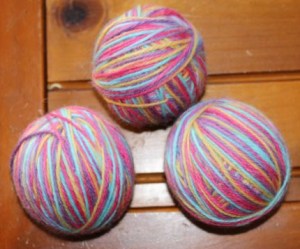
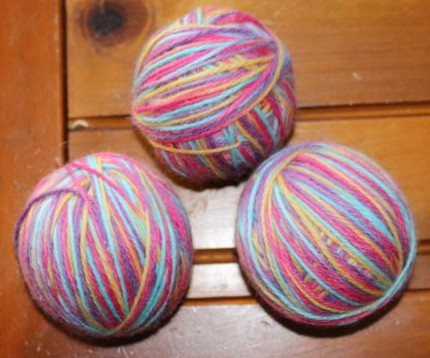
Some of the woolen balls before felting.

Some of the woolen balls before felting.

Some of the dryer balls in old socks.

Some of the dryer balls in old socks.

Felting wool requires water and heat, which is why accidentally placing a damp or wet woollen jumper in the dryer can shrink it and ruin it, as the fibres become felted together. To felt the balls, I placed them into some old odd socks I had lying around, one at a time. I placed hairbands around the sock to close it so that the woolen ball couldn’t come out in the wash. I threw them in the washing machine with some towels and did a hot wash, then they went into the dryer on the hot setting with the towels. This needs to be repeated a few times, until the strands of wool can’t be separated from one another on the outside of the ball. I just waited until I needed to wash towels or sheets and put them through the dryer until the balls were felted enough. I think my first lot of balls went through this process five times before I was happy with them.

This ball has been through the felting process twice, and still needs some more work.

This ball has been through the felting process twice, and still needs some more work.

Each load of washing that goes into the dryer needs around four to six balls to effectively reduce the drying time, more balls are better, especially if you have a large capacity dryer with full loads. I found that I could make three dryer balls from two balls of the Cosy Wool from Lincraft, which were 8 ply 100g balls. So four balls of this wool was enough to give  me six dryer balls for my dryer.

My first lot of finished dryer balls.

My first lot of finished dryer balls.

When it rained last week, I was able to try out my new dryer balls. I was very happy that the clothes didn’t take as long to dry as previously and the woolen balls didn’t clatter about in the dryer like the plastic ones. They will help me reduce our electricity consumption, save me time, and they look pretty! My cat thinks they make good toys to chase down the hall too 🙂

I’m so happy with my new woollen dryer balls, I think we will make some more sets as Christmas presents for some of our family members.

Hair Clips

Standard

IMG_0961Both L and A have had numerous hair clips in their short lives, bought from a range of places, and we still never seem to have enough. They get lost, hidden in drawers or used on the teddies so that when they are actually wanted for hair we can’t find them. I even made them clip keepers to store them on, yet they still go missing. I’d been thinking about trying to make my own hair clips for a while now, and this is my first effort.

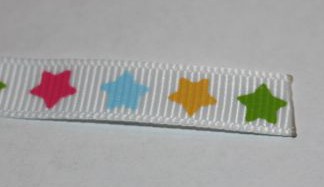
I bought the supplies for making hair clips online from Think Bowtique. They have a huge range of hair accessory making supplies and ribbon, and I found everything I needed there. Most of the ribbons came from Think Bowtique, except the owl and pink flower ones, which I picked up in Big W.

IMG_0951

Heat set end.

Heat set end.

Starting the clip.

Starting the clip.

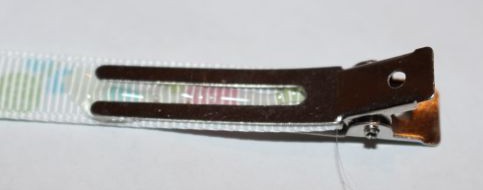
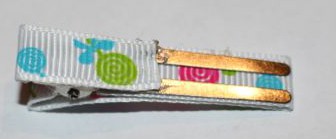
I used 9mm grosgrain ribbons, which I cut into lengths of about 12cm, and then heat sealed the ends in a candle flame so that they wouldn’t fray. I used hot glue to secure the ribbon to the alligator clips, first on the underside of the top, starting as close to the hinge as I could. Then I folded the ribbon onto the top of the clip,  went around the end, and finished up about mid-way down the underside of the clip. I had to work fast as the hot glue dries quickly, so a few of the ribbons weren’t quite straight. For my first try though, I’m pretty happy with how it went, and I know I will get better with practice.

The underside of a finished clip.

The underside of a finished clip.

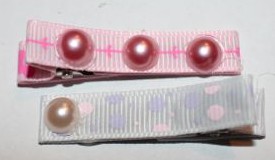
I added some little buttons and some half-pearls to a few of the clips to see what they would look like. I was happy with the result, and L and A both really liked them. Next time, I will try some other combinations of decorations added to the basic clips.

Clips with button.

Clips with button.

Clips with half pearls.

Clips with half pearls.


Clip with non-stick strip.

Clip with non-stick strip.


To help the clips stay in the kids’ hair I added some little non-slip rectangles that I also bought at Think Bowtique. They were very easy to add to the inside of the clip, and really help to keep the clips in place. A has quite fine hair, and one of these clips stayed in her hair all day yesterday, even through a trip to the playground and running around the yard.

A with the first starry clip. in her hair.

A with the first starry clip. in her hair.

A very helpfully watched while I made these clips, and asked many questions, most notably “What are you doing now?”. She picked out which ribbons to use, and the buttons, and she modeled the clips for me.

Now that I see that I am capable of making basic hair clips myself, I think I will do some experimentation with different ribbons and embellishments. I think I will also make some in school colours for the kids to wear to school. There are so many possibilities, and all of them are fun!


Button Hair Bands

Standard

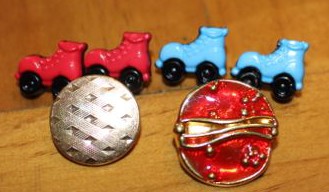
IMG_0943IMG_0936A found some cute buttons in our button collection, including some really cool roller skate buttons. She wanted to wear them in her hair, so we had a go at making them into hair bands.

IMG_0938

Button loops.

The roller skate buttons had reasonably large loops on the back, so it was easy to pass the folded hairband through the loop. The other buttons had smaller loops, so I had to find some little bands, and it was more fiddly to get the band through.

Band through the button loop.

Band through the button loop.

Bands tied through the loops.

Bands tied through the loops.

Once the band was through, I looped one end through the other and tightened the band. I also added a spot of hot glue to the bands on the back of the each button so that the band was held in place.

A was very pleased with her new hair bands, and immediately wanted one in her hair.

A's new hair band in her hair.

A’s new hair band in her hair.