Category Archives: Nature

Bees in Loretta’s Bonnet by Lois Wickstrom

Standard

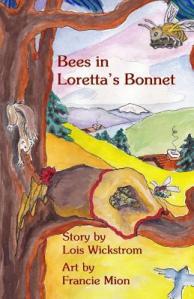
beeslorettaBees in Loretta’s Bonnet by Lois Wickstrom and illustrated by Francie Mion, picture e-book, 34 pages, published in 2016.

While bringing in wood from the woodpile during winter, Loretta finds a leafcutter bee’s nest. She puts the nest back in the woodpile and watches it to see what happens when spring arrives.

Bees in Loretta’s Bonnet blends facts and fiction into a delightful and educational picture book. Information about leafcutter bees is integrated subtlety; the kids won’t even know they are learning about nature! The story is easy to read and the text is clear. Quaint illustrations feature throughout the book.

At the end of the book there are instructions for making a home for solitary bees, such as the leafcutter, to encourage them into your garden. This looks like an easy and fun activity for kids, as well as something that will help your garden flourish.

Suitable for primary school children, Bees in Loretta’s Bonnet makes for lovely shared reading time.


*I received this book from the author as a digital copy in exchange for an honest review. I did not receive any other remuneration, and the review is composed entirely of my own opinions.
D is for Dudley & Other Nature Tales by Ron Chandler

Standard

dudleycoverD is for Dudley & Other Nature Tales by Ron Chandler, paperback, 74 pages, published in 2015.

D is for Dudley & Other Nature Tales is a collection of short stories, mostly about animals and the environment.

The first couple of stories in the book were too short and lacked substance. This didn’t bode well for the rest of the book, but I continued hoping to find that the other stories were better. There wasn’t one I liked much until about half way through the book, with the title story, “D is for Dudley”. It was a little unbelievable, I would definitely be suspicious if my kids volunteered to do the washing!, but I liked the theme. Striving to protect the environment and animals it contains, is quite noble, and these kids do their best to save the extremely large terrapin from hunters within the bay.

The best story in this collection was by far “Chicken Feathers”. It is the story of a young girl who grooms a rooster for the county fair. She is competing against her much older and more experienced neighbour. Despite her young age, she believes in her ability to win, and even when her rooster is looking scraggly, she doesn’t lose heart, she tries even harder to get him in shape. This is a lovely lesson showing that determination and persistence are often rewarded. The only downside to this tale is a slight undertone of racism.

It states in the blurb on the back of the book that the stories “celebrate nature”, but these stories don’t so much do that as they do showcase humanity’s depravities. Throughout the book there were people behaving badly. There were alcoholic parents, bickering couples, dog fighters, hunters, and animal abusers. I found most of the stories to be very depressing and often distasteful. One story made an offhand comment about a twelve year old girl skipping meals to stay skinny. This is not only awful and inappropriate, it also had no relevance to the story. In another tale a boy looked a girl over from her toes to her shoulders in an appreciative way. Again, this was an unnecessary addition to the story, and it’s quite sexist, it’s as if she had no face. There are also girls being told that they will want to dress up and go to balls, instead of doing “tomboy” things. I found there to be a sexist vibe throughout the book, which was disappointing. I also felt that hunting for sport, which is something I’m opposed to, was condoned as a suitable activity for kids.

This book is aimed at kids aged 8 to 12, but I really can’t recommend it to anyone. Even aside from the sexism throughout the book, most of the stories weren’t particularly good. They all lacked description and depth, and sometimes even a clear direction. Since I was expecting a book full of the gloriousness that is nature, I found this to be very disappointing indeed.


*I received this book from the author, who asked me for an honest review of this book. I did not receive any other remuneration, and the review is composed entirely of my own opinions.

Weeds in Nana’s Garden by Kathryn Harrison

Standard

weedsinnanasgardencoverWeeds in Nana’s Garden by Kathryn Harrison, picture book, published by Flipturn Publishing in 2016.

Nana’s garden is a special place, full of blooms, lush greenery and fairies. A young girl enjoys time with her Nana in the garden throughout the year, until one summer she discovers weeds choking the garden beds. She has never seen weeds like that in Nana’s garden, and she doesn’t know how or why her Nana would let the garden get like that. Her mother explains that Nana has Alzheimer’s Disease, and her brain is developing more and more tangles that make it hard for her to think and remember, a bit like how the weeds in the garden were making it hard for the plants to grow properly.

Weeds in Nana’s Garden is a lovely picture book designed to help explain Alzheimer’s Disease and other dementias to young children through a garden analogy. The weeds in the garden are like the tangles growing in Nana’s mind, causing her confusion, frustration and forgetfulness. It is sad to experience a loved one being claimed by dementia, and it can be very difficult to explain the process to children. This book will make it much easier for children to understand what is happening.

Each page is executed with colourful illustrations. Can you find the cat and fairies in each picture? The text is simple and easy to read, and the story is not too long. It is well written for the intended audience.

I think this book would be an excellent resource for families dealing with the onset of dementia in their loved ones. There is a question and answer section at the back that answers some of the common questions that children might ask. This will help parents to explain this disease in simple terms to their children.

Weeds in Nana’s Garden is suitable for preschoolers to primary school children. Sales of this book will also help the Alzheimer Society of Canada, with $1.00 from each book sold being donated to them.


*I received this book as a digital copy from the author, who asked me for an honest review of this book. I did not receive any other remuneration, and the review is composed entirely of my own opinions.


Gum Leaf Bookmarks

Standard

Every house seems to have a sock-eating monster, but I think our resident sock-eating monster has a mate that only likes to eat bookmarks! It’s the only possible explanation 🙂 We like making bookmarks, and we even have a special holder for them, yet every time I want a bookmark, they all seem to be MIA. So here we go, making more bookmarks!

A and I collected some large, dry gum leaves from under some of the the big gums nearby. We looked for reasonably flat and undamaged leaves. A found a very pretty pinkish leaf that she liked.

IMG_6152We used permanent metallic markers to write messages on the leaves. The girls worte “Merry Christmas” on many of the leaves, and then signed their names, so that these bookmarks could be given to their teachers as part of their end of year presents.

We had to wait for the metallic ink to dry completely before laminating the leaves. I managed to get about three leaves to each laminating pouch. After the laminating was done I carefully cut around the leaves, making sure to leave a border of sealed laminate around each one.

These unique bookmarks were quick and simple. They were well received by the teachers too.

IMG_6154

Island Cupcake Tower

Standard

IMG_5701Recently we held a birthday party with a beach theme. As the centrepiece of the food table, I made cupcakes to place on my cupcake stand. My stand has three levels for holding cupcakes, plus a place for one right at the top. I used this design to make the cupcake stand into an island cupcake tower.

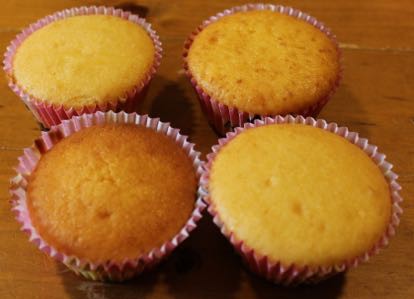
Freshly baked cupcakes.

Freshly baked cupcakes.

First, we baked the cupcakes using a basic butter cake mix. A helped me set out the paper cases (she chose ones with Disney Fairies on them!), and spoon the mixture into the cases. We only filled each one about half way so that they didn’t rise too much.

Once the cupcakes were completely cool, A and I divided the cupcakes into piles for each level on the stand. The lowest level held the most cupcakes, and was to represent the water of our island. A helped me mix up the butter (vienna) cream to ice them. I like to use a simple recipe for butter cream that I found on Taste.com. We added some blue food colouring to the butter cream until it was the blue we wanted, and then we generously covered the cupcakes with it. We used the flat edge of a knife to create the “waves” by tapping the top of each iced cupcake, pulling some of the butter cream up in peaks.

A sea cupcake.

A sea cupcake.

Adding coconut to the top of the cupcake.

Adding coconut to the top of the cupcake.

We made a second batch of butter cream, this time colouring it yellow for our layer of sand cupcakes. We had previously coloured coconut to use as the sand on these cupcakes. We covered each cupcake with butter cream, and then dipped them into the yellow coconut until the tops were completely covered. I made the butter cream thick on these cupcakes to help hold the plastic toy palm trees we then placed on each one.

Beach cupcake.

Beach cupcake.

Grassy cupcake.

Grassy cupcake.

The final layer of cupcakes was to be the heart of the island, with green butter cream and green coconut for the grass. Again, we applied the butter cream generously to help secure the plastic ferns we added for foliage. These cupcakes were the pinnacle of the cupcake stand. The cupcake on the very top was the centre of the island, which sloped down to the sea at the bottom. I think it looked quite effective on the table!

Island cupcakes.

Island cupcakes.

Power’s Out by Rachel Meehan

Standard

Water's EdgePower’s Out by Rachel Meehan, e-book, 223 pages, published by Cherry House Publishing in 2013.

Two years on from when Paul and Nairne leave the Grear farm behind in Water’s Edge, sees them traveling the countryside with Dog, staying away from the towns and trying to survive. Civilisation is crumbling, bandits control the roadways and the city streets, and there is a dwindling number of people to trust. When they stumble across a self-sufficient community residing in an abandoned convent, they are taken in and given shelter in exchange for Nairne’s assistance with their wind turbines. The community consists of about thirty people working together to survive, including some young people similar in age to Paul and Nairne. This could become home for the pair, ending their wanderings. Nothing is that simple though. Danger is present as they set out to help the community acquire much needed parts and supplies, which means venturing far beyond the safety of the convent’s walls. Their past is also creeping closer, but will it catch them at last?

The second book of the Troubled Times series, Power’s Out, was fast-paced and exciting. With lots of action, it is an exhilarating ride of survival. There was much more explicit violence in this story than its predecessor, which helps to illustrate how civilisation has fallen back to more instinctual behaviours as the world around it falls apart. When the constraints of society fall away and there are no longer any policing bodies to enforce laws, there is violence for gain, and violence for enjoyment. This is a terrifying insight into base human nature, but one which I think is rather accurate. There are plenty of unscrupulous people taking advantage of others in stable communities, but when there is no one to enforce the law, or those enforcers are corrupt, there arises the opportunity for these behaviours to increase. And that’s what we see in Power’s Out. The scenes of violence are vivid and scary, but the people behind the violence are even scarier!

It is easy to step into the Scottish landscape portrayed in this book, and follow along with Nairne and Paul, experiencing what they experience. All of the characters are richly described and developed, allowing the reader to get to know them. With the introduction of more characters from the community, different aspects of Nairne’s and Paul’s characters become evident. Paul and Nairne have become extremely close during their traveling and it is hard to let others in, though they are each tempted by a young member of the community. There are a lot more characters to get to know too. Suddenly Nairne and Paul don’t just have each other to rely on and interact with, they have to cope with others, most of whom do not realise how dire their situation really is. I liked Ronnie a lot. He’s a bit of a clown, but he is also loyal and caring. Iain, I didn’t like as much, he was a prig, but I think most of that came from being jealous of Paul and Isobel. She seemed a bit oblivious to how Iain felt about her, but perhaps she just didn’t want to acknowledge his feelings. She certainly took to Paul, and was likable as a character. I particularly liked Isobel’s father, Jack. He was sensible, kind, intelligent, and fair. He was also very accepting of Paul and Nairne, and was ready to learn from them and to be assisted by them, an attitude that not everyone in the community shared. The older members of the community, including their leader, Arthur, for the most part, were a bit naive, believing that things could continue as they were indefinitely, that they would be left untouched by the outside world.

The end of Power’s Out was very intense. I felt quite anxious as I read the last few chapters, wondering if Nairne and Paul would make it through, if the community would survive, and how things would play out. It left me feeling rather desperate to read the final installment of this wonderful trilogy!

Power’s Out is suitable for high school students through to adults. It contains violence and some bad language. The themes of societal breakdown and environmental disaster could be frightening for less mature readers.


*I received this book as a digital copy from the author, who asked me for an honest review of this book. I did not receive any other remuneration, and the review is composed entirely of my own opinions.

Pinecone Bird Feeder

Standard
Items we used.

Items we used.

A came across this idea in one of her kindergarten readers and begged for us to try it out at home!

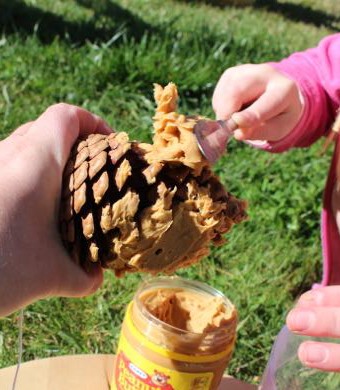
Coating the pinecone with peanut butter.

Coating the pinecone with peanut butter.

We tied a piece of string to the pinecone so that it could be hung up in a tree when we were finished, and then I helped A to cover the pinecone in peanut butter. This was a little messy, but A didn’t get nearly as much peanut butter on herself as I had thought she would.

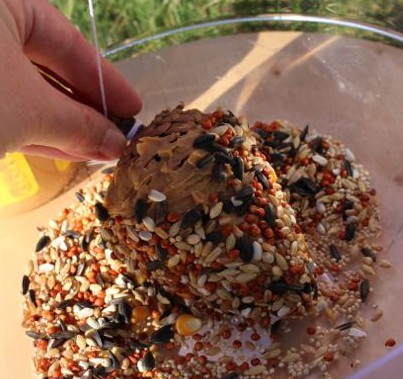
Rolling the pinecone in birdseed.

Rolling the pinecone in birdseed.

Then A rolled the pinecone in a bowl of birdseed. We used a basic parrot mix because most of the birds that hang about in our yard are parrots such as cockatoos and galahs. A pressed as much seed into the sticky peanut butter as she could, completely covering the pinecone. When the pinecone could hold no more seed, we took it into the yard and hung it up in a large bottlebrush tree.

Making sure the whole pinecone was covered.

Making sure the whole pinecone was covered.

And now we wait for the birds to come and have a feast.

Our new bird feeder hanging in a tree.

Our new bird feeder hanging in a tree.

Wild Discoveries Wacky New Animals by Heather L. Montgomery

Standard

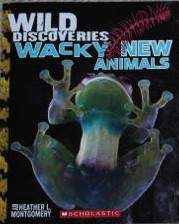
IMG_3949Wild Discoveries Wacky New Animals by Heather L. Montgomery, paperback non-fiction, published by Scholastic Inc. in 2013.

There are still millions of undiscovered species all over the world. This book showcases just a few of the most interesting creatures discovered recently, including a leech with large teeth, a frog with translucent skin and green bones, a blue earthworm, a tiny seahorse and a stick insect as long as your arm!

Wild Discoveries Wacky New Animals is an interesting read. Each page contains plenty of facts about each creature, including its scientific name, size, role and where it was discovered. There are also plenty of colour photographs depicting the animals and their various traits. There is a glossary of terms at the back of the book and a small section on kids discovering new animals.

An enticing non-fiction book for primary school children, Wild Discoveries Wacky New Animals would appeal to nature and animal lovers along with those interested in more unusual (or gross) fare. I cannot un-see the “snot flower” or the Atewa Hooded Spider, but I can refocus on the cute little Siau Island Tarsier! My third grader found this book fascinating, and is now looking into more wacky and strange animals.

Creating a Terrarium

Standard

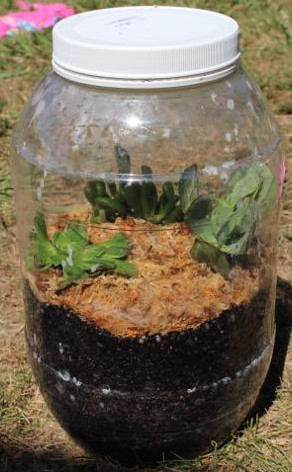
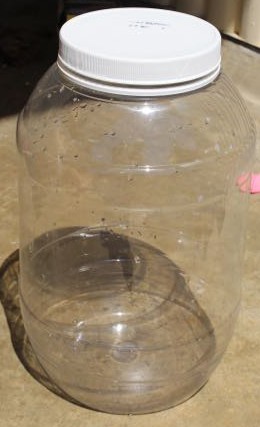
IMG_4033Terrariums can be lovely mini gardens, perfect for sitting on the table and brightening up the house. Any clear container can be used for a terrarium, but it’s nice to find an unusual shape. We started with a big plastic tub that used to hold mini-pretzels.

Our plastic container.

Our plastic container.

The kids collected some gravel from our front garden beds to place in the bottom of the container for drainage. You can buy decorative pebbles or gravel for this. Using different coloured materials will create a pretty layering effect on the side of the terrarium. We just used what we had available to reduce costs.

Adding gravel.

Adding gravel.

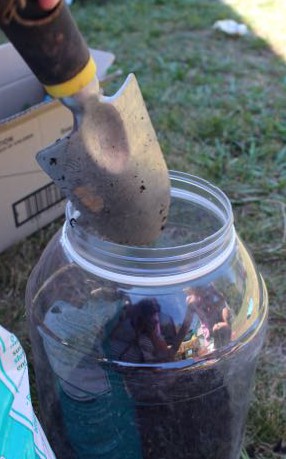
As we wanted to plant succulents into our terrarium we did buy proper cacti and succulent potting mix. We used this to fill the container up to about half-way. Both L and A had a go at putting the potting mix into the container, but quite a lot of it got spilt! Once the dirt was in, we tapped the container down gentled to help the soil settle.

Then it was time to add the plants. We used three small succulents, which the kids chose from Bunnings. I removed some leaves from each of the plants to use for propagating new succulents before I planted them in the terrarium. I carefully placed each succulent roughly equidistant around the container, patting the soil down gently and then watering them in.  We added moist sphagnum moss as the top layer, carefully placing it around the plants, but not too close to the stems to avoid rot. This will help to retain moisture. Alternately we could have used small pebbles or rocks to finish off (we already had the moss for our carnivorous plants).

Getting the potting mix in the container.

Getting the potting mix in the container.

The succulents we chose are all different shades of green. Choosing plants with different coloured foliage can increase the aesthetics of the terrarium, and of course, there are many plants that do well in terariums aside from succulents. I think our next one will have to contain some ferns.

When the lid to the container is placed on the top, the moisture is trapped inside the terrarium, causing condensation on the plastic. This keeps the terrarium moist without watering very often, though it also obscures the plants. The plants have everything they need within the closed terrarium, but if it is too wet inside, you can remove the lid for a day or two or as long as needed. Or you can leave your terrarium open if you prefer, and treat it more like your average indoor plant.

Looking from above.


UPDATE 19/3/15: L dropped the terrarium! Luckily the container is plastic, so it bounced, but one of the plants catapulted right out the top (I had the lid off allowing the soil to dry a bit), along with a good chunk of the moss. So the poor plant lost all but two of its leaves. We have replanted it in the hopes that succulents are so hardy it will survive, but it looks a little sad at the moment. I have just left the soil bare and the lid off as the weather is beginning to cool a little and is more humid, so it is less likely to dry out too much. L felt so bad about dropping the terrarium, but these things happen! The other two plants are doing very well and we are seeing new growth.

Freaky Phobias by Joel Levy

Standard

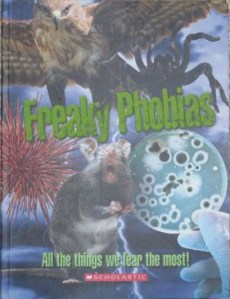
IMG_2519Freaky Phobias by Joel Levy, paperback non-fiction, 80 pages, published by Scholastic Australia in 2011.

This book is a fascinating insight into a range of phobias. It covers the most common ones, such as arachnophobia and claustrophobia, alongside some extremely unusual phobias. I never knew there was a word for the fear of otters or knees or kissing, but there is! And there are many other phobias that I had never considered, but discovered in Freaky Phobias.

Freaky Phobias is an informative and interesting book for primary aged children. I learnt quite a lot whilst reading Freaky Phobias, as did my second grader. It had a good depth of information for children, and plenty of fun facts to engage the reader. The photography depicted all of the terrors contained within the book with such clarity that my second grader wanted to skip some of the pages because she felt anxious.

Freaky Phobias contains an A-Z of Phobias, providing the names and descriptions of quite a few phobias. I think this glossary could have been enhanced by including the phonetic spelling of the names, as some of them are quite long and complicated words, which I had difficulty pronouncing.

This is quite a good non-fiction title for young learners (and big ones too!)