Tag Archives: fine motor skills

Counting Pom Poms

Standard

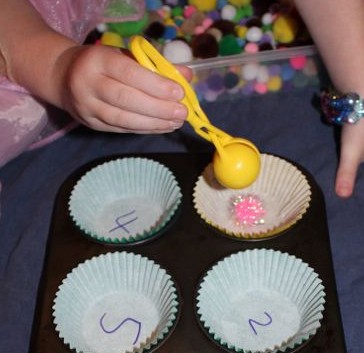
IMG_8622I wrote numbers in the inside base of twelve muffin cases (numbers 1 to 12), and placed the muffin cases into our muffin trays. Then I asked A to place the correct number of pom poms into each muffin case. She used some big plastic tweezers and some scoop tweezers to pick up the pom poms and transfer them to the muffin cases.

The muffin cases numbered and set out.

The muffin cases numbered and set out.

The plastic tweezers.

The plastic tweezers.

For each muffin case I would ask A how many she needed to put in, and she would read the number out loud. She counted each pom pom as she went, and then re-counted them at the end to make sure she had them all right. As she went, I asked her to do some basic subtraction and addition to work out how many pom poms she had to get to reach the right number.


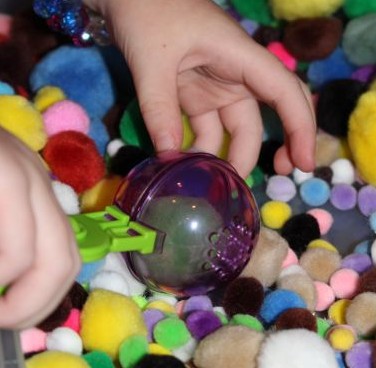
Scooping up some pom poms.

Scooping up some pom poms.

A liked practicing her numbers and it was fun using the tweezers. Some of the little pom poms were hard to pick up, and this was a good chance for her to practice her fine motor skills.

Placing a pom pom into the muffin case.

Placing a pom pom into the muffin case.

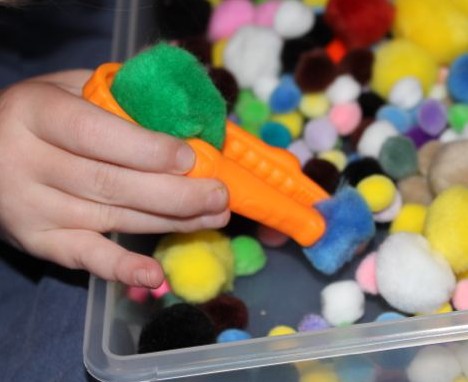
Using the tweezers to grab a pom pom.

Using the tweezers to grab a pom pom.

Spray Bottle Painting

Standard

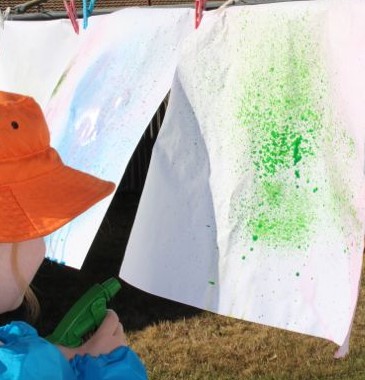
IMG_7781A few cheap spray bottles and some watered down paint made for a wonderful evening of painting in our yard.

I hung paper from the clothesline for this activity. It took the kids a little while to learn not to spray when the wind was blowing towards them, but eventually they got more paint on the paper than on themselves! They were wearing their art smocks, but they definitely required a bath after this.
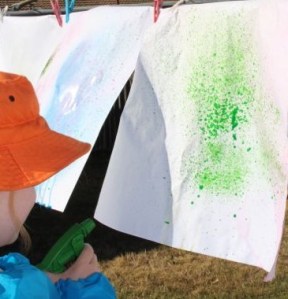
A spraying her paper.

A spraying her paper.

I had a little trouble getting the right consistency for the paint, at first some of it was too watery, and we could barely see the colour on the paper, then one of them was so thick, it wouldn’t suck up the tube. After a bit of trial and error, we got three spray bottles working just right. We also found that the darker paint colours, such as blue and green worked much better than when we tried lighter colours like yellow and orange.
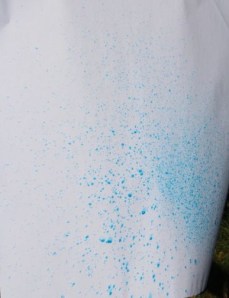
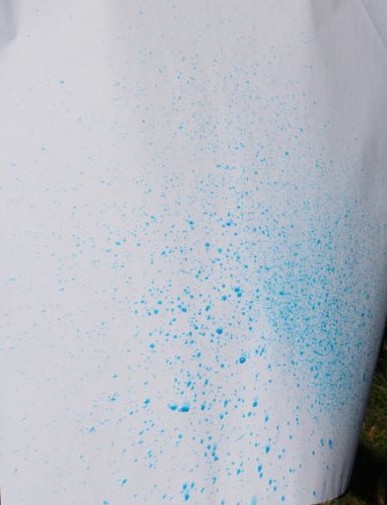
Using the spray setting.

Using the mist setting.

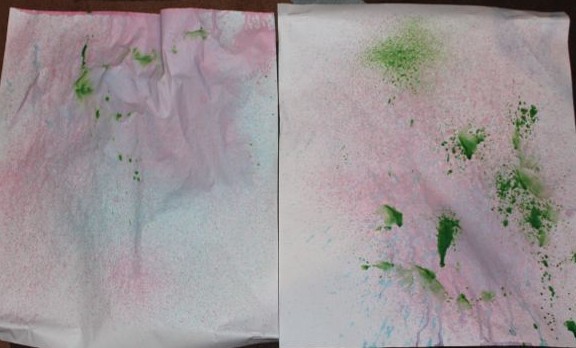
A stood on a chair to be more level with the paper hanging from the line. L was at a good height, and got started right away. First they tried using their spray bottles on the mist setting. It created some great spray patterns, though L and A both wanted to add so much paint that it began just rolling down off the paper. Squeezing the spray bottle handle to spray the paint gave their hand muscles a little workout, but them didn’t seem to mind. A sometimes used both hands to spray and steady the bottle. Accurate aiming took some practice for both of them too.
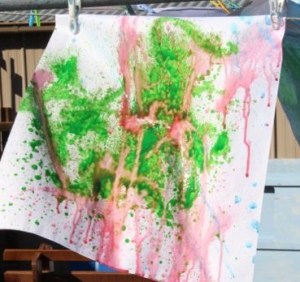
Using the jet setting on the spray bottle.

Using the jet setting on the spray bottle.

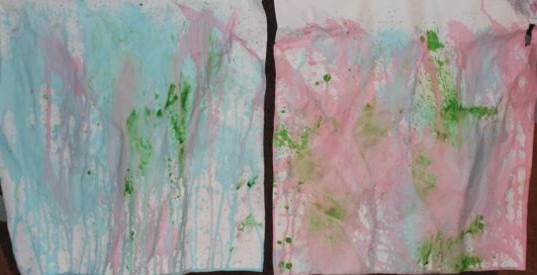
They also tried using the jet setting on the spray bottles, which sprayed the paint quite a long way. They loved the noise it made when the paint hit the paper, but they also missed the paper a number of times. Once they hit Big L in the back while he was across the yard tending the garden, but most of the missed paint sprayed onto the clothesline. After the paintings were dry and I’d removed them from the line, I hosed as much of the paint off as I could. Most of the paint came off that way, the rest just adds character to our clothesline 🙂

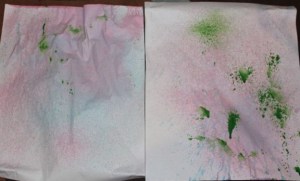
Jet setting spray painting.

Jet setting spray bottle paintings.

Spray setting spray paintings.

Mist setting spray bottle paintings.

Threading Wall Decoration

Standard

IMG_3578

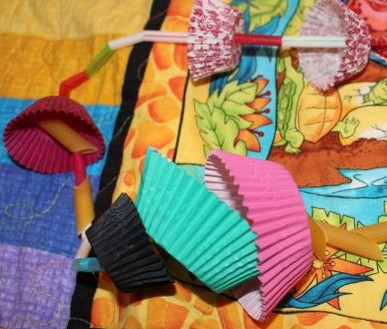
Threading a patty-pan case.

Threading a patty-pan case.

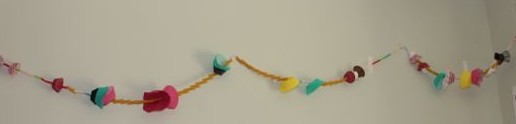
Today we gathered together some dry pasta, cut-up straws, patty pan cases in two sizes, cotton balls and some string and set to work making a wall decoration for A’s room. I had some large plastic needles that A could safely use to thread her items onto the string. A cut quite a long piece of string so that it would stretch across her wall. I tied it off at the end so that the threaded items wouldn’t fall off the end, and then she got started. She used the point of the needle to push through the patty-pan cases and the cotton wool balls. The latter were reasonably hard to get the needle through, and she required some help with this, but she liked the way they looked once they were on the string.

IMG_3570She found that the straw pieces disappeared into the pasta if they were put together, so they were best separated by the patty-pan cases or the cotton wool. She had fun counting the straw pieces and pasta as she threaded them on too.

Once she was finished, I tied the string off, and we hung it up in her room. It was too heavy for blu-tack alone, so we tied one end to the curtain rod, and the opposite end to a hook that was already on the wall, with the centre section held up with bits of blu-tack at various intervals to give it a scalloped look. It brightened up her wall, and she had fun making it.

IMG_3577


Marshmallow Sculptures

Standard
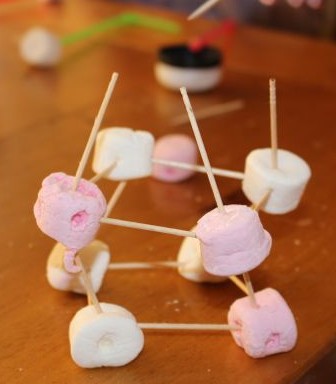
Marshmallow and straw building.

Marshmallow and straw building.

We practiced our architectural skills using marshmallows, plastic straws and toothpicks. It was lots of fun, and the kids loved eating the marshmallows once they were finished 🙂

Marshmallow and toothpick house.

Marshmallow and toothpick house.

L discovered that the toothpicks worked better than the straws, as they were shorter and stronger. She also found that using triangles as her base shape created a stronger structure that could be built up much taller than those made with squares.

After the tower building was complete, both L and A made some original sculptures using the marshmallows.  I particularly liked L’s ‘Cat doing splits’.

Making crazy sculptures.

Making crazy sculptures.

Spiky echidna.

Spiky echidna.

Cat doing splits.

Cat doing splits.

Counting with a Hole-punch

Standard

Putting holes into paper with a hole-punch is almost as much fun as cutting paper into tiny pieces with the scissors… At least according to A. Both are good for her fine motor skills and coordination. Both have the potential for a huge amount of mess, which is very appealing to her , yet not quite so appealing for me! Using the hole-punch makes less mess as long as she doesn’t open the part where the little punched out circles collect… And we can use it for a simple counting activity.

We used a single hole-punch as it is easier for A to use. I cut up some paper and wrote numbers on each piece, then asked her to punch that amount of holes into the paper. Initially I left the sections together, but quickly realised she would need the sections separated to make it easier to punch the holes around the edges of the paper. So I cut the paper into separate pieces for each number. She really liked doing this activity. She carefully counted each hole to make sure she got the right number on each section of paper.

Once A had finished with the hole-punch, L used it to make lots of holes in a piece of scrap paper, just because it is fun 🙂

IMG_2310IMG_2313IMG_2316


Beading Necklaces

Standard

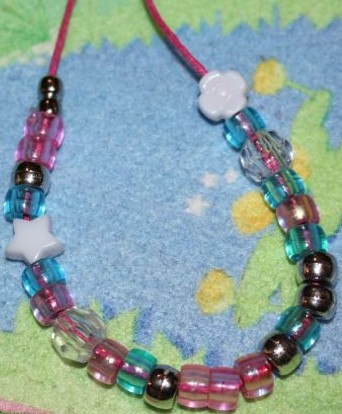
IMG_2105Since L was able to thread beads onto some elastic, she has loved making her own necklaces and bracelets. Plastic beads are readily available and reasonably cheap, and are great for beading fun with the kids. It is cheaper, and longer lasting than store-bought play jewelery, and you get all the fun of creating something for yourself with the beads you want to use. L and A use the jewelery they have made in their dress-ups, and often wear them around the house and out and about just because they like them. They have also made them as gifts for their friends.

We usually use elastic for our beading projects, as it makes it easy for the kids to put on and take off themselves. Proper clear beading elastic is the best for this, but we have used basic hat elastic too. Unfortunately, after a while, the hat elastic tends to stretch and break, which requires tying the broken section together (more knots on the necklace) or re-threading the beads.

IMG_2106This time, however, I had some pre-made non-stretchy necklace lengths with clips to do them up, I think they came from Spotlight. Only the beads with the larger holes would fit over the end of each length, but the kids didn’t mind, they threaded lots of beads onto them, and then wore them about the house. I had to help them undo and fasten the clips though, so it didn’t lend itself to independent dress-up play as much as the elastic ones we’ve made.


IMG_2109

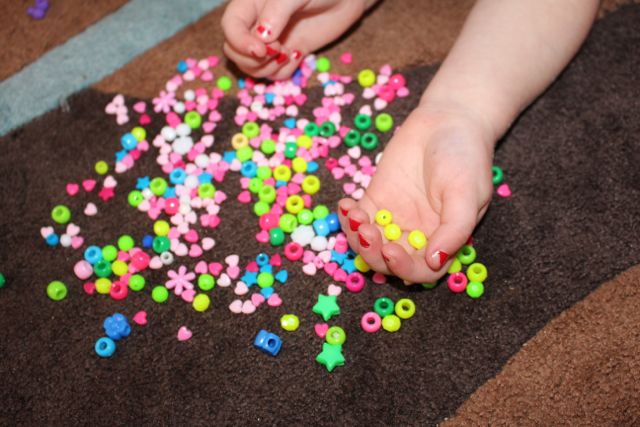
IMG_2111A also spent some time running her hands through the beads, swishing them around with her fingers, and trying to get them to stick to her hands. She liked the sensation of rolling the beads in her palms, and spreading them on the floor.

Sensory play with the beads.

Sensory play with the beads.

Sorting and Patterns with Beads

Standard

IMG_2028

A big pile of plastic beads and we were set for an hour of fun! A separated all these beads into different coloured piles. She was particularly excited about the four shades of pink she found. She also liked the fluoro yellow and fluoro green beads, though she called them “blue-ray” colours 🙂

Sorting.

Sorting.

More sorting.

More sorting.


The sorted piles.

The sorted piles.

Once she had sorted all the colours out we compared the size of each pile. She showed me the biggest piles and the smallest piles. She also counted the number of beads in the smaller piles. We talked about some of the shapes she could see too. Some of the beads were round, some heart shaped, some looked like flowers, and she even found a red butterfly.

We used the beads to practice making patterns. I set out some simple two and three colour patterns and asked A to place the next bead. She liked doing that, and then she made up some of her own patterns with the beads.

Placing the next bead in the pattern.

Placing the next bead in the pattern.

Making patterns.

Making patterns.