Category Archives: Themes

Paper Plate Aquarium

Standard

Both L and A have been fascinated by the ocean and its inhabitants for a while now. They want to read books on ocean creatures, watch ocean documentaries, do sea creature craft, and watch The Little Mermaid and Finding Nemo over and over and over…  They also want some pet fish, but we just don’t have a good place where we could keep a fish tank at the moment, not with Baby T learning to climb on everything and pull things over. We improvised instead, and made some little aquariums using paper plates to hang in their rooms.

L's aquarium.

L’s aquarium.

Painting the plate blue.

Painting the plate blue.

First, the kids painted one of the plates blue to represent the water in their aquariums. This was fairly quick, but of course, we had to wait until they were dry. While that happened, the kids started colouring in their sea creatures with markers. L only coloured in a few of her creatures, as she only wanted to make one aquarium, but as A wanted to make two, she coloured all of hers in. I found the undersea creatures to colour in on the Crayola site. There are lots of colouring pages available to print there.
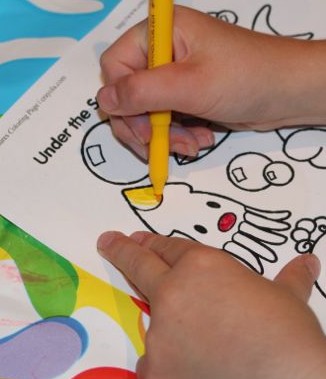
Colouring in.

Colouring in.

L cutting out her fish.

L cutting out her fish.

L only needed a little bit of help cutting her sea creatures out, but A asked me to do hers after she almost cut off the fish’s head. We used crepe paper to make sea weed, I just cut a few different green shades and some brown into strips. The kids glued some seaweed on, and then added their sea creatures. They both added some more strips of seaweed after this, making some of the animals appear to be hiding in the sea weed. This was their idea, and I love it.
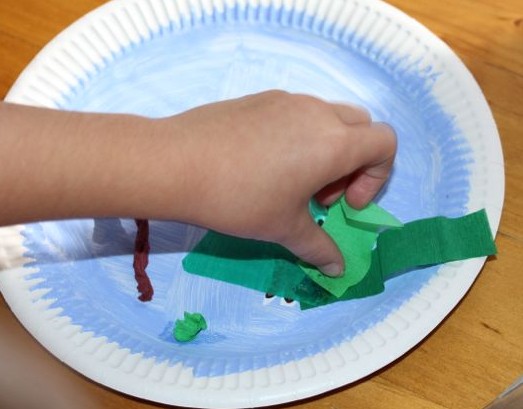
Adding sea weed.

Adding sea weed.

Gluing on sea creatures.

Gluing on sea creatures.


I made the lids for the aquariums using a second paper plate. I cut the centre out, leaving just the ridged bit around the edge. Then I taped some plastic cling wrap over the plate, creating a clear cover for the aquarium. We stuck the two paper plates together at the edges using tape, added some string to the top of each aquarium and hung them up.

A's aquariums.

A’s aquariums.

Frankfurt Octopuses

Standard

This is a fun and interesting way to serve cocktail frankfurts. A friend of mine served these at an undersea themed birthday party last year, and I just had to try them for myself.

Frankfurt octopuses.

Frankfurt octopuses.

Surprisingly easy to make, the kids often ask for their frankfurts to be made into octopuses now. I use a sharp knife to cut into each frankfurt starting from about half-way up, slicing through the bottom half length-ways. Then I turn the frankfurt around and cut it through again, so now the bottom half is in quarters lengthways. Then each quarter is cut in half again to make eight tentacles. I have found it just as easy to cut through the two opposite quarters of the frankfurt at the same time, as it is to tackle each quarter separately.

Cut up ready to cook.

Cut up ready to cook.

Cooking in the pot.

Cooking in the pot.

Once the frankfurts are cooking, either on the stove top, or in the microwave, the tentacles will start to curl up and out, giving the frankfurts an octopus look.


The kids like to have tomato sauce with their frankfurts. They dip the octopus’ tentacles into the sauce and bite them off. While they were eating, I heard a lot of “I have a four-leg octopus” and “I have a no leg octopus!”. L even exclaimed she had a “no-head octopus” after she bit the top off her frankfurt.

Frankfurt octopuses ready to eat.

Frankfurt octopuses ready to eat.


Animal Magnets

Standard
Lots of spare animal cards.

Lots of spare animal cards.

Last year Woolworths wowed all the kids with their Aussie Animal Cards to collect. And then came the baby wildlife Aussie Animal Cards just before Christmas. L and A got to collecting them, and filling up their albums, but they were left with lots of spares. When the promotion finished, we didn’t quite have the full set. Our friends were very generous in giving us their spares to try to complete our sets, and now I think we are only short one card. However, there is a huge stack of spares left, and most people we know already have a full set, and still have spares. The kids like looking through all the spares, but I thought they might be able to be put them to a better use.

I received a new laminator for Christmas, and I was keen to try it out. L picked out five of the Aussie Animal Cards, and I placed them into an A4 laminating pouch and laminated them. I cut around each card, making sure there were no pointy corners. We glued some magnets to the back of each one. We tried some of the magnets at the top of the card, and some in the centre, both worked well.

Laminating the cards.

Laminating the cards.

Adding magnets.

Adding magnets.


Once the glue was dry we put our new animal magnets onto the front of the fridge.

Lined up on our fridge.

Lined up on our fridge.

Jelly-fish

Standard

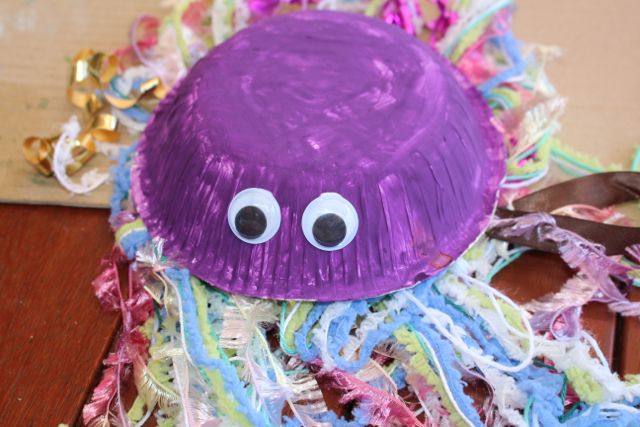
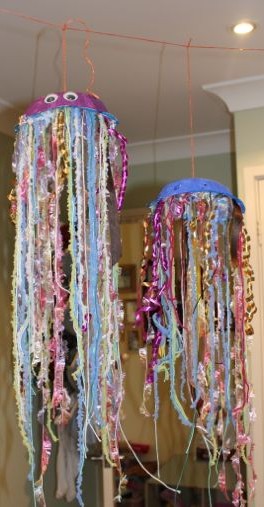
IMG_4769These wonderful jelly-fish were made using a paper bowl and scraps of various yarns, cotton, and ribbons. The ribbons were all collected from gifts we had been given for birthdays last year and were just sitting in the craft box awaiting their final purpose. It’s great when we can re-use something like that in our craft pursuits.

IMG_4754

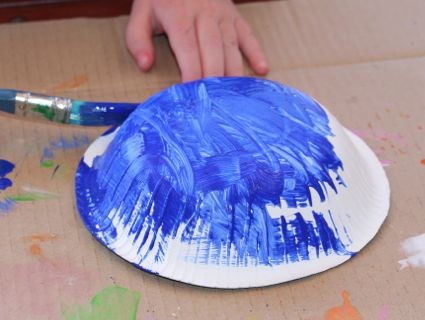
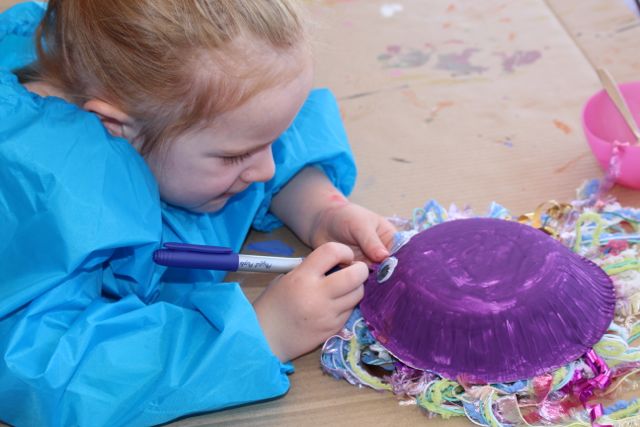
Painting the top of the jelly-fish.

We ended up making three jelly-fish. First we painted the bowls, L picked orange, A picked blue and purple. I ended up finishing off the purple one though, as A got a bit tired of using the tiny detail brush she’d decided to paint with. She chose a much thicker brush for the blue paint, which allowed her to paint the bowl more quickly and easily.

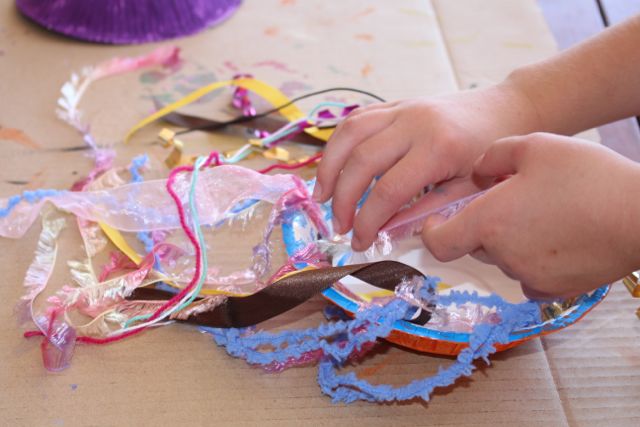
While the bowls dried we sorted out our tentacles. I thought the jelly-fish would look better with tentacles of varying lengths, so I wasn’t very particular about the length of the pieces as I cut them up. I placed the tentacles into two piles, one for each child, so that they each had a range of different tentacles to choose from. I ended up needing to cut more yarn up as we ran out before we had finished. Some of the yarn was feathers, and some was a powderpuff yarn that was fluffy. I thought these yarns looked really good on the jelly-fish, and it gave them a bit more variety and texture, than if we’d just used plain yarns.

Taping on tentacles.

Taping on tentacles.


Attaching tentacles.

Attaching tentacles.


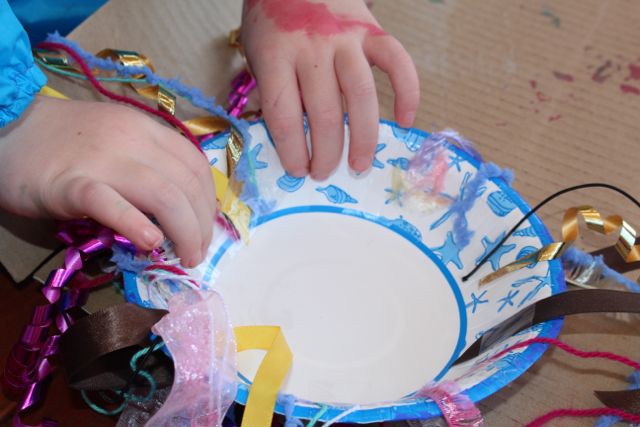
To stick the tentacles onto the bowl, we used sticky tape. The kids made bundles of several tentacle pieces together in some sticky tape, and then they taped that to the inside edge of the bowl. I found that it was easiest to use a longer length of tape, stick the tops of the tentacles along it, and then fold it over to form a rectangle of tape housing a number of tentacles, and then tape that section into the bowl. We continued doing this all the way around the edge of the bowl to give the jelly-fish a good coverage of tentacles.


Decorating with markers.

Decorating with markers.

L and A used some permanent markers to decorate the top of their jelly-fish. We also stuck on some googly eyes to the side of the bowl.

We hung the jelly-fish up in their rooms, and they look great with their tentacles wafting about in the breeze.

IMG_4871

Propagating Succulents

Standard

After painting their terracotta pots, the kids wanted to plant something in them. We have a single succulent plant growing out by our letterbox that seems pretty hardy, and I thought it would be fun to try to propagate some new plants from it’s cuttings.

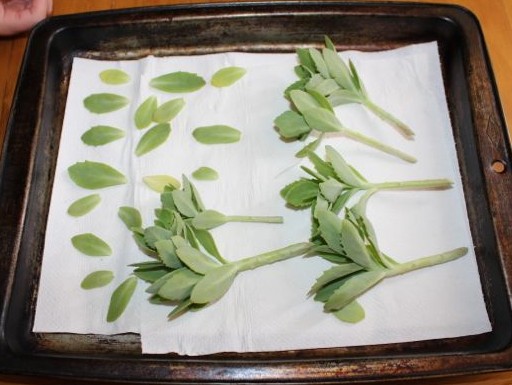
Cuttings drying out.

Cuttings drying out.

The succulent in our garden is a good size, so we were able to take several stem cuttings. We removed the lower leaves from the bottom of each stem. We left the leaves and the cuttings to dry out for a few days.

Succulents generally like well-drained soil, so L collected some red gravel from one of our garden beds to place in the bottom of each pot to improve drainage. She then filled each pot with some cacti and succulent potting mix. My mother had told me to try dipping the base of the cuttings into honey prior to planting them. This is supposed to kill any bacteria on the cutting, and improve growth. I’d never tried this before, but we pulled out some honey and dipped each cutting in. It’s hard to know whether it worked, but all of our cuttings survived, and had new growth on them, so I think we will use honey on our cuttings again in the future. L placed a single stem cutting into each pot, patted the soil down and gently watered them in.

Gravel used for drainage.

Gravel used for drainage.

Adding soil.

Adding soil.


Placing the cuttings into the soil.

Placing the cuttings into the soil.

Patting the soil down around the cutting.

Patting the soil down around the cutting.


We placed them in a sunny spot, and checked on them every day, keeping the soil moist, but not too wet. After a week or so, we noticed some of the cuttings had produced some new leaves, and some little roots had appeared near the base of the stems.

All of these succulents in their decorated pots were given away as Christmas presents, mostly to their teachers. The kids were so proud to show off the pots that they painted and the plants that they had grown. They made unique gifts that were well received and appreciated.

Watered in and ready to grow.

Watered in and ready to grow.

As we began to clean out the laundry this week, in preparation for painting, we discovered some unused pots under the laundry tub. These will make excellent vessels for our next round of succulent growing. I would like to try propagating some cuttings from other types of succulents too.

Wings & Co: Operation Bunny by Sally Gardner

Standard

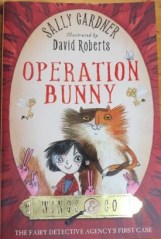
IMG_3647Wings & Co: Operation Bunny by Sally Gardner and illustrated by David Roberts, paperback, 185 pages, published by Orion Children’s Books in 2012.

Emily Vole was abandoned in a hatbox as a baby, and she is adopted by the very rich Ronald and Daisy Dashwood. Daisy is very vain and rather stupid, and when she falls pregnant with triplets, she turns Emily from adopted daughter into a Cinderella like slave. Emily works from sun-up to sun-down cleaning, washing, and caring for the triplets. She is not allowed to go to school and has to sleep in the laundry. One day by chance Emily meets her wonderful and elderly neighbour Miss String, and her man-sized talking cat, Fidget. They help and teach Emily, and open her to the world of magic and fairies. When the evil witch, Harpella, comes wreaking vengeance, Emily and Fidget set off on the run. They team up with the grumpy and rather self-important Buster who is a fairy detective, and together they try to destroy the evil Harpella.

I really enjoyed this story, and am looking forward to the next instalment to see what Emily, Fidget and Buster get up to. It was well written with some funky black and white illustrations to enhance the story. I found it to be an entertaining read that I wanted to keep reading to the end. I will be encouraging my first grader to read this, as I think it is suitable for school aged children. Emily is a quirky character with independence and smarts, and I liked her. Fidget was also a good character, with many cat and fish related phrases, and a rather sardonic sense of humour. I will enjoy reading this again to my pre-schooler.

Flower Picture

Standard

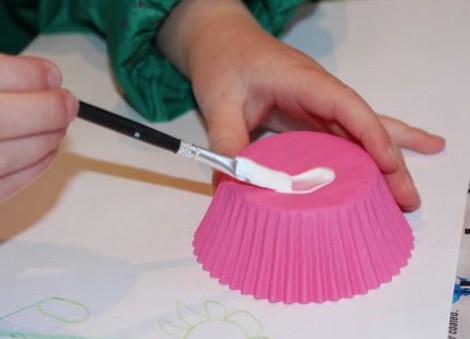
A few weeks back at playgroup the craft activity was making a banner of flowers. The stems and leaves were drawn on in crayon, and the flowers were patty pan and muffin cases. Today A made a smaller version of this flower picture at home, with the addition of some muffin case leaves.

Adding glue.

Adding glue.

Placing the muffin cases.

Placing the muffin cases.

A drew some stems on where she wanted her flowers to be, and then she began adding the muffin cases. We had a mix of red, blue, yellow and green cases. Some of the cases were glued to the stems whole to represent open flowers, while others were folded in quarters as budding flowers.

The open flowers received a pom pom centre and the green cases were folded into eighths to make leaves. A glued these onto some of the stems. She also added some crayon grass to the bottom of the picture to complete the scene.

Finished flowers.

Finished flowers.

Stencils with Paint

Standard

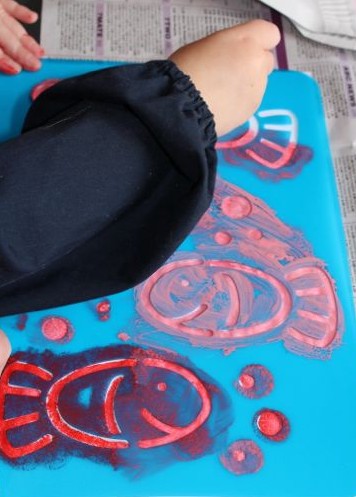
IMG_3671A rainy day resulted in lots of craft and art today, so since we had the paints out I dug out our packet of stencils. They are A4 sized plastic stencils, perfect for the kids to use. I put out several sponge applicators, but A decided to use a paintbrush on most of hers.IMG_3670

IMG_3668IMG_3669


One of the stencils has the alphabet on it in both upper and lower case, as well as numbers and some punctuation. L used this to paint out her spelling words this week. It was a bit tricky, as the stencil had to be held up off the previous letters so as not to smudge the paint. There was still some smudging, which might have been reduced if we’d wiped down the stencil in between doing each letter. She used one of the sponge applicators to apply the paint, and had some help from Big L with holding the stencil.

IMG_3685 IMG_3686

Paper Plate Fish

Standard

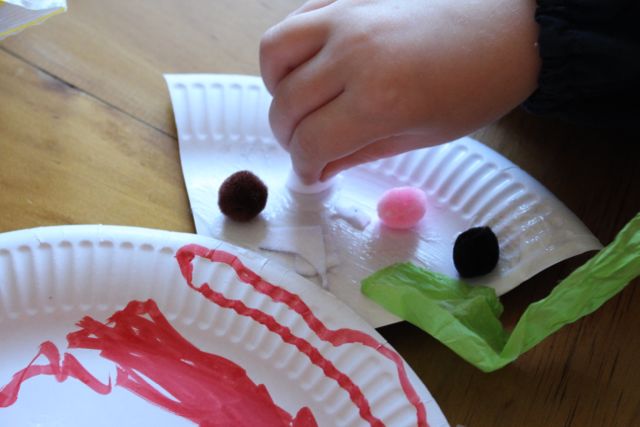
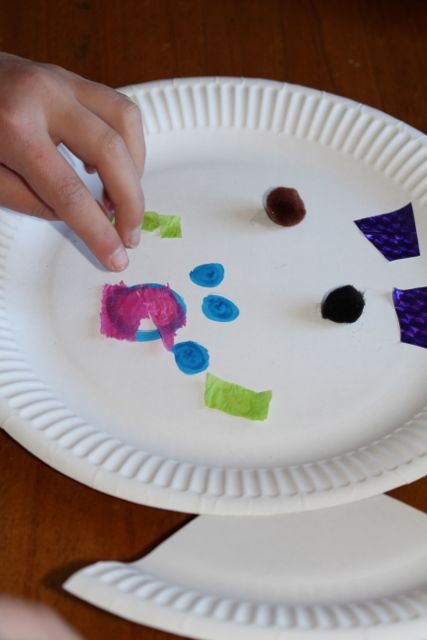
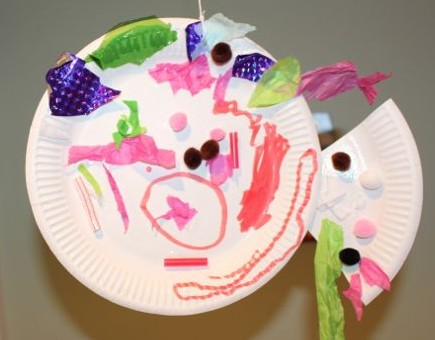
I love crafting with paper plates, they have so many uses 🙂 This time we used them to make fish. A whole plate for its body, and a quarter plate for its tail. I cut a triangle out of L’s for a mouth, but A decided to draw a mouth on for herself. The kids used collage materials and paint pens to decorate their fish. Once they were dry I punched a hole in the top of them so that we could attach some string and hang them up.

Gluing.

Gluing.

Adding pom poms.

Adding pom poms.

Sticking on tissue paper.

Sticking on tissue paper.

A's fish hanging up.

A’s fish hanging up.

L's fish.

L’s fish.

Egg Carton Caterpillars

Standard

IMG_3595This is a craft that gets done a lot at pre-schools and playgroups, but never seems to lose its appeal. In the past we have decorated these caterpillars with paint, textas, stickers, and gluing on bits of paper, cellophane and fabric. Sometimes they are short caterpillars and sometimes long, but always fun!

Painting a caterpillar.

Painting a caterpillar.

Waiting, waiting, waiting for them to dry.

Waiting, waiting, waiting for them to dry.

We had half an egg carton left over from some other craft, so I cut this in half to make two caterpillars for A. She chose to paint one green and one red. She put so much paint on them that it took all day to dry… Eventually we got back to them and A decorated them. I punched two holes with my awl in the head of each caterpillar so that A could add pipe-cleaner antennae. She also glued on some googly eyes, and then used pompoms to decorate their bodies. She gave the red one a pompom nose. They are very cute!

Bending the antennae into shape.

Bending the antennae into shape.

Decorating a caterpillar.

Decorating a caterpillar.