Category Archives: Themes

Hand-print Bookmarks

Standard

IMG_4472For Mother’s Day this year we made bookmarks using the hand-prints of the kids. I found some old scrapbooking papers that had pink or blue heart patterns on them to use as our base for the hand-prints.

Using the paint pad.

Using the paint pad.

A's hand-prints.

A’s hand-prints.

Each child chose the background paper to use, and the colour of paint for their hand-print. Predictably A chose pink on pink for her bookmarks. L used the rainbow paint pad for her hand-prints on the back on the blue paper.  Unfortunately the rainbow paint didn’t come out as clearly as the other paint, but L liked it as it was. The boys used blue paint on blue paper. Using paint pads for hand-prints makes it easy to get a good amount of paint on the hand, and is much less messy than using conventional paint.

Hand-prints.

Hand-prints.

After the hand-prints were dry, I carefully cut around each hand. The kids wrote some lovely messages on the back of one of their hands using a marker. A pushed down her marker quite hard, and the ink is visible through the hand-print. She also drew a lot of love hearts! I love it because it is so unique.
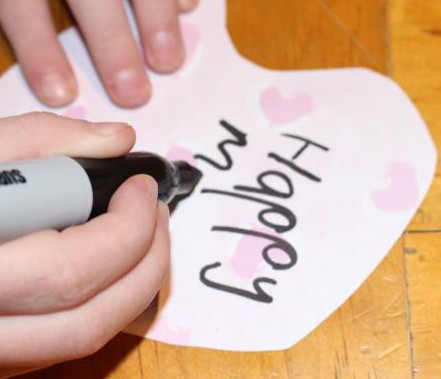
Writing a message on the back of the hand-print.

Writing a message on the back of the hand-print.

To finish the bookmarks I laminated the hand-prints. I arranged the hand-prints so that A’s hands and Baby T’s hands were together to make a bigger bookmark each, while L’s hand-print was big enough as one. I also did a single print of my hand to make a bookmark for my mum. Once laminated, I carefully cut around the hand-prints so that there was a small amount of plastic laminate around each one. The kids were happy with their bookmarks.
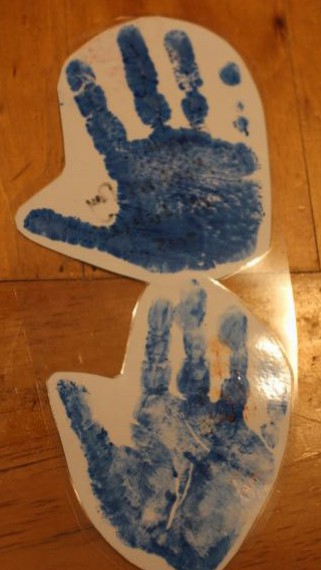
One of the boy's bookmarks.

One of the boy’s bookmarks.

A hand-print bookmark in my latest read.

A hand-print bookmark in my latest read.
Pinecone Bird Feeder

Standard
Items we used.

Items we used.

A came across this idea in one of her kindergarten readers and begged for us to try it out at home!

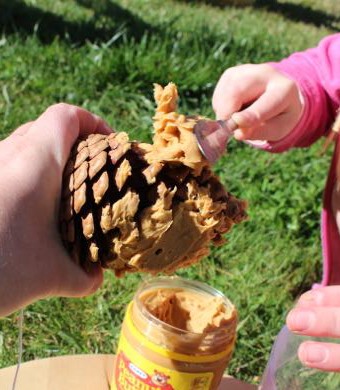
Coating the pinecone with peanut butter.

Coating the pinecone with peanut butter.

We tied a piece of string to the pinecone so that it could be hung up in a tree when we were finished, and then I helped A to cover the pinecone in peanut butter. This was a little messy, but A didn’t get nearly as much peanut butter on herself as I had thought she would.

Rolling the pinecone in birdseed.

Rolling the pinecone in birdseed.

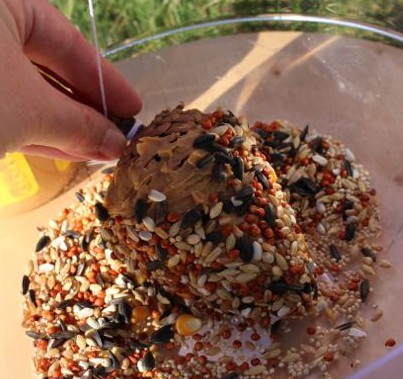
Then A rolled the pinecone in a bowl of birdseed. We used a basic parrot mix because most of the birds that hang about in our yard are parrots such as cockatoos and galahs. A pressed as much seed into the sticky peanut butter as she could, completely covering the pinecone. When the pinecone could hold no more seed, we took it into the yard and hung it up in a large bottlebrush tree.

Making sure the whole pinecone was covered.

Making sure the whole pinecone was covered.

And now we wait for the birds to come and have a feast.

Our new bird feeder hanging in a tree.

Our new bird feeder hanging in a tree.

Star Jumps by Lorraine Marwood

Standard

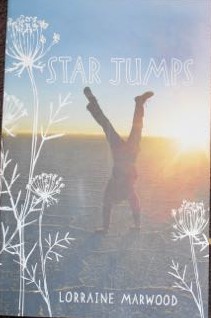
IMG_4454Star Jumps by Lorraine Marwood, paperback verse novel, 128 pages, published by Walker Books Australia Pty Ltd in 2009.

Ruby is growing up on a dairy farm in rural Australia, which has experiencing drought conditions for some time. Ruby and her siblings, Keely and Connor want to help their parents to keep the farm afloat. Ruby is too young to help with the calving, but she watches, and tries to help where she can. If they all work together, perhaps they will see another year on the land.

Star Jumps is a touching story of drought and the struggle that accompanies it, told in beautiful verse from the perspective of a young girl on a dairy farm. The author has obviously experienced the vagaries of the weather for farmers firsthand, and has conveyed the sense of frustration and sadness that drought brings to those dependent on agriculture. The story also highlights the hardiness of those on the land, even the children, despite knowing the hardships, can still find pleasure and fun on the farm between jobs.

I’m not normally a big verse or poetry reader, but I found this book to be well written and moving. It is suitable for primary and lower high school students. Though I think children from country regions may be able to appreciate it more wholly than children without exposure to agriculture, it would be good for all children to read something a bit different. I will be adding Star Jumps to my daughters’ book shelf and encouraging them to read Ruby’s story. I hope Star Jumps will remind them that there is always some good in any situation, you just have to find it, or work to make it happen.

The Candlestick Dragon by Melanie Ifield

Standard

IMG_4407The Candlestick Dragon by Melanie Ifield, paperback novel, 194 pages, published by Melanie Ifield in 2013.

Daniel is short for his age, wears glasses, and is constantly bullied at school. He never expects to experience adventure outside of a book, he can’t even swim, and he’s not very fond of physical activity anyway. Yet a simple excursion to the recycling centre with his mother, Darling, changes Daniel’s whole world. He brings home a candlestick with a statue of a dragon clinging to it, but it is no ordinary candlestick! The dragon blinks his eyes, shakes off his stoney exterior and speaks to Daniel. He is Nilofar, a small dragon, roughly the size of a cat, and he is on a mission, sent from his homeland, Novarmere, through a gateway portal to Earth. Adventure is at hand, with magic, wizards, a young princess, brave warriors and terrifying creatures that Daniel could never have imagined.

I enjoyed this fantasy adventure story, which was exciting, well written, and contained interesting and well described characters and landscapes. I particularly liked Nilofar. As a child I would have loved to have discovered a friendly dragon that was small enough to sit on my shoulder, wrapping his tail around me and chuckling smokey bursts about my head! Really, I would still like a friend like this! Cute and brave, Nilofar was my favourite character, though all the characters were interesting, and I came to feel rather protective of Daniel. Rishana’s attitude felt very true to form for a young teenage princess with so much power at her fingertips, I liked her vacillation between pouty teenager and easygoing comrade. We were able to see her in her role as the confident Princess of Novarmere, as well as the young and inexperienced girl that she actually is. And their immediate enemy, the evil wizard Rullin, was suitably evil, cunning and boastful.

Most suitable for middle primary school through to lower high school students, The Candlestick Dragon is still a good read for adults too. Some younger readers may find some of the action and the mythical creatures a little frightening. There is some fighting and death, though I didn’t feel that it was overly graphic. I am happy for my third grader to read this book, and will be encouraging her to do so.

I received The Candlestick Dragon for free through Goodreads First Reads. It is the first book in the Chronicles of Novarmere: Dark Wizard Quartet. The second book hasn’t been released yet, but I am very keen to read it and follow Daniel’s next adventure.

Octonauts Cake

Standard

IMG_4135

All my kids are Octonauts crazy and have been for ages, so when T’s birthday came around, it made sense for us to make an Octonauts cake. L suggested that I somehow sculpt a whole 3D octopod, she even drew me some plans! I thought this would be way too difficult and time consuming to manage, so I attempted something rather more simple using Octonaut figures (which I bought from Toys’r’Us)

This cake was still a little time consuming, but it was fairly easy to make. The cake base used a double quantity of butter cake mix (I had some Greens mixes in the cupboard that I used). The ocean used two packets of blue Aeroplane Jelly (berry flavoured, yum!), and the rest was butter cream and crushed Nice biscuits for the beach sand.

The cut-out section of the cake.

The cut-out section of the cake.

The cake was baked in a rectangular baking dish. Once it was cool, I cut out a section on the top where I wanted the ocean to be. I cut into the cake to a depth of roughly 1-2cm, leaving an edge to contain the jelly. At one corner, I left a larger section to make into a beach.

Nice biscuits.

Nice biscuits.

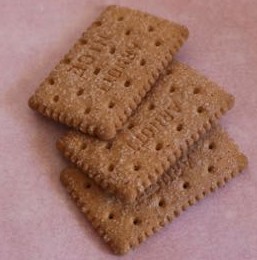
I made up the butter cream, keeping some of it white to use on the beach. I spread the white butter cream over the beach section and down the sides of the cake, then I made the ‘sand’. For this I used three Nice biscuits (any sweet light coloured biscuits could work), and laid them on some baking paper. I folded the baking paper over the biscuits, and then used my rolling pin to crush them. Once I was happy with the consistency of the ‘sand’ I transferred it from the baking paper to a bowl, and began spreading it over the white butter cream, gently pressing it down across the top of the beach and down the sides of the cake.

Crushed biscuit.

Crushed biscuit.

The sandy beach.

The sandy beach.

The rest of the butter cream, I coloured using blue food colouring with a dash of green to make it closer to the colour of the jelly. The colour was quite intense, and did stain my fingers a little while I was icing the cake. I covered the edges of the cake in blue butter cream, down the sides and around the edge of the cake directly onto the foiled cake board. I iced the blue part of the cake roughly to make it appear more like waves.

I smooshed the jelly with a spoon and added it to the cut-out section in the centre of the cake. I spread it out carefully to the edges, making sure that the cake was covered, but not overflowing. Then it was time to add the figures.

The cake ready for the figures.

The cake ready for the figures.

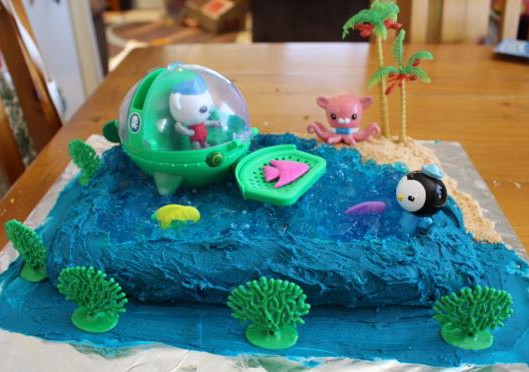
A and L helped me to place the figures onto the cake. Captain Barnacles went in the Gup E in the water with the fish rescuing net and some fish. Peso went directly into the water, while Professor Inkling was up on the beach. We raided our stash of animal figurines and found a palm tree and some funny flat bushes that A thought looked like seaweed. The palm tree went onto the beach, and A placed the seaweed around the edge of the cake on the icing on the cake board. All the figures were washed before and after use on the cake.

Just before the seaweed was added.

Just before the seaweed was added.

I was happy with how the cake looked, and it tasted delicious. T was also thrilled to get the Octonaut figures to play with afterwards. He asked to blow out the candles three times too!


Florence Takes the Lead by David Harding

Standard

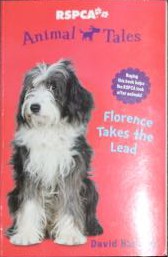
IMG_4099Florence Takes the Lead by David Harding, paperback chapter book, 85 pages, published by Random House Australia in 2012.

Ben has a beautiful shaggy sheep dog called Florence, who is his best friend, and goes most places with him. When his parents decide to have a long weekend away in the country, Florence goes with them to stay at the guesthouse. Together they discover a pig farm still using the old methods of sow stalls and farrowing crates, which means that the pigs are heavily confined. Can Ben and Florence help to liberate the pigs and educate the farmer regarding more humane pig farming practices?

Florence Takes the Lead is part of the RSPCA Animal Tales series, which promote the humane welfare of animals. These books are suitable for lower and middle primary school students, and will be particularly appealing for animal lovers. This was a reasonably simple adventure story with an important message about animal welfare, and the great work the RSPCA do. While the story is fictional, the adventure is based on animal welfare situations that unfortunately do happen. However, these books are a fun way for younger children to become aware of the various issues facing animals and those that advocate for them. After the story ends, there is a fact file, first providing some information about the RSPCA, and then some information about pig farming in Australia. And there are more books in this series just waiting to be explored!


Bone Collection: Animals by Rob Colson

Standard

IMG_4093Bone Collection: Animals by Rob Colson and illustrated by Sandra Doyle, Elizabeth Gray and Steve Kirk, paperback non-fiction, published by Scholastic Australia in 2013.

Explore the animal world through their skeletons. Bone Collection: Animals covers a range of animals from fish and frogs to apes and humans. First it looks at the skeleton of a specific animal, then follows this with facts about similar animals. At the end of the book, there was a double page with a lion’s skeleton separated with the major bones named. There were also some general bone facts, and a glossary to help with some of the terms found within the text that may be unknown to a young reader.

A combination of illustrations, photos and diagrams alongside fascinating facts about a wide variety of creatures make this an excellent non-fiction text for primary school students. The illustrations of the skeletons throughout this book are exquisitely detailed. The depth of information is good for this age group, whilst also being interesting and presented in an appealing style.

My third grader read this book to me, and we both learnt quite a few things! She just wanted to keep reading until we were finished, as she was finding it so entertaining and enlightening. We liked that each page had a little diagram showing the relative size of the creature to an adult human. Her favourite animal was the three-toed sloth with its long arms and claws, while I found the blue whale’s humungous jaw bones very interesting.

Wild Discoveries Wacky New Animals by Heather L. Montgomery

Standard

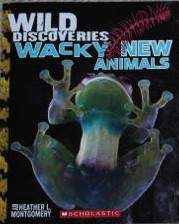
IMG_3949Wild Discoveries Wacky New Animals by Heather L. Montgomery, paperback non-fiction, published by Scholastic Inc. in 2013.

There are still millions of undiscovered species all over the world. This book showcases just a few of the most interesting creatures discovered recently, including a leech with large teeth, a frog with translucent skin and green bones, a blue earthworm, a tiny seahorse and a stick insect as long as your arm!

Wild Discoveries Wacky New Animals is an interesting read. Each page contains plenty of facts about each creature, including its scientific name, size, role and where it was discovered. There are also plenty of colour photographs depicting the animals and their various traits. There is a glossary of terms at the back of the book and a small section on kids discovering new animals.

An enticing non-fiction book for primary school children, Wild Discoveries Wacky New Animals would appeal to nature and animal lovers along with those interested in more unusual (or gross) fare. I cannot un-see the “snot flower” or the Atewa Hooded Spider, but I can refocus on the cute little Siau Island Tarsier! My third grader found this book fascinating, and is now looking into more wacky and strange animals.

Creating a Terrarium

Standard

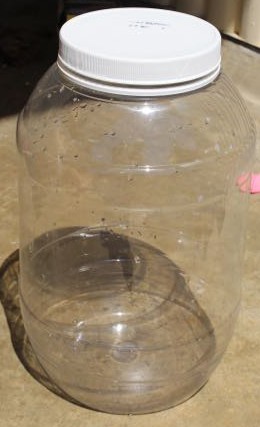
IMG_4033Terrariums can be lovely mini gardens, perfect for sitting on the table and brightening up the house. Any clear container can be used for a terrarium, but it’s nice to find an unusual shape. We started with a big plastic tub that used to hold mini-pretzels.

Our plastic container.

Our plastic container.

The kids collected some gravel from our front garden beds to place in the bottom of the container for drainage. You can buy decorative pebbles or gravel for this. Using different coloured materials will create a pretty layering effect on the side of the terrarium. We just used what we had available to reduce costs.

Adding gravel.

Adding gravel.

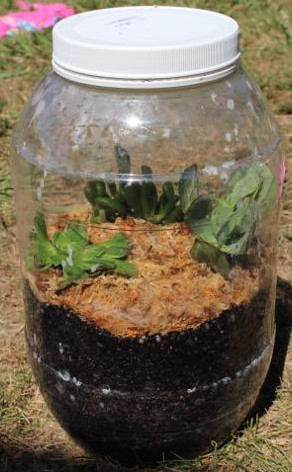
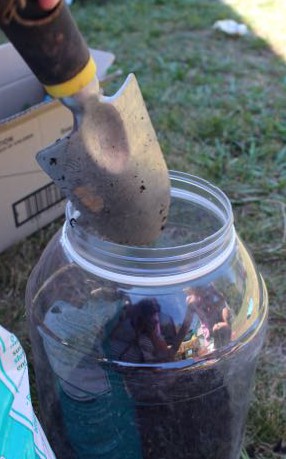
As we wanted to plant succulents into our terrarium we did buy proper cacti and succulent potting mix. We used this to fill the container up to about half-way. Both L and A had a go at putting the potting mix into the container, but quite a lot of it got spilt! Once the dirt was in, we tapped the container down gentled to help the soil settle.

Then it was time to add the plants. We used three small succulents, which the kids chose from Bunnings. I removed some leaves from each of the plants to use for propagating new succulents before I planted them in the terrarium. I carefully placed each succulent roughly equidistant around the container, patting the soil down gently and then watering them in.  We added moist sphagnum moss as the top layer, carefully placing it around the plants, but not too close to the stems to avoid rot. This will help to retain moisture. Alternately we could have used small pebbles or rocks to finish off (we already had the moss for our carnivorous plants).

Getting the potting mix in the container.

Getting the potting mix in the container.

The succulents we chose are all different shades of green. Choosing plants with different coloured foliage can increase the aesthetics of the terrarium, and of course, there are many plants that do well in terariums aside from succulents. I think our next one will have to contain some ferns.

When the lid to the container is placed on the top, the moisture is trapped inside the terrarium, causing condensation on the plastic. This keeps the terrarium moist without watering very often, though it also obscures the plants. The plants have everything they need within the closed terrarium, but if it is too wet inside, you can remove the lid for a day or two or as long as needed. Or you can leave your terrarium open if you prefer, and treat it more like your average indoor plant.

Looking from above.


UPDATE 19/3/15: L dropped the terrarium! Luckily the container is plastic, so it bounced, but one of the plants catapulted right out the top (I had the lid off allowing the soil to dry a bit), along with a good chunk of the moss. So the poor plant lost all but two of its leaves. We have replanted it in the hopes that succulents are so hardy it will survive, but it looks a little sad at the moment. I have just left the soil bare and the lid off as the weather is beginning to cool a little and is more humid, so it is less likely to dry out too much. L felt so bad about dropping the terrarium, but these things happen! The other two plants are doing very well and we are seeing new growth.

The Very Best of Friends by Margaret Wild and Julie Vivas

Standard

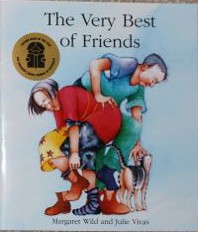
IMG_3948The Very Best of Friends by Margaret Wild and illustrated by Julie Vivas, paperback picture book, first published by Margaret Hamilton Books in 1989, this edition published by Scholastic Australia Pty Limited in 2004.

James and Jessie live on a farm with lots of animals, but only one cat, William. As James goes about his jobs on the farm, William goes with him, he curls up on his lap in the evenings and on the bed at night. And then James dies suddenly and Jessie falls deep into grief, shutting William out, letting him run wild and become mean, something he never was with James. To move forwards, Jessie must work on her friendship with William and regain his trust.

A poignant tale of friendship and loss, beautifully spun for younger children, The Very Best of Friends will touch your heart. It is a reminder that all relationships need work, and if you fail to tend them, they will wither, but with a little love, kindness and attention they might thrive again.

While the story is beautiful, the illustrations are distinctive and just gorgeous. I love the way that William is depicted, and how he changes from the well-tended cat to the wild thing he becomes after James dies.

The Very Best of Friends is suitable for primary school children. It is a book I read as a young child,  and I am now sharing it with my own children. This wonderful picture book can be used to start a discussion on the complicated issues of loss and grief, and that life must go on. Though something sad happens, the friendship that blooms between Jessie and William is lovely and inspiring. It is important to keep living your life even when you have lost someone, and I found this book to be helpful in explaining that to my children.


* The Very Best of Friends won the 1990 Children’s Book Council of Australia Book of the Year in the Picture Book category.