Paper Lanterns

Standard

IMG_0727Paper lanterns are a quick and easy craft activity, great for rainy days!
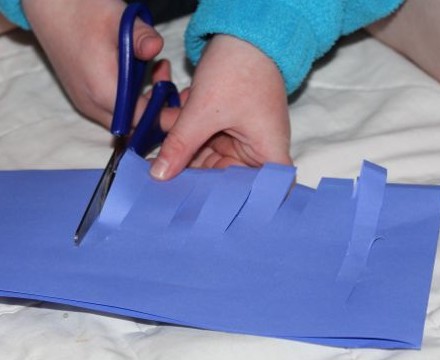
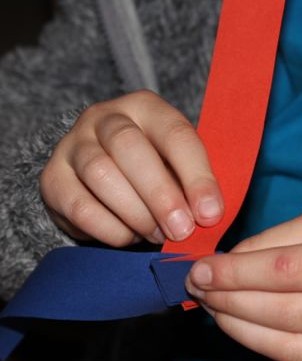
A cutting her paper.

A cutting her paper.

The kids each picked out a sheet of coloured paper and folded it in half lengthways. They cut into the paper from the folded edge, parallel to the short side of the paper, until about 1cm from the non-folded edge. The cuts continued at roughly 1-2cm intervals down the length of the paper. Though A’s cuts were a little wobbly, she was very careful not to cut all the way through.
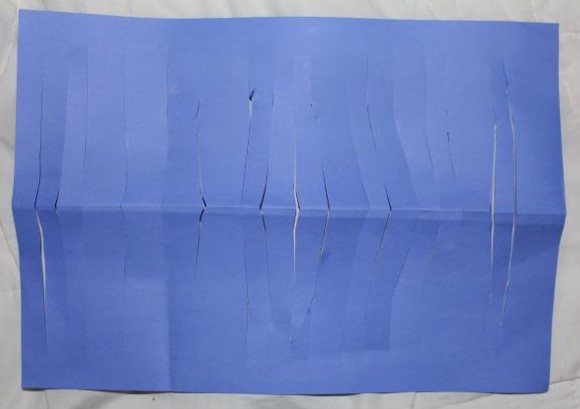
The cut paper.

The cut paper.

Once the cutting was finished, they unfolded their sheets, and with the folded edge facing out, they curled one short edge around to join the opposite edge in a circle. We used sticky tape to secure the two edges together, but staples or glue would have also worked. The kids used some strips of paper in other colours as handles for their lanterns, attaching them with tape to the top.

A's big lantern.

A’s big lantern.

We had a packet of coloured squares too, which we used to make some mini-lanterns. L thought these little lanterns were very cute, and has hung some of them in her room.

Having the packet of little squares out led A to ask about making a flame for inside her lantern. She picked out some orange and yellow squares, and scrunched them together to form a flame. I helped her tape her flame into the base of her big lantern.

A's lantern flame.

A’s lantern flame.

The flame inside the lantern.

The flame inside the lantern.


Talk of flames led to talk of campfires, and next thing I know, L has made a fire from red, orange and yellow paper squares, and A has cut up a piece of black paper to form the sticks of a camp fire. A carefully arranged her sticks, and then placed the fire on top of them. She put her little puppy toys next to the campfire and pretended that they were having a little rest next to the warm fire. I love it when the kids have some spontaneous pretend play.
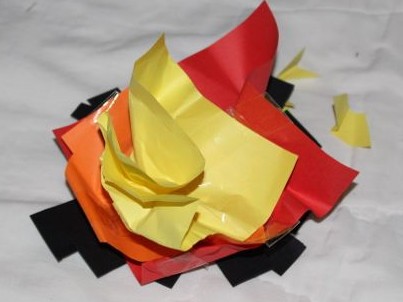
The campfire.

The campfire.

The puppies enjoying the warmth of the campfire.

The puppies enjoying the warmth of the campfire.
The Runaway Hug by Nick Bland and Freya Blackwood

Standard

IMG_0510The Runaway Hug by Nick Bland and Freya Blackwood, paperback picture book, published by Scholastic Australia in 2011.

When Lucy asks for a hug before bed, Mummy tells her it is her last one. Lucy promises to return it, and Mummy gives her a nice, gentle hug. Then Lucy runs off to share it with the other members of her family, where it becomes bigger and peanut-buttery, but still nice. The hug runs away with Annie, and Lucy chases her to get it back, but it’s not easy, and she really wants to give Mummy back her last hug.

This is a sweet book about sharing love within families and the differences each family member brings. It contains simple language suitable for emergent readers to try, and delightfully quirky illustrations. At the start of the story, Mummy appears to be searching for a skirt in the dirty wash pile in just her undies and shirt, despite it being almost bedtime. I liked that the house was messy, there were drawings on one of the walls and Mummy was breastfeeding the baby at the end. The steps in the house also made me think of the MC Escher house. I really enjoyed the uniqueness of the illustrations, and the realistic portrayal of a house with four children in it.

The Runaway Hug is a nice book to share while cuddling up with your child. It leaves us with a warm and happy feeling each time we read it together. Best for preschoolers and lower primary school children, this award winning* picture book is loved by both my preschooler and my second grader.


* The Runaway Hug won The Children’s Book Council of Australia Book of the Year in the Early Childhood category in 2012.


Bringing Down the Moon by Jonathan Emmett and Vanessa Cabban

Standard

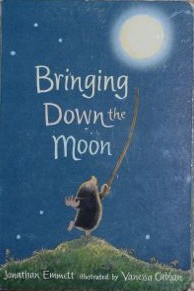
IMG_0749Bringing Down the Moon by Jonathan Emmett and illustrated by Vanessa Cabban, boardbook, first published by Walker Books Ltd in 2001, this edition published by Walker Books Ltd in 2004.

One night Mole burrows up through the dirt and sees the moon for the first time. He doesn’t know what it is, but it is so pretty, he wants to catch it. He tries jumping and reaching it with a stick and climbing a tree to get closer to it, but nothing works, and he disturbs all his friends along the way. But when he thinks he has broken the moon, his friends are there to console and reassure him.

Bringing Down the Moon is one of my pre-schooler’s favourite board books, and we enjoy reading it together before bed. She loves it when Mole yells “hot-diggerty!”, she thinks that is a very funny phrase! I also like this story of discovery and friendship. It is a lovely story with beautiful illustrations. Mole is a curious little fellow, and his friends are compassionate and understanding. Mole learns that the moon isn’t near enough to touch, but it is beautiful up there in the night sky. And it’s beautiful that he shares that moment with his friends.


Paper Worms

Standard

IMG_0723It was raining this afternoon, and we were all feeling a little tired after school, so we picked a nice easy activity to do. We cut coloured paper into strips, and then used them to make worms.

L folding up a worm.

L folding up a worm.

A made some just by folding a single strip of paper up like a concertina, and then adding eyes. L made hers using two strips of paper. She started by lining the ends up perpendicular to each other, and then taping the strips together in a right angle. Her first worm was blue and red, so she folded the blue over the red, then the red over the blue, and then the blue back over the red in the opposite direction, and so forth until she reached the end of the strips. It was a bit like plaiting the paper together to form a spring-like tube. She taped the ends together so that her worm didn’t unravel, and then she stuck on some eyes.

A's concertina.

A’s concertina.


A two strip worm.

A two strip worm.

A's concertina worm.

A’s concertina worm.

I love these eye stickers, they are so easy for the kids to use, and we don’t have to wait for any glue to dry. A likes the eyes that have eyelashes, because all her creations “are girls and need pretty eyelashes”. A had difficulty making worms using two strips of paper, so L made her a worm to add eyes to, which was very thoughtful.

The kids took their little worms off to bed with them tonight, and L even made her worms a special sleeping place on her desk where they would be warm and comfy.

Surprise Rainbow Cake

Standard

IMG_0634

This double decker rainbow cake was fun to make and looked great when Big L cut into it (it also tasted really nice).

We started out by making a double quantity of buttercake mix, which in this case was two packet mixes. I sometimes make cakes from scratch and sometimes from packets, depending on cupboard contents, time, and inclination. I happened to have a couple of cake mixes handy, so we mixed them up according to the packet.

In one of my rare moments of organisation, I had previously taken the block of butter out of the fridge to give it plenty of time to soften before mixing up the cake batter. Unfortunately, Big L assumed I’d just forgotten to put it back in the fridge, and tidied it away. So it was hard as a rock when it came time to add it to the mix. Big L suggested that he cut it up for me, and promptly snapped one of our butter knives in two! He then softened it a little in the microwave, but it was still fairly hard when we added it to the bowl, and the batter was a little lumpy as a result, but it didn’t affect the taste at all.

Adding colour to the batter.

Adding colour to the batter.

The kids both wanted to have a go at using the mixer. Neither one of them managed to turn it off prior to lifting it from the bowl…. Must work on that. Once it was finally mixed, I divided the batter into five bowls, with each bowl holding a little less than the one before it, until the batter was gone. I added a few drops of food colouring to each bowl, and the kids mixed the colour in. We had blue, green, yellow, pink and red.

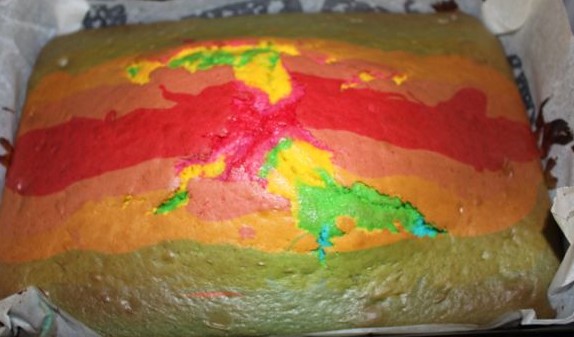
To cook the cake we used a rectangular baking tray lined with baking paper. I used the biggest bowl of batter first, which was blue, and poured it into the base of the tray, spreading it out to the edges. Then I took the next bowl, the green batter, and poured it into the tray in a stripe down the centre of the blue. I continued this with each of the remaining colours in progressively smaller stripes until all the batter was in the tray. Then we popped it in the oven and waited for it to cook.

Ready to cook.

Ready to cook.

Straight from the oven.

Straight from the oven.

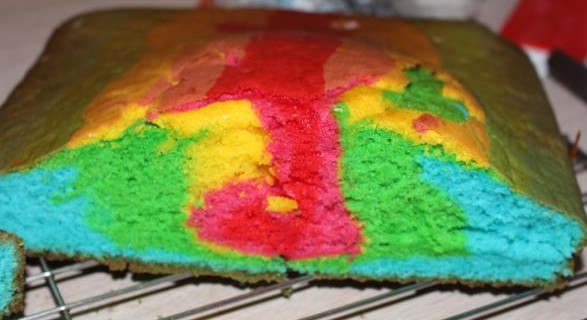
The cake really puffed up in the centre of the tray, but that didn’t really matter. Once it was cool, I cut it in half. The inside of the cake looked awesome! I leveled off the top of the cake to make each half reasonably flat on top so that they could be stacked one on top of the other.

After leveling the top of the cake.

After leveling the top of the cake.

Cut in half.

Cut in half.


Ready to spread frosting.

Ready to spread frosting.


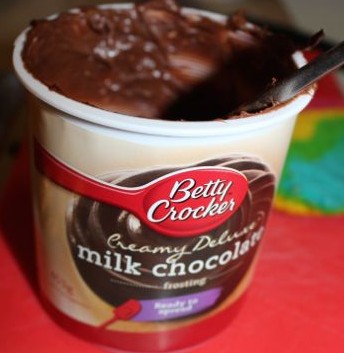
I normally make icing or butter cream from scratch using icing sugar, but I cheated this time and bought a container of Betty Crocker’s Milk Chocolate Frosting. It saved a bit of time and made the cake very chocolatey.

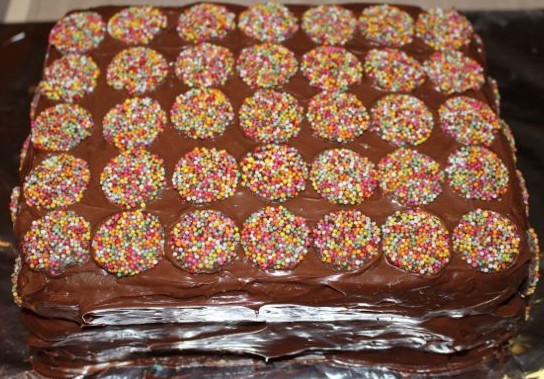
I spread the chocolate frosting between onto the top of one half of the cake, and then placed the second half on top. I made sure it was all straight, and then I covered the whole cake in frosting, smoothing it out with a spatula. I covered the top of the cake in lines of chocolate freckles. I had some left over, so I added these down the sides of the cake.

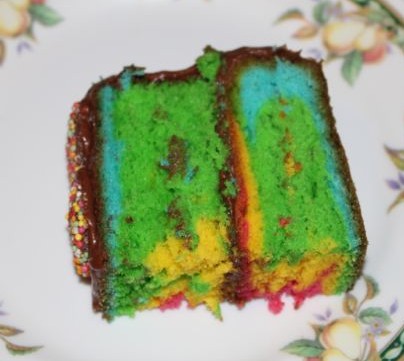
Cutting into the cake and revealing the hidden rainbow surprise was very exciting! The cake was very yummy too. A and L got chocolate frosting all over their faces and hands, while Baby T ate his little piece much more politely.

A slice of surprise rainbow cake.

A slice of surprise rainbow cake.

The inside of the cake.

The inside of the cake.

Paper Plate Collage

Standard

IMG_0560

Collage materials ready for use.

Collage materials ready for use.

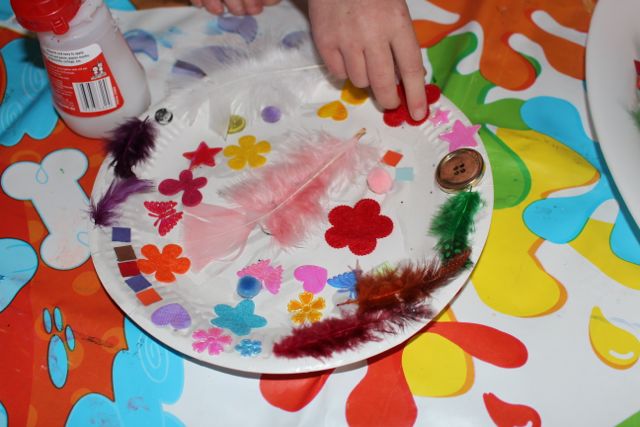
A used a paper plate as the base for her latest collage. She chose a range of collage materials and I placed them on a tray for her to use. She had feathers, cardboard mosaics, felt flowers, sparkly fabric shapes, cut up straws, matchsticks and buttons.

Using Clag glue, A pasted her items onto the plate. I helped her glue down the buttons and pom poms with craft glue, which is stronger than Clag. She was very careful about where she placed each item, and wanted to make sure that everything was visible, and that she had just the right amount of each shape (for her own standards!). She was very pleased with her finished collage.

After it had dried, she wrote a birthday message on the back for Big L, and gave it to him as a birthday card. He said it was one of the best birthday cards he had ever received.

Putting on glue.

Putting on glue.

Making the finishing touches.

Making the finishing touches.


Fly Guy Presents Sharks by Tedd Arnold

Standard

IMG_0513Fly Guy Presents Sharks by Tedd Arnold, paperback non-fiction reader, published by Scholastic Inc in 2013.

Fly Guy and Buzz head to the aquarium to learn about sharks in this informative reader. It contains plenty of photographs throughout the book, complementing the interesting factual text. And Fly Guy and Buzz are always there, leading the way to more knowledge on sharks.

Moving onto non-fiction titles can be a little scary as they often have longer and harder words, and are more complicated than their fictional counterparts. Using some well loved characters, such as Fly Guy and Buzz, is useful in piquing the interest of young readers, especially those that may be reluctant to try non-fiction. I was impressed with the simple and interesting layout and facts. There was enough factual information to sink your teeth into (sorry about that awful pun!) without it becoming overwhelming.

This book is aimed at lower primary school children as a reader, but I read it to my preschooler, and she really enjoyed it. She loves Fly Guy, so this book had appeal before we even opened it. My preschooler did learn some things about sharks, such as they breathe through gills and they don’t sleep, she was particularly impressed by the Great White Shark being able to smell blood from so far away. She told me she is glad she’s never met a shark! She also liked the comments that Buzz makes, and the picture of Fly Guy pretending to have shark teeth. Combining Fly Guy and such an engaging topic as sharks was a stroke of genius, and we look forward to reading more in the Fly Guy Presents series.


Bee Cupcakes

Standard

IMG_0497

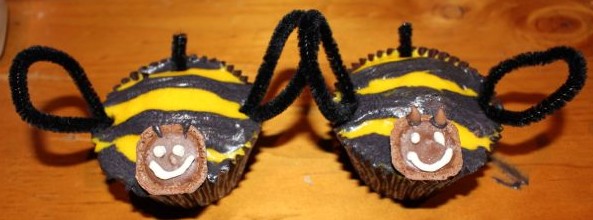
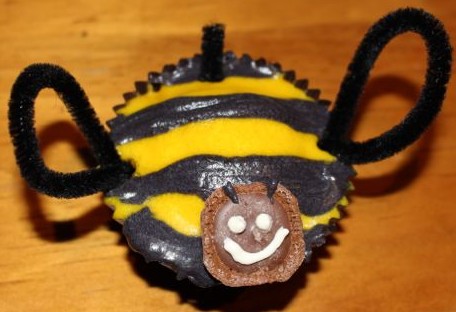
L helped me to make these cute little bee cupcakes.

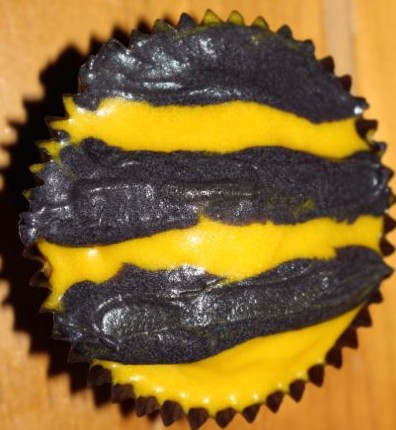
IMG_0483We made a batch of vanilla cupcakes in dark coloured muffin cases. Once they were cool, we iced each cupcake with yellow icing. I wanted the icing to be thick, but smoother than I normally make cake frosting. So I didn’t use as much butter, and I added the milk to the mix a little at a time until I had a nice consistency. I only had liquid food colouring on hand and that makes the icing runnier too. Over the top of the yellow icing, I carefully iced stripes of black icing, well, dark grey was as dark as I could get it, but I used black food colouring. Gel or paste colouring would have been better for making black. I’m happy with the colours anyway.

Once the stripes were done, we added a head made from a honeycomb pods (little choc filled biscuit cups made by Mars). I used white chocolate fudge writing icing to draw on the faces and then some black icing for little antennae. Some of the bees also got mini choc chips as antennae.
IMG_0492

Wing made from a pipe cleaner.

Wing made from a pipe cleaner.

L helped me make wings and stingers from black pipe cleaners. She placed the wings to the sides of the cupcakes, and the stinger at the opposite end to the head. I was quite happy with how the wings looked when we were finished.

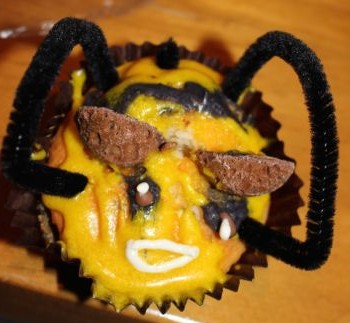
L made a couple of bee cupcakes all by herself too. I didn’t interfere with her creative juices, just let her get on with making her bees how she wanted. She used some of the pods for antennae, mini choc chips for eyes, and the white chocolate for the pupils and mouth. Her wings and stinger were pipe cleaners. She had a lot of fun creating her bee cupcakes.  And she really liked eating them too!

One of L' s bees.

One of L’ s bees.

Underpants, Thunderpants by Peter Bently and Deborah Melmon

Standard

IMG_0508Underpants, Thunderpants by Peter Bently and illustrated by Deborah Melmon, paperback picture book, published by Parragon in 2011.

On a fine and sunny day, Dog hangs out his underpants to dry on the line. Then a thunderstorm whips up the wind, blowing the underpants right off the line and spreads them all around. They land in some interesting places, including in the jungle and the ocean, and one pair even gets blown right out into space.

At a time when my children are obsessed with toilet humour, this book was a good find. They think any story about underpants is funny, and this rhyming tale definitely tickled their funny bones! A perfect book for preschoolers, with a short story, large text and clear, colourful pictures. I like the octopus that gets four pairs of the undies, and no surprises,  my kids like it best when the hunter goes splat in the poop. I wasn’t quite ready for the book to end actually, it just felt like there should have been more, but maybe that was because my kids were laughing and I wanted to extend the experience! Underpants, Thunderpants is a fun book.

The Big Beet by Lynn Ward and Adam Carruthers

Standard

IMG_0440The Big Beet by Lynn Ward and illustrated by Adam Carruthers, paperback picture book, published by Omnibus Books in 2013.

When Thelma McGruff feels like a burger for tea, her husband Bertie goes out to the field to pull a fresh beetroot. The oversized beet is hard to pull up, and Bertie suggests having canned beets instead. Thelma prefers fresh and she goes to help Bertie pull up the beet. Even with the two of them, they can not pull up the beet. A couple going by stop to help, and then a few more helpers arrive, until there is a line of people trying to pull up the big beet. Then along comes a tiny girl in a frilly tutu who wants to help too, but everyone thinks she will be too small to make any difference.

This book has rhyming text and a good rhythm when read aloud. It is perfect for sharing, and is loved by my preschooler. She laughs at the story and at the illustrations. She loves that there are lots of animals below ground trying to hold the beet in while all the people above try to pull it out. She also likes the other things she can see underground, like the space ship and some dinosaur bones. Every time one of the people falls over, she laughs, it is a funny read.

According to the back of the book, this is based on a traditional folk tale, but I don’t think I know that one. It has certainly been given an Aussie twist though. Beetroot on burgers is very Australian, along with the barbie and Pavlova, playing wheelie bin cricket and the character’s nicknames too. I liked this about the book.

This story actually reminds me a bit of Pamela Allen’s Who Sank the Boat? in that it is the smallest and most unlikely participant that tips the balance. Working together can accomplish things that an individual cannot, and everyone can contribute. This is a good lesson that children can take away from this story. The Big Beet is most suitable for preschoolers and lower primary school children, but I also enjoyed it.