Author Archives: TodayWeDid

Unknown's avatar

About TodayWeDid

I spend my time sharing my love of reading, arts and crafts with my four children. I also review children's and YA books.

Fruit Kebabs

Standard

With all the lovely summer fruits out at the moment, we have been eating a lot of fruit salad. The kids would probably live on fruit if they could. Instead of just cutting up the fruit and mixing it together before adding it to bowls for everyone, today we decided to make some fruit kebabs.

IMG_7575

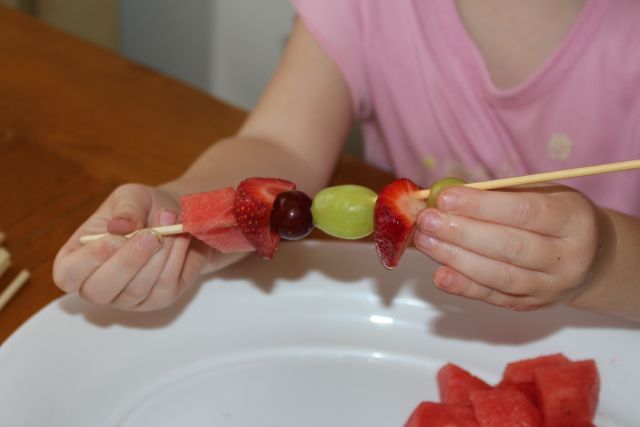
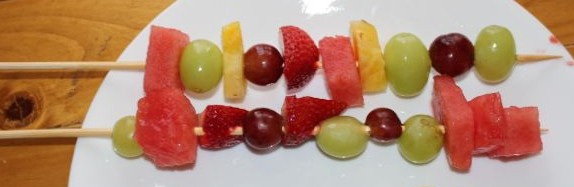
It was pretty simple. I washed the fruit and cut it into chunks and put them on a tray. We had watermelon, pineapple, two types of grapes and strawberries. I left the grapes whole. Any fruit firm enough to be threaded onto skewers would have worked, but these are the fruits we are enjoying at the moment.

Threading a strawberry carefully onto her skewer.

Threading a strawberry carefully onto her skewer.

Adding a grape.

Adding a grape.


I discovered I only had jumbo skewers, rather than the standard sized ones in the drawer, so our kebabs were a bit bigger than normal. The kids also made some mini-kebabs with toothpicks, which really only fitted a couple of pieces of fruit. Soaking the skewers in water for half an hour or so can reduce the incidence of little splinters from the skewers coming off on the fruit, but I didn’t do that today as the kids were too impatient to wait. Luckily for us, no splinters!

I let the kids make their own kebabs by threading on whatever pieces of fruit they wanted. A found this quite easy, but L often threaded her pieces of fruit too close to the edge, and some of them broke and fell off. They made a couple of kebabs each, and then there was all the fun of eating them!

Finished fruit kebabs.

Finished fruit kebabs.

Some mini-kebabs.

Some mini-kebabs.

The Princess Diaries Series by Meg Cabot

Standard

The Princess Diaries are written in first person as Mia writing entries into her journal. The language used is appropriately teenager-ish with lots of “Why me?” and “I am not even kidding”, an extremely annoying phrase, as well as plenty of obsessive comments about boys, kissing, breasts and other teenage behaviours. For this reason, I think it would be unsuitable for children below upper primary or early high school to read.
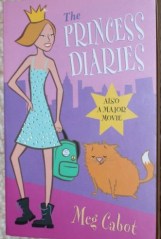
IMG_4928The Princess Diaries by Meg Cabot, paperback, 230 pages, published by Macmillan Children’s Books in 2001.

Mia Thermopolis thinks she is just a normal high school student with normal teenager problems, like flunking algebra, and lack of breast development. She thinks she is unattractive, unpopular, and flat-chested, and is sometimes bullied by the popular jocks and cheerleaders at school. Her best friend, Lilly, is a genius with tendencies towards being a bit domineering and superior, and Mia finds her brother, Michael, very attractive, but she can’t tell Lilly that. Mia lives in New York City with her artist mother and their extremely overweight cat, Fat Louie. Also her mum is dating her algebra teacher, the one subject she is currently failing. Her father lives in Europe in a small country called Genovia, and for her first fourteen years, Mia has thought he was a rich politician there, but then she discovers that her father is actually the reigning monarch of Genovia, and in turn Mia is the Princess of Genovia. That is when her life is turned upside down, and she has to face reporters, her Grandmere’s princess lessons, and having a bodyguard tag along on her every move, even around school. She records her adventures in the journal her mother gave her in the hopes that she might express her feelings somewhere at least, even if she won’t tell her.

I actually really enjoyed this book. It was entertaining and funny, and I came to like Mia. Of course, I could hardly see Mia as an average teenager though, even before it is revealed that she is a princess. After all, her mother is a well-known artist, and she spends summers and Christmases with her father at her Grandmere’s chateau in France. She attends what appears to be an expensive private school and mingles with geniuses on a daily basis. Her best friend, Lilly, has her own public access show, which Mia helps to film, and Michael publishes his own webzine.  That is hardly the life of an average teenager. And did it really come as such a surprise that her father was royalty? Where did Mia think all of that money came from, why does her Grandmere have before and after hour privileges to the shops in Genovia, why does her Grandmere’s chateau require a private airstrip, why doesn’t she spend her holidays at her father’s home? And why hasn’t she asked her father any of these questions? If you can just accept the premise that Mia believes herself to be a normal teenager, and that she really hadn’t asked herself any of those questions about her father, the story is quite enjoyable.


IMG_4927The Princess Diaries: Take Two by Meg Cabot, paperback, 213 pages, published by Macmillan Children’s books in 2001.

In the second book of the Princess Diaries, Mia has new problems to deal with. Her mum is getting married to her algebra teacher, whom she still refers to as Mr G, despite the impending certainty that he will soon be her stepfather. And her Grandmere has taken it upon herself to organise a most grandiose affair for the wedding, which Helen (Mia’s mother) will never agree to. Part of that included inviting Helen’s parents, whom she doesn’t get along with particularly well, all the way from Indiana, along with Mia’s cousin Hank. And if that isn’t bad enough, she has to cope with press interviews, and a secret admirer that she hopes is Michael, about which she still can’t talk to Lilly about it. Another enjoyable story about an unlikely teenage princess moving through the hazardous world of family, friends and high school.


Animal Magnets

Standard
Lots of spare animal cards.

Lots of spare animal cards.

Last year Woolworths wowed all the kids with their Aussie Animal Cards to collect. And then came the baby wildlife Aussie Animal Cards just before Christmas. L and A got to collecting them, and filling up their albums, but they were left with lots of spares. When the promotion finished, we didn’t quite have the full set. Our friends were very generous in giving us their spares to try to complete our sets, and now I think we are only short one card. However, there is a huge stack of spares left, and most people we know already have a full set, and still have spares. The kids like looking through all the spares, but I thought they might be able to be put them to a better use.

I received a new laminator for Christmas, and I was keen to try it out. L picked out five of the Aussie Animal Cards, and I placed them into an A4 laminating pouch and laminated them. I cut around each card, making sure there were no pointy corners. We glued some magnets to the back of each one. We tried some of the magnets at the top of the card, and some in the centre, both worked well.

Laminating the cards.

Laminating the cards.

Adding magnets.

Adding magnets.


Once the glue was dry we put our new animal magnets onto the front of the fridge.

Lined up on our fridge.

Lined up on our fridge.

Melting Crayons

Standard

The other evening I went through all of our drawing implements and sorted them out. We have them stored in a five drawer storage unit, a drawer for pencils, one for markers, one for crayons, one with stickers, and one with lead pencils, pens, erasers, and pencil sharpeners. I threw out any markers and pens that didn’t work. I sharpened all of the lead and coloured pencils, throwing away ones that kept breaking. I waded through the stickers, throwing out sticker sheets that actually had no stickers left on them, and rescuing some sticker sheets that had fallen down the back of the other drawers. Then I got to the crayon drawer…. there were dozens of crayons jammed in this drawer, so many that it was very difficult to shut the drawer. I took them all out and sorted the broken from the unbroken. I collected all of the broken pieces together and put them into a pencil case to deal with later. IMG_4897

Later came around when I decided to try and melt some of the crayons together to make a bigger usable crayon. I wasn’t sure what would happen, so I put a random selection of crayon pieces into a muffin case, and microwaved it. My microwave wasn’t particularly happy about this, and turned itself off near the end. Since I previously blew up a microwave by accidentally microwaving a pop-stick, and I didn’t want a repeat of that, I immediately removed the crayons. Luckily the microwave is just fine, it was just protesting, and given the smell the crayons gave off, I can’t blame it. However, the crayons did melt, and mixed all together, ending up brown. That was fine though, as at least I knew they could be melted.

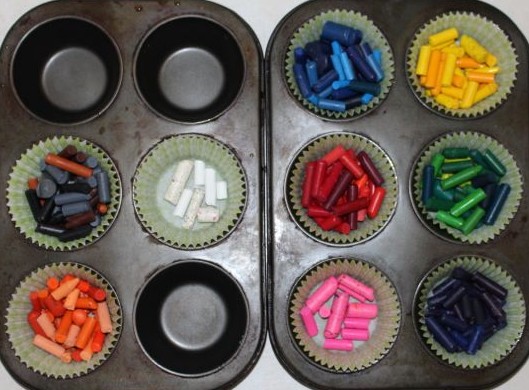
I thought my other option would be to heat them in the oven, but with the hot weather I wasn’t keen to put the oven on. I had a bit of a Eureka moment then, when I realised that I could use the hot weather to my advantage. Nature could melt the crayons for me! So after I removed all of the paper coverings (sliced down the side with a small blade and peeled the paper off), I sorted all the crayon pieces out into piles of different colours, placing them into muffin cases in the muffin trays. I sat the muffin trays outside in the sun this morning.

Separated into like colours.

Separated into like colours.

After about an hour and a half I went out to see how the crayons were going in the sun. They were melting quite well, and the trays were very hot. After about three hours the crayon pieces were pretty much all melted, and I gave them a bit of a stir to mix it together. There were a few pieces in some of them that didn’t melt, but I think they were all pieces that came out of the Crayola Twistables Crayons. I guess this sort of crayon isn’t the same as the others.

After about an hour and a half in the sun.

After about an hour and a half in the sun.

After about three hours in the sun.

After about three hours in the sun.

I brought the muffin trays into the shade using my oven mitt, and once they were a little cooler, I removed the muffin cases full of melted crayon and brought them inside. I sat them on the bench to cool and harden. Once they were completely cooled, I removed them from the muffin cases. Now I have some nice chunky crayons that Baby T can use for his first drawing attempts, instead of the mostly unused broken pieces I had before.

My new chunky crayons.

My new chunky crayons.

Next time I have a bunch of broken crayons, I think I will melt them and then pour them into some of our metal cookie cutter shapes to cool. We have some dinosaur shapes that would make great crayon shapes.
Sponge Painting

Standard

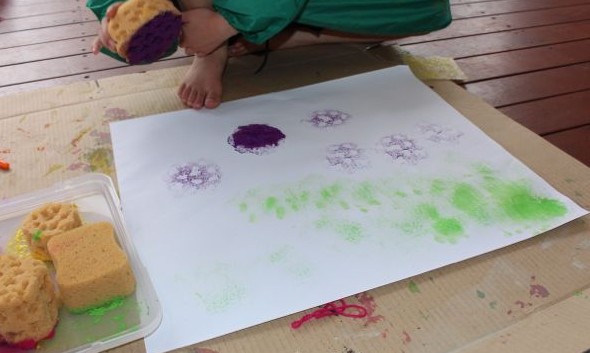
IMG_4866Using sponges can be a fun way to paint. We had a set of synthetic sea sponges I’d picked up from somewhere (probably Bunnings, I’ve been spending a lot of time there lately), and we set to work with some poster paints. I placed some paint onto a plastic tray so that L and A could dip the sponges into the paint easily. This, in theory, should have worked nicely, except both L and A pushed the sponges down until the sponges had absorbed all of the paint from the tray. This was way too much paint, so when they first put the sponge on the paper, it just left a big blob instead of the sponge texture I’d been aiming for.

L making prints.

L making prints.


A squashing the sponge down.

A squashing the sponge down.


It was very hard to convince A to press the sponge to the paper more gently. She just wanted to squish all the paint out of the sponge in one go. And when my attention was diverted by L asking me a question, A used that opportunity to paint her palm with the sponge and do some hand prints too. By the end of the activity, L was managing to get some nice textured prints from the sponge. On one of L’s paintings, she used one colour to make lots of prints across the paper, and then, when that was dry, she used a different colour over the top. This gave a nice layered and multi-coloured effect. Most of the paintings ended up with lots of sponge prints all over them in all of the colours we had out. This is definitely an activity that we will be doing again.

Using the sponge to make multi-layered art.

Using the sponge to make layered art.

Some of the finished sponge paintings.

One of the finished sponge paintings.

Painting Paper Doilies

Standard

IMG_4807I hadn’t seen paper doilies around for some time, so upon spying a packet of them in Wheel & Barrow, I bought some, thinking they would come in handy for our arts and crafts.

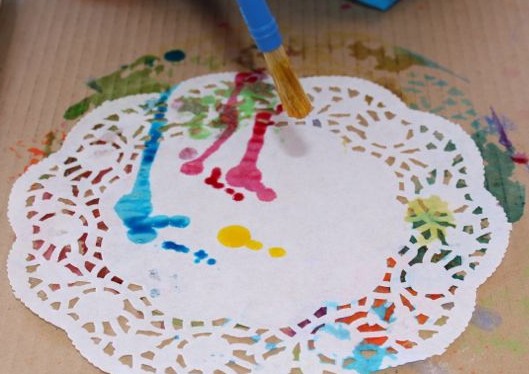
Dropping colours onto the doily.

Dropping colours onto the doily.

Paper doilies are quite thin, and readily suck up liquid, so we used food colouring in water as our paint. We had some green, pink, yellow and blue coloured water, and when they mixed it made some interesting colours and patterns.

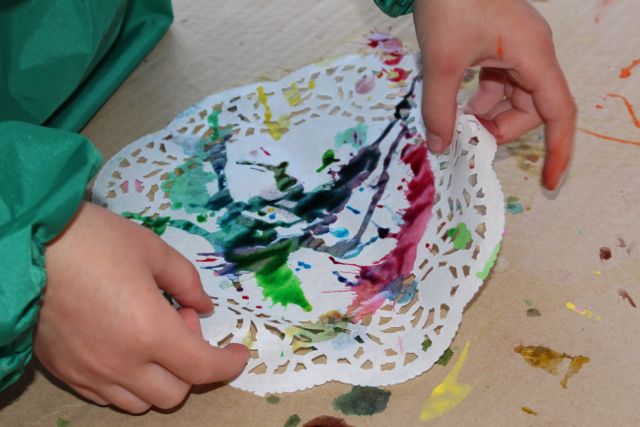
Tipping the doily to spread the colour.

Tipping the doily to spread the colour.

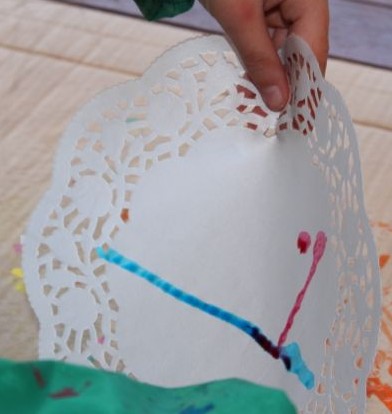
moving the colour about.

moving the colour about.


We used a different paint brush for each colour, dropping the coloured water onto the doilies and then picking them up to make the colours run across the doily. After placing some drops of coloured water on the doily, we found that turning the doily around slowly like a steering wheel made some good patterns. A found it easiest to put some coloured water on, and then pick the doily up from one side and let that colour run off, and then put more drops on and pick up a different side so that that colour ran in a different direction.

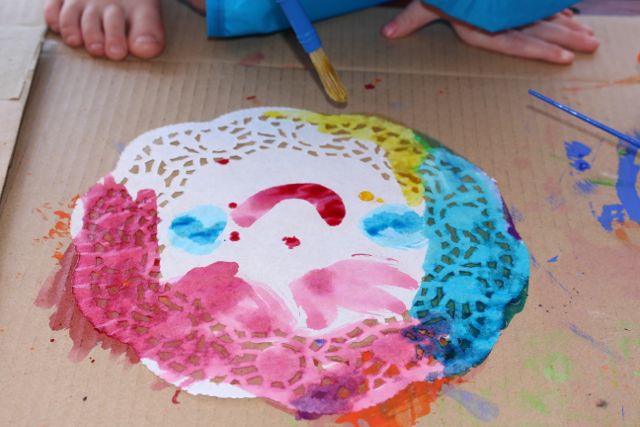
Painting the doily.

Painting the doily.

Both kids also used the paint brushes to apply the colour directly to the doilies, painting the edges, and giving some of the doilies faces.


The doilies dried quickly and we placed them up on some of our windows. I like the way they have brightened up those spaces.

Displayed on the window.

Displayed on the window.

Bubble Wrap Prints

Standard

IMG_4865We sometimes get parcels or items that have bubble wrap protecting their contents. If I can grab it before the kids pop all the bubbles, I usually collect the bubble wrap to be re-used when we post something. In my pile of bubble wrap, I discovered three different sizes of bubbles which was perfect for doing some bubble wrap prints.

Adding paint to the bubble wrap (and hands).

Adding paint to the bubble wrap (and hands).

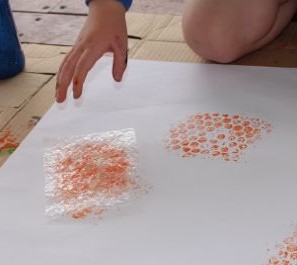
First we tried using a paintbrush to apply the paint directly to the bubble wrap, and then placing the painted bubble wrap onto the paper, but there was just too much paint, so we weren’t able to discern the bubble pattern. It worked much better when we added paint to some kitchen sponges and then pressed the bubble wrap against the sponge to get a little bit of paint. Then L and A pressed the bubble wrap against the paper, and lifted it up to reveal the bubble wrap print left behind.


Pressing the bubble wrap to the paper.

Pressing the bubble wrap to the paper.

Using the large bubble wrap.

Using the large bubble wrap.


The medium sized bubble wrap (orange) worked the best of the three sizes. We used different colours for each size too, adding further variety to our prints. L favoured the large bubble wrap, while A liked using the medium bubble wrap best.

IMG_4793IMG_4867

Jelly-fish

Standard

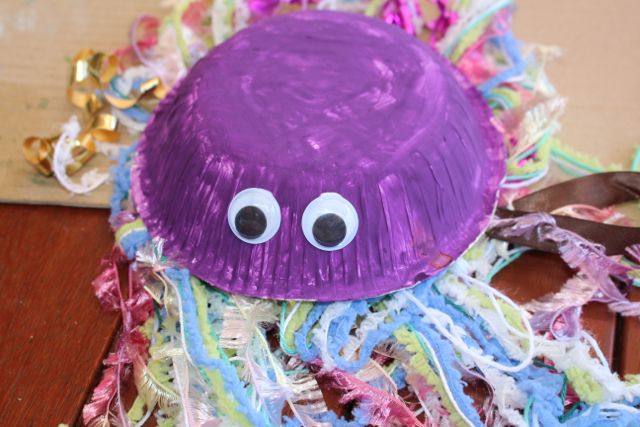
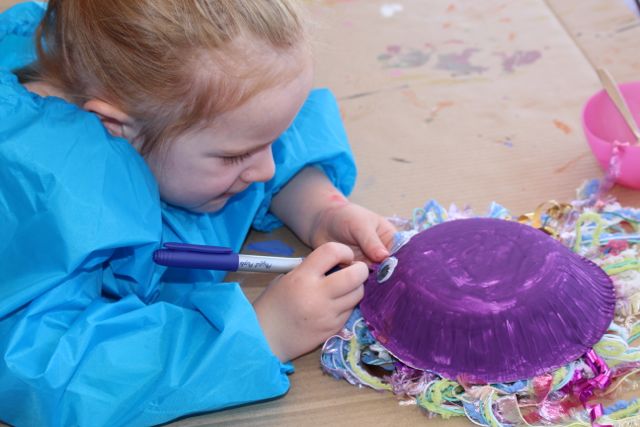
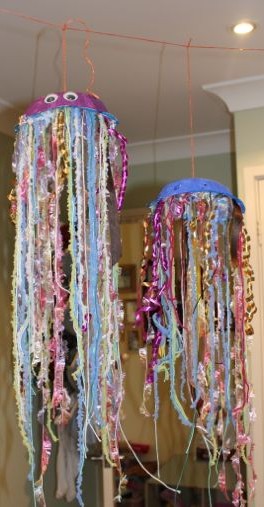
IMG_4769These wonderful jelly-fish were made using a paper bowl and scraps of various yarns, cotton, and ribbons. The ribbons were all collected from gifts we had been given for birthdays last year and were just sitting in the craft box awaiting their final purpose. It’s great when we can re-use something like that in our craft pursuits.

IMG_4754

Painting the top of the jelly-fish.

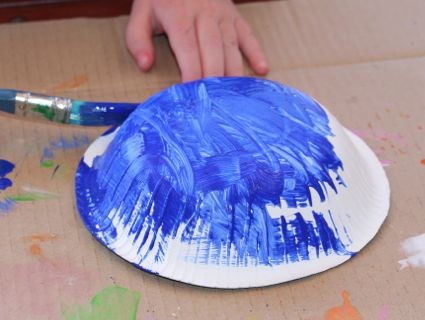
We ended up making three jelly-fish. First we painted the bowls, L picked orange, A picked blue and purple. I ended up finishing off the purple one though, as A got a bit tired of using the tiny detail brush she’d decided to paint with. She chose a much thicker brush for the blue paint, which allowed her to paint the bowl more quickly and easily.

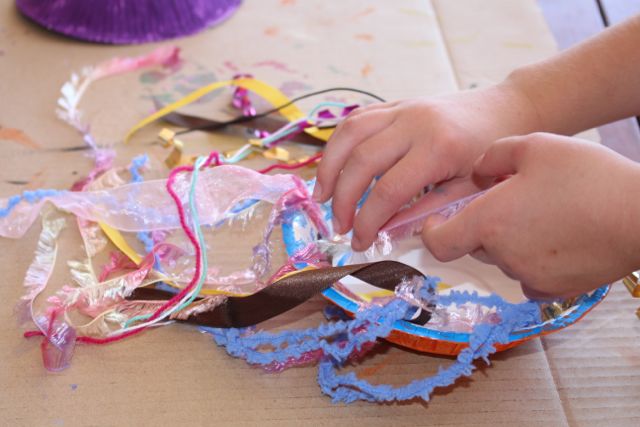
While the bowls dried we sorted out our tentacles. I thought the jelly-fish would look better with tentacles of varying lengths, so I wasn’t very particular about the length of the pieces as I cut them up. I placed the tentacles into two piles, one for each child, so that they each had a range of different tentacles to choose from. I ended up needing to cut more yarn up as we ran out before we had finished. Some of the yarn was feathers, and some was a powderpuff yarn that was fluffy. I thought these yarns looked really good on the jelly-fish, and it gave them a bit more variety and texture, than if we’d just used plain yarns.

Taping on tentacles.

Taping on tentacles.


Attaching tentacles.

Attaching tentacles.


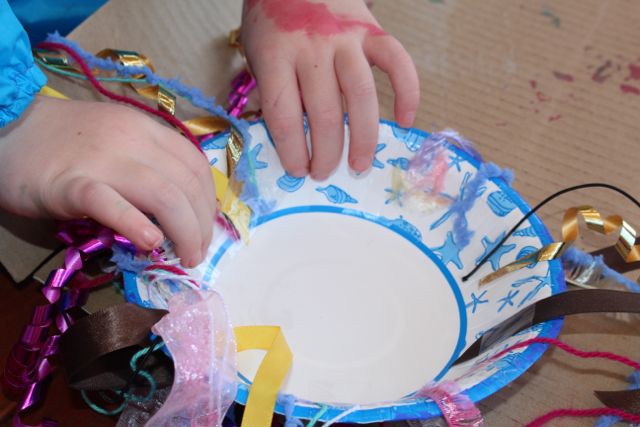
To stick the tentacles onto the bowl, we used sticky tape. The kids made bundles of several tentacle pieces together in some sticky tape, and then they taped that to the inside edge of the bowl. I found that it was easiest to use a longer length of tape, stick the tops of the tentacles along it, and then fold it over to form a rectangle of tape housing a number of tentacles, and then tape that section into the bowl. We continued doing this all the way around the edge of the bowl to give the jelly-fish a good coverage of tentacles.
 

Decorating with markers.

Decorating with markers.

L and A used some permanent markers to decorate the top of their jelly-fish. We also stuck on some googly eyes to the side of the bowl.

We hung the jelly-fish up in their rooms, and they look great with their tentacles wafting about in the breeze.

IMG_4871

Cold Coloured Spaghetti

Standard

It seemed like it was about time that Baby T got involved in some messy play with L and A. I wanted something that he could have fun with, but that wouldn’t be too bad if he ate some of it. So I decided that cooked spaghetti would be great to try. Of course, after cooking the spaghetti, it had to be completely cold before the kids could play with it.

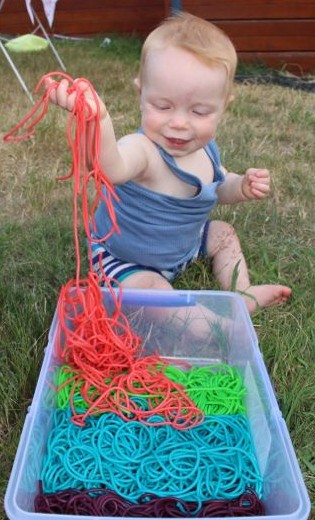
I wanted to make the spaghetti coloured. I thought that if I cooked the spaghetti first, and then mixed food colouring through it, the food colouring would probably just rub off on the kids when they played with it. So I cooked the spaghetti in four batches, each with a different food colour added to the water during the cooking. This worked quite well, and gave us some lovely, vibrant colours. When I tipped the coloured spaghetti into the colander, I rinsed it thoroughly with cold water to cool it quickly and to wash any excess colour away. Some of the colour still came off on the kids’ skin, but it washed off easily. L and A kept trying to eat bits of it too, even though it was cold.

Red, green, blue and purple spaghetti.

Red, green, blue and purple spaghetti.

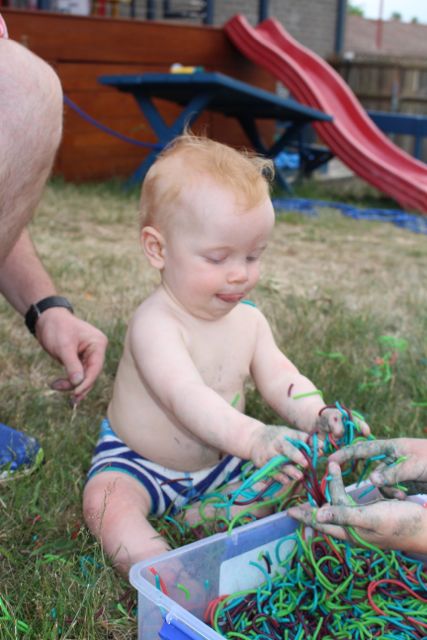
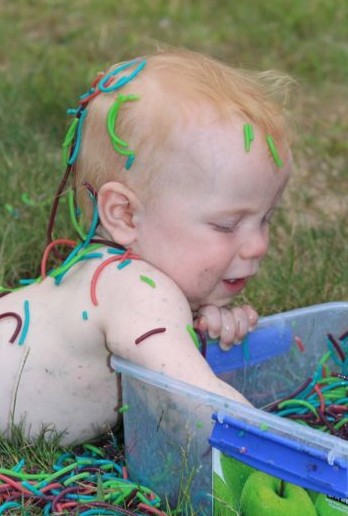
We started with four separate colours of spaghetti in a tub, but it quickly became mixed together. All of the kids really enjoyed this simple activity, running it through their fingers, squishing it, swirling it around. And because it was a bit sticky, they also enjoyed lifting their hands in the air and wobbling about the spaghetti that was stuck to them. Baby T also enjoyed throwing it, mushing it on his tummy, putting it in his hair, and trying to eat it several times. Overall, he had a ball with it.

First impressions.

First impressions.

Enjoying the spaghetti.

Enjoying the spaghetti.

Really getting into it.

Really getting into it.


After a while we added some water to the tub to see what would happen. This made the spaghetti slippery instead of sticky, and provided a new sensory experience for them.

IMG_4821

This was a very messy activity, and I was very glad we’d decided to do it outside. The kids came in one by one for a bath each, and I attempted to pick up as much of the spaghetti off the grass as possible. There was plenty of grass mixed up in it by then, so I put it in our compost bin. All the kids have asked to do this sensory activity again soon.

Box Construction City

Standard

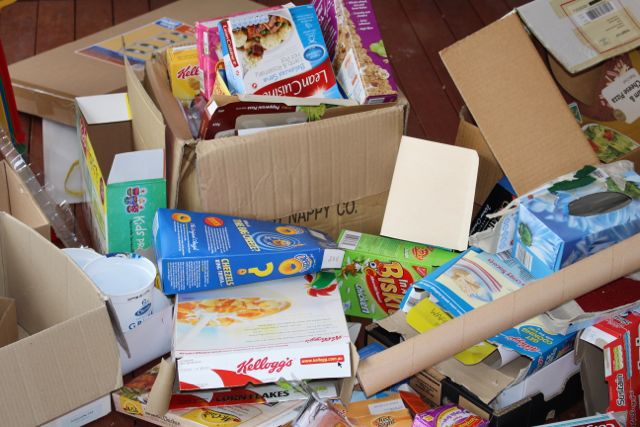
Over the last few months we have been collecting cardboard boxes instead of recycling them straight away. There were also a number of box construction items that had come home from school, and were added to the pile for re-purposing. The pile of boxes grew and grew, until it was taking up plenty of valuable decking real estate. There were a lot of cardboard boxes, of all shapes and sizes, from jelly crystal and bikkie boxes, through to nappy and big packing or freight boxes.

IMG_4715

And what would we do with so many boxes? Well, the answer to that is Boxtown! The end of our deck was transformed into a city this morning by L, A, Big L and myself. Baby T wanted to help, but it was nap time, so he flew off to dreamworld while the rest of us got our builders’ hats on.

Building the library.

Building the library.

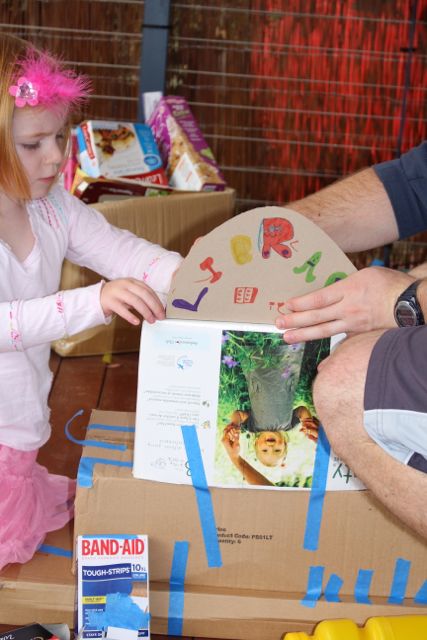
The first large building to be built was a library (I think this must be a reflection of how much we like to read!). L made a lovely sign for the top of it, and both kids helped me tape the boxes together. A tried to attach a thin cracker box as a walkway to another building, but she never made the other building to attach it to, so it just stuck out at the side of the library. Well, at least it did until it fell off, and A didn’t notice, so I didn’t mention it.


Hospital with chopper on the heli-pad.

Hospital with chopper on the heli-pad.

There was also a hospital, complete with heli-pad and helicopter. The helicopter even had a red cross on its side and rotors that could spin. Besides the hospital was an airport and runway made out of painters tape. L made some planes out of cardboard rolls to live at the airport.


Airport and runway.

Airport and runway.

There were other small buildings too, including a dental clinic made from toothpaste boxes, a restaurant made from a yoghurt container, and a doctor’s surgery made from bandaid boxes. These were chosen and made entirely by L, who sorted through the boxes until she found the appropriate ones 🙂

Office tower.

Office tower.

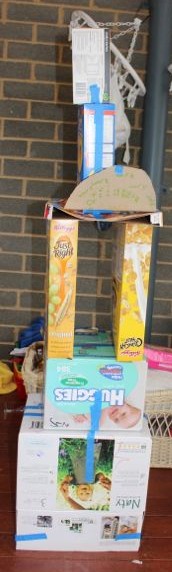
The biggest building in Boxtown  was the office block. Big L helped the kids make it so big, it actually stood taller than L. It was a large skyscraper towering over the rest of Boxtown. A used markers to draw some windows and doors, and make it “pretty”, while L made a sign for it. She wrote the word ‘work’ all over the sign so we had no doubt what was supposed to occur inside the office block, though she made no suggestion as to what work her workers would be performing.

There were also a few houses. A decorated a shoe box, giving it some chimneys and windows, which I think was a house. L made a large dog house too.

This was several hours of building fun, and then some more fun playing in the city. And once the kids have finished playing with Boxtown we will recycle it and reclaim our deck 🙂