Tag Archives: kids art

Paint Scrapers

Standard

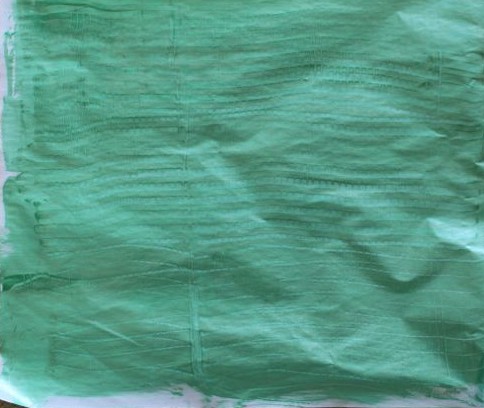
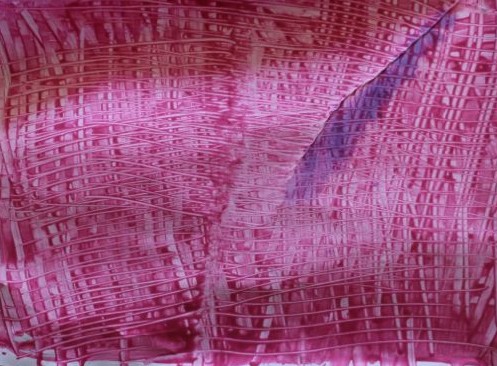
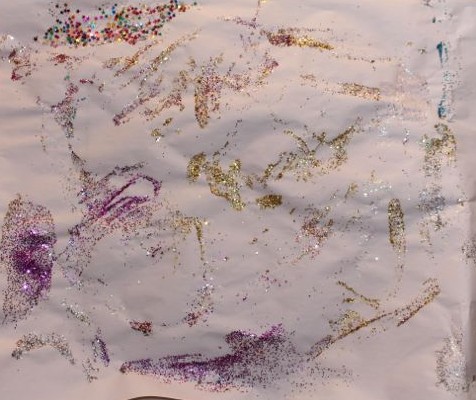
IMG_0266Big L’s birthday is coming up and A wanted to make some special wrapping paper to wrap his presents in. She chose to use metallic paints and paint scrapers for this activity.

IMG_0267

The paint scrapers we used.

The paint scrapers we used.

Spreading the paint.

Spreading the paint.

I bought the paint scrapers at Riot Art & Craft for a few dollars. They are sturdy plastic and each one has a different edge to make different patterns.

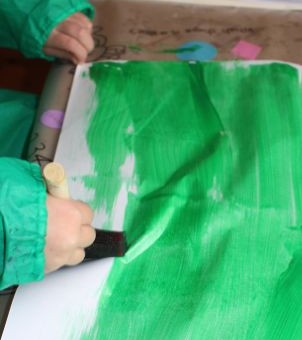
A used a sponge brush to spread the paint over the paper, and then while it was still wet she used the paint scrapers to make patterns in the paint. Most of her paintings were done in one colour, but the one I like the best has three metallic colours. It’s a bit hard to tell in the photos, but the metallic paint looks fantastic!

Creating a square pattern.

Creating a square pattern.

A really liked using the paint scrapers in one direction, and then in the perpendicular direction to create a pattern of squares.

Using one of the scrapers.

Using one of the scrapers.

L and A also did some paintings using normal paint and the paint scrapers. They both created some lovely artworks using this method. The patterns that the paint scrapers left were more obvious in the normal paint than in the metallic paint.

IMG_0270IMG_0271


Mosaics Rainbow

Standard

IMG_9989

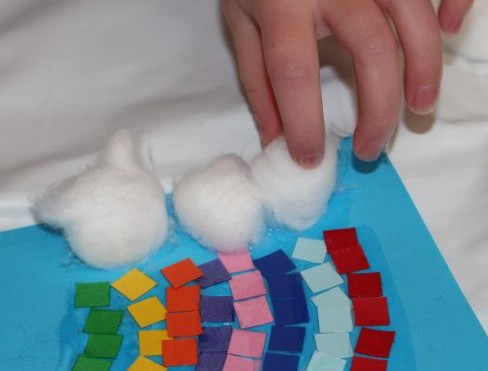
This rainbow was made using cardboard mosaic squares. A made arches of glue and then placed the squares onto the glue to create the rainbow. It took a while for her to do this, but I think it is a lovely rainbow.

Placing mosaic squares.

Placing mosaic squares.

This turned out to be an excellent activity for A’s fine motor skills, as she had to pick up a single mosaic square, and then carefully place it where she wanted it. Sometimes she had to lift a square up and place it down again if she missed, or move them about in the glue to get them into position. She was getting a bit tired towards the end of the rainbow, and I helped her finish the last arch of red squares.

Sticking on some clouds.

Sticking on some clouds.

A chose to make clouds using cotton balls. She packed the cotton balls in so the clouds are very fluffy.

When it dried, the paper under the rainbow became a bit crinkly where the glue had dried. As is A’s tendency, she did use rather a lot of glue, but it looks fine on the wall next to some of her other rainbow pictures.

Jellyfish Picture

Standard

IMG_9984

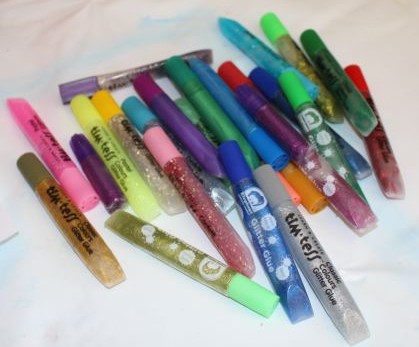
Our pile of glitter and metallic glues.

Our pile of glitter and metallic glues.

We have a tub of glitter glue and metallic glue tubes that the kids use on all sorts of projects. I like using glitter glue over glitter as it is generally less messy (unless A leans in it and then spreads it all over the place…or dangles her hair in it), and it’s easier to place exactly where we want it. The downside is that the kids (especially A) put it on so thick it takes ages to dry, and we often need to leave our projects at least overnight to dry.

Drawing on her waves.

Drawing on her waves.

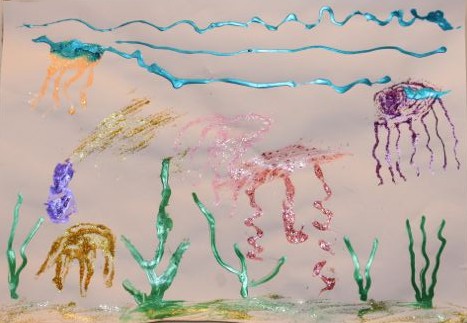
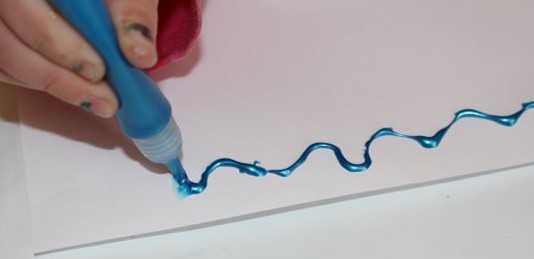
Today A used the glitter and metallic glues to draw a jellyfish picture. She started out painting fish, but they morphed into jellyfish. She also wanted to add an eel, but it grew tentacles and became a jellyfish too. She drew waves with some blue metallic glue, and sand with yellow glitter glue. There’s also some seaweed done in green metallic glue.

I like how glittery this picture is.

Drawing sand at the bottom of her picture.

Drawing sand at the bottom of her picture.

Making a jellyfish.

Making a jellyfish.


Glitter Art

Standard

IMG_9993The kids love glitter, but it gets everywhere! I find it in their hair, their school bags, their clothes, even when we haven’t used glitter for a while. Glitter and sand both appear in my house from origins unknown on a daily basis 🙂 It is nice for use in our art projects though, and this was a very simple glitter art, done in the backyard in an attempt to prevent excessive glittering of the house.

Applying glue.

Applying glue.

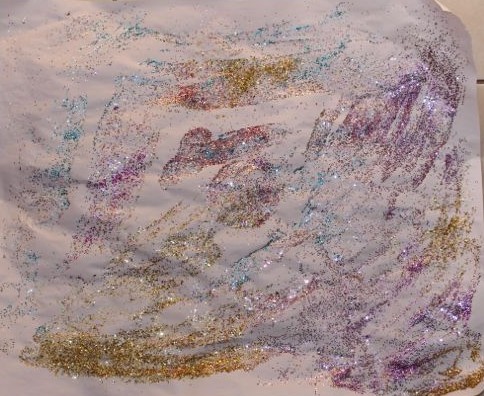
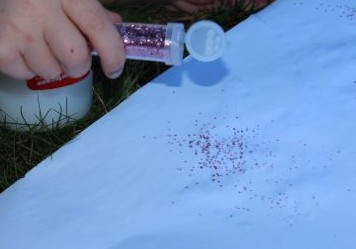
The kids each had some big sheets of paper and some glue. L used the glue to make shapes and words on her piece of paper, while A just added lots of glue all over her paper. Then they sprinkled glitter liberally over the glue. A was a bit wild with the glitter, and lots of it missed the paper (I was happy we’d decided to do this outside!).

Sprinkling on glitter.

Sprinkling on glitter.

Most of our glitter containers have little shaker holes to prevent the glitter coming out in one big pile, which make them a little easier for the kids to use. We had some different sized glitter, and different colours, as well as some rainbow star shaped glitter, which looked great on their pictures.

L's starry circle.

L’s starry circle.


IMG_9996

Pipe Cleaner Rainbow

Standard

IMG_9991

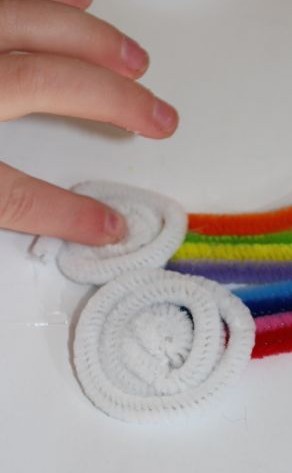
Placing the pipe cleaners.

Placing the pipe cleaners.

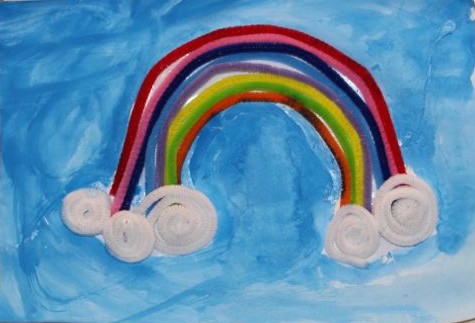
Another rainbow made by A. This time she glued pipe cleaners onto some paper to form a rainbow. She chose the order of the colours, and I helped by applying craft glue (the bottle is almost empty). A bent all the pipe cleaners into arches herself. When she was finished placing the pipe cleaners, I used sharp scissors to cut the bottoms of the inside colours to even the bases up a little.

Making clouds.

Making clouds.

Gluing the clouds on.

Gluing the clouds on.

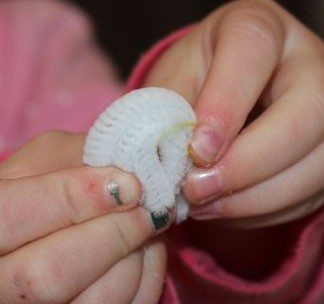
Rolling the pipe cleaners up like spirals to form the clouds was A’s idea, and I think it worked well. She rolled up some white pipe cleaners for this.  I was impressed by how carefully and neatly she did this.

Once she had some clouds finished, she glued them at the bottom of the rainbow.

Painting the sky.

Painting the sky.

Having made the rainbow on white paper, A decided that it should really be in the sky, so the paper should be blue. I suggested she could use some watercolour paints to paint her sky. A liked this idea, so out came the paints. She carefully painted around the rainbow and clouds, making a lovely blue sky for her rainbow.

Pom Pom Rainbow

Standard

A is into rainbows at the moment.IMG_9867

Sorting pom poms.

Sorting pom poms.

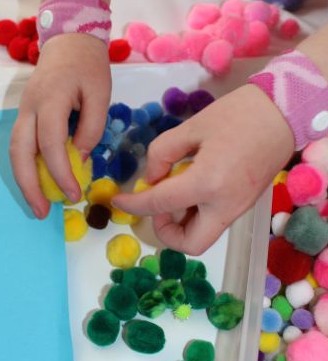
I got out our tray of pom poms, which contains many pom poms in various sizes and colours. A first sorted through them to find the pom poms she wanted to use, placing them in piles of like colours. She chose to use six colours in her rainbow, and to place it on clouds. The clouds are made of cotton balls as A thought they were fluffier, and more cloud-like than the white pom poms we had.

Placing a line of pom poms.

Placing a line of pom poms.

A asked me to place a line of craft glue on her paper in the shape of a rainbow. She carefully placed the pom poms onto the line of glue, one at a time, making an arch in one colour. Then she worked on the next colour, and the next until she had her rainbow complete. Placing the pom poms using her pincer grip was good for her fine motor skills.

Sticking on the clouds.

Sticking on the clouds.

Once all the pom poms were placed onto the paper, A put some glue at the bottom on each side of the rainbow. This is where she placed the cotton ball clouds. I thought it looked very good like this, but A decided that it needed some birds (some birds turned into a lot of birds!).

We have put this one up on our wall. It looks a little lonely at the moment, but we are planning to make some more rainbow pictures to go alongside it.

Rainbow picture with birds.

Rainbow picture with birds.

Painting with Marbles

Standard

IMG_9842

Blobs of paint.

Blobs of paint.

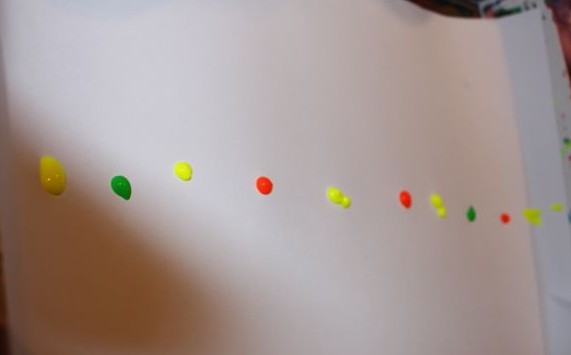
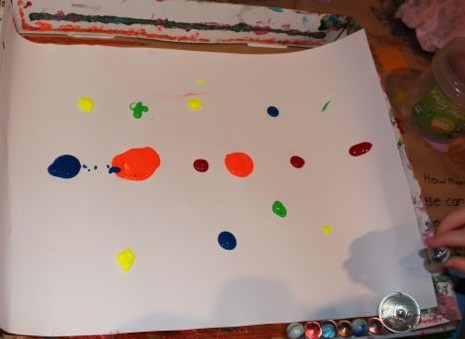
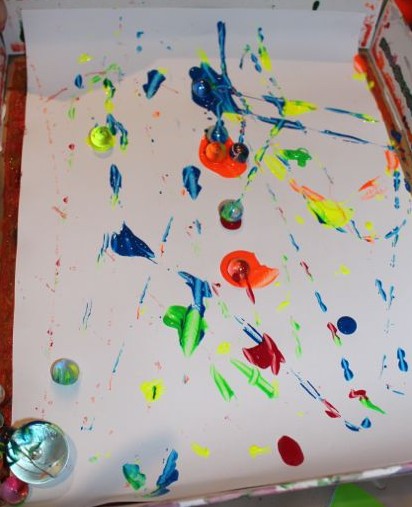
For these paintings each of the kids had a cardboard tray that we laid a piece of paper in the bottom of, then blobbed paint onto the paper. A requested a lot more paint than L.

Rolling the marbles about.

Rolling the marbles about.

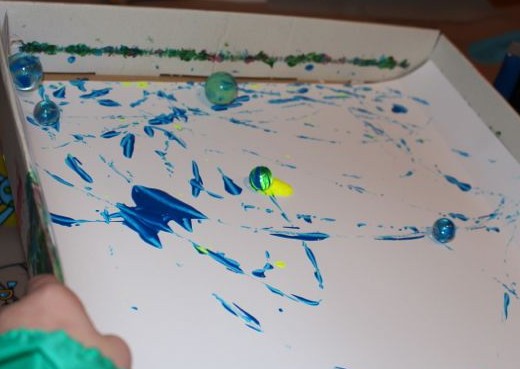
They each chose some marbles to place in their tray. We have a collection of small marbles, and a few larger ones, over which the girls argued. The largest marbles made larger tracks in the paint, but the size of the marbles didn’t really matter for this painting technique. Both L and A placed more than one marble in at a time, and then tilted the tray about to make the marbles roll around. If they tilted the tray too fast the marbles would sometimes fly right out, and we ended up with a few splashes of paint, but that’s what the muck mat is for.

One of L's marble paintings.

One of L’s marble paintings.

Once the marbles ran through the blobbed paint, they transported the paint all over the paper, making lovely patterns. As A had used so much paint, some of her marbles actually got stuck in the paint, and we had to push them along. It also meant that the paint colours mixed together and covered the paper, allowing the marbles to form tracks in the paint, rather than making tracks with the paint.

These are easy and fun paintings to do, and they look great!

A's paper with lots of paint.

A’s paper with lots of paint.

A rolling her marbles through the paint.

A rolling her marbles through the paint.

More rolling marbles.

More rolling marbles.


A's finished marble track paintings.

A’s finished marble track paintings.

Clay Monsters

Standard

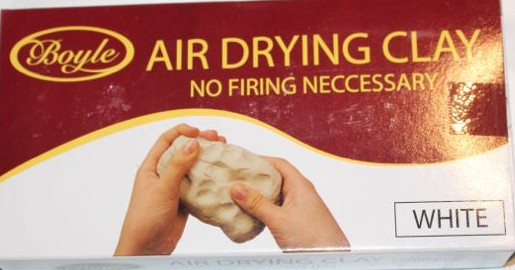
IMG_8261L had previously used some clay at school for modelling, but this was the first time for A. We used white air drying clay, which I bought at Bunnings.

Our dry monsters.

Our dry monsters.

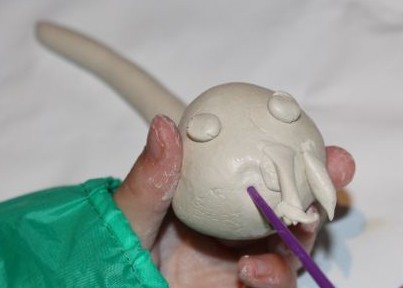
The clay was easy to work with, and the kids treated it much like they would have play dough. They enjoyed the sensation of squishing it in their fingers, and rolling it into balls and sausages. Once they got down to the serious business of shaping their monsters we added a little water to the clay to make it sticky enough to create features. Working with wet clay can get pretty messy too, so we worked on a muck mat, and had damp tea towels for hand (and face) wiping as necessary.

Using a paint brush to add detail.

Using a paint brush to add detail.

I let the kids decide what kind of monsters they would model, yet both of them decided to make serpent monsters. Neither of the kids are particularly keen on snakes, so perhaps they thought snake-shaped monsters would make very scary clay monsters.

Making the clay smooth with water.

Making the clay smooth with water.

A made her clay into a long body with a little head, while L made her snakey monster with a huge head and fangs. L used a paintbrush to add some details to her serpent, such as a mouth. A painted water along the body of her snake until it was very smooth. Her monster really looked like a snake, but she assured me that it was a really terrifying monster. A also made a funny little spotty blob monster, which she said was like a germ.

My monster with umbrella.

My monster with umbrella.

I also made a clay monster of my own, because playing with clay is just fun. My monster was a bit of a blob with four feet, and numerous eyes made by poking the clay with a toothpick. It is also holding a clay umbrella with a toothpick handle. The umbrella was L’s idea, and I love it, it made my monster very quirky, especially since it doesn’t have hands or even arms for that matter, so I think it is holding the umbrella with its side! It has a tail that looks a bit like the opening of a trumpet, and three spikes on its head, but no nose.

The germ monster.

The germ monster.

We placed the monsters onto plastic wrap so they wouldn’t stick to anything, and then left the monsters to dry completely, which took a few days. This was not helped by a bout of rain at the time, keeping the air moist. While they were drying we were careful not to move them or bump them.

L thought she might like to paint her monster once it was dry, but in the end we left them as is. I quite like all of the clay monsters that we made, and we have placed them onto a shelf for display.


Rainy Day Pictures

Standard

IMG_9777While I was walking down one of the hallways at L’s school I spotted some wonderful rainy day art on the wall done by one of the classes. I liked them so much we tried them at home. At school they had used oil pastels and edicol dye, but we substituted watercolour paints, as we didn’t have the dye.

L drawing her picture.

L drawing her picture.

First we drew a picture using the oil pastels. Most of the picture was drawn in white, including the clouds and raindrops. L put big bolts of lightning on her first one too. I also drew a picture and added a rainbow to it as an example for A of what we could do. A copied this picture, adding rainbows to her art.

Adding watercolours paint.

Adding watercolours paint.

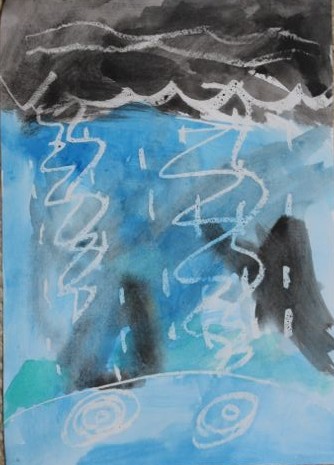
Once we finished drawing with the oil pastels, we used watercolour paint to cover the paper. The oil pastels resist the paint, so that only the blank paper is coloured, and the picture emerges clearly. I used black and blue for my clouds, light blue for the sky and light green for the hills. L made her first picture very blue with deep black clouds at the top. She also added some black in the background, giving her picture a cityscape look. She told me that the swirls at the bottom are from the drops of rain, but I think they look like scorch marks from her lightning. A had one picture copied from mine with black clouds, blue sky and green hills, but her other one was almost all blue. For this one she added some purple across the bottom, mixing it with the blue, and told me it was a river with lots of fish.

A's second picture.

A’s second picture.

My rainy day painting.

My rainy day painting.

L's thunder storm.

L’s thunder storm.


A has a tendency to use a lot of paint in her art, and this left her paper quite wet and a bit soggy in places. Mine and L’s paintings dried quickly, but we had to wait a while for A’s. We have our rainy day pictures displayed on our living room wall.

Tie Dye

Standard
Mirrored fold.

Mirrored fold.

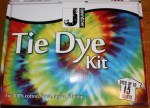
IMG_9696We just had to try tie dyeing, it is so much fun, and it produces some beautifully unique and bright clothes. We used basic white cotton t-shirts and singlets for our tie dyeing, but it suits lots of other garments and cloth items too. I bought the tie dye kit from Educational Experience, as I wanted an all inclusive starter pack to help us get this fabulous activity right. This kit even came with a very handy DVD showing how to make some of the popular folds for tie dying.

L creating a swirl fold.
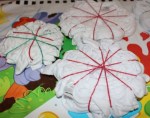
L creating a swirl fold.

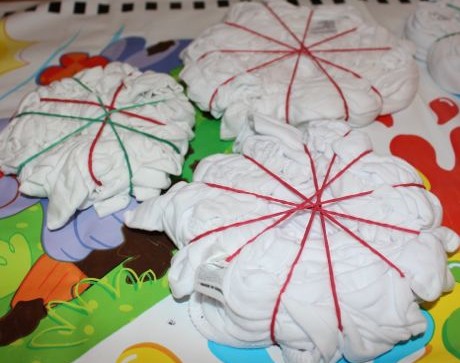
All tied up.

All tied up.

We washed our shirts, and then folded and tied them up in various ways while they were still damp. L was quite good at getting her shirts folded, A needed a little help, especially when placing the rubber bands around the fabric. They tried swirls, scrunches and concertina folds. I also helped A place one of her singlets into lots of little puffs of fabric each secured tightly by a rubber band. I also tied up some shirts. My favourite to do was making the swirl.
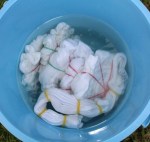
Soaking in the soda ash solution.

Soaking in the soda ash solution.

The shirts had to soak in soda ash solution for at least twenty minutes. We did this in one of our large nappy buckets (a clean one!). While they were soaking we got our dyeing area set up. We did it outside to minimise the potential for getting dye on anything that it wouldn’t come out of, like the carpet. I laid down a muck mat on the grass, and the kids wore old clothes and art smocks, as well as gloves to protect their hands. The kit came with dye applicator bottles that required the addition of water and vigourous shaking to make the dye usable, so I did this, and then we could start. There were three dyes, red, blue and yellow, but these were easy to mix to make sections of purple, green or orange.

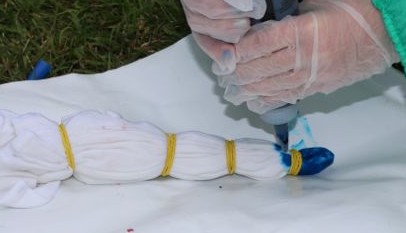
L dyeing the end of her bull's eye short blue.

L dyeing the end of her bull’s eye shirt blue.

Excess soda ash solution was squeezed out of each shirt as we removed it from the soaking bucket. Then it was ready for the dye to be applied. The kids enjoyed putting the dye onto their shirts in various colour combinations. It was very messy though, and even with the protective clothing, both kids had splashes of dye on their skin. A kept touching her face, resulting in numerous dye splotches on her forehead and cheeks, and L splattered some blue dye onto her legs. It didn’t wash off our skin with the first wash, but it was mostly gone by the following day.
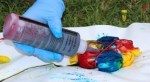
Dyeing a swirly shirt.

Dyeing a swirly shirt.

Some dye ran off onto the plastic muck mat, so we opted to place our shirts onto cake cooling racks to help reduce the run-off dye from getting on the fabric where we didn’t want it. We also wiped down the mat with paper towel and washed dye off our hands in between shirts. When each shirt was finished receiving dye, it was placed into a plastic zip-lock bag to rest for about 24 hours.

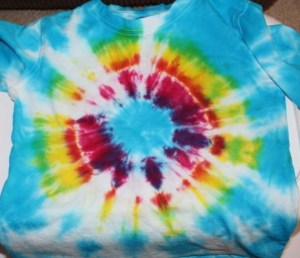
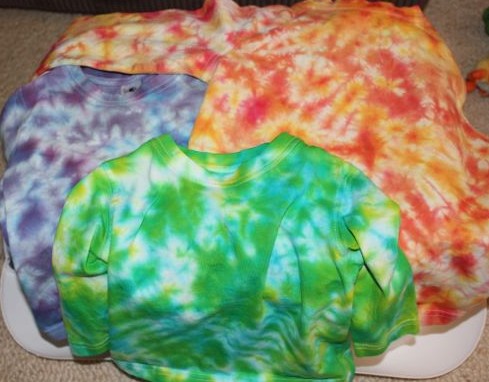
After waiting a whole day, I rinsed the shirts out, removing excess dye. I removed all the rubber bands, and rinsed them some more, and then washed all of them in a regular wash. The first round of rinse water from the machine was still pretty blue, but it ran clear after that. I hung all the shirts up to dry. It was a spectacular row of colour hanging on my line. All the patterns came out wonderfully and the kids are so happy with them.
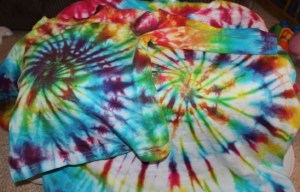
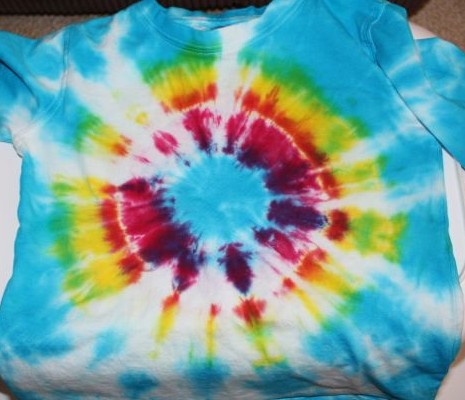
Spirals.

Spirals.

Scrunch pattern shirts.

Scrunch pattern shirts.

L's bull's eye.

L’s bull’s eye.

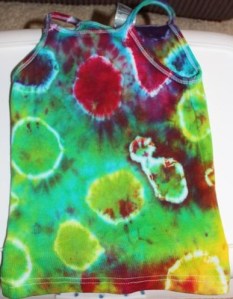
This is A's singlet that had all the little tufts of fabric caught in rubber bands. The whitish circles is where the rubber bands were.

This is A’s singlet that had all the little tufts of fabric caught in rubber bands. The whitish circles are where the rubber bands were.
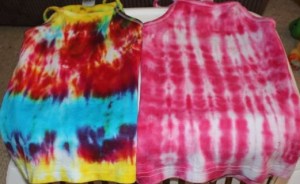
The left singlet was folded in quarters and the right was vertically concertina folded.

The left singlet was folded in quarters and the right was vertically concertina folded.