Category Archives: Fine Motor Skills

Rainbow Sight Words

Standard

IMG_3872A has just started kindergarten. To help her with her reading we have been learning sight words. To help her learn and retain these words, we like to do activities with the words, the same way we learn our spelling words.

IMG_3860This week we tried making rainbow words with the sight words. First I wrote each word in large letters on some paper, and then A traced over the letters with different coloured gel pens and pencils. She particularly liked using her sparkly gel pens! Markers, crayons and chalk also work well. A continued tracing over and over the word with different colours to form rainbow letters.

This is a great activity for practicing the letter shapes, learning the words and learning the spelling. It is fun too! IMG_3867

Felt Christmas Tree Decorations

Standard

IMG_2671

IMG_2659I was browsing in Riot Art & Craft the other day and we came across these little felt decoration kits. They looked like fun, so I bought two.

Sorted and ready to go.

Sorted and ready to go.

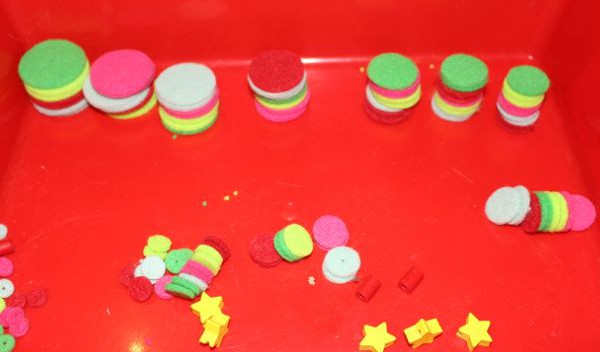
The circles came pre-punched in felt rectangles, so the kids popped them all out then put the scraps in the bin. Once we’d sorted the circles into piles of different sizes, I noticed that we were short a few circles, and the kids had to go and get them from the bin (luckily they were in a new bin bag so there wasn’t anything yucky in there!). We sorted the piles from biggest to smallest to make it easier to pick up the right sized circles.

Threading the felt circles.

Threading the felt circles.

We tied knots in the end of the silver string and threaded the plastic needles. Then the kids got to work, first adding the cylindrical bead for the tree trunk, and then the felt circles in descending order and finally the star bead. This was where it got a little tricky however, because then the instructions suggested making a loop and taking the thread back through the beads and circles to tie it off at the base where we started. I had to help the kids do this, and the star bead mostly popped off when we tried to tie the thread at the opposite end. The star was easy to thread back on, and then I added a knot above it to stop it slipping off again.

I have added a drop of craft glue to the bottom of the trunk bead and the top of the star bead to prevent the thread pulling through in the future. And I trimmed the end of the thread ready to hang on the Christmas tree.

L (7 years) found this an easy and enjoyable activity that she could complete herself. On the other hand, A (5 years), had more difficulties and required more help with tying the knots and getting the thread back through everything. Putting on the beads and felt circles was easy enough, but she kept letting the thread go, and she had trouble re-threading the needle. A made several trees with help, and still enjoyed it, but L could have done this as a solo activity.

IMG_2672

Cardboard Roll Trees

Standard

Making play trees is quite easy using some simple materials, such as cardboard rolls, tissue paper and streamers. Using cardboard rolls of different length or width can make an even more interesting forest of play trees.

IMG_1678

We made four different trees to play animals and dinosaurs with.  A chose to make our play trees green because “trees are meant to be green mummy!”, but I think we could have made trees in other colours to play with. I like the idea of a magical forest of pink and purple trees to play with our fairies and unicorns!

IMG_1658

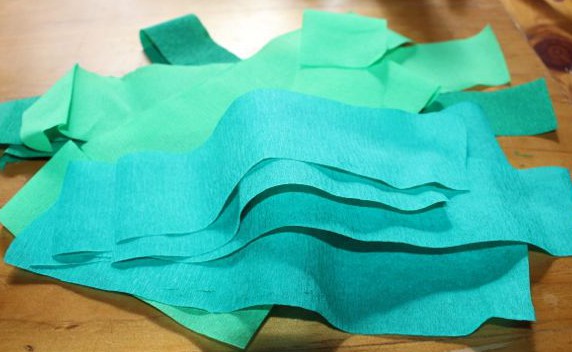
Strips of streamers.

Strips of streamers.

The first tree uses green streamers as the leaves. We had streamers in a few shades of green, so we used strips of each on our tree, but one colour would have been fine also.

The strips taped together.

The strips taped together.

We cut the streamers into strips, and laid them in a pile. Then A twisted the end of the pile together and used sticky tape to secure it. She placed the bundle of streamers into one end of a cardboard roll and taped it down. She fluffed out the streamers in all directions to create the top of the tree. A has been referring to this tree as her “jungle tree”.

IMG_16690

Taping on the tissue paper circle.

Taping on the tissue paper circle.

Adding more layers of tissue paper.

Adding more layers of tissue paper.

The second tree used tissue paper circles for the foliage. A placed a cardboard roll onto the centre of a circle of tissue paper and taped it down. Then she turned it up the right way and used a dot of glue in the centre of the tissue paper circle to attach another circle to the first, and then a third one on top of that. We used four or five pieces of tissue paper, but adding more would have made a puffier tree. Once the glue had dried, we were able to shape the tissue paper to create layers of foliage.

IMG_1668

A cut strip of paper.

A cut strip of paper.

The first leaf attached.

The first leaf attached.

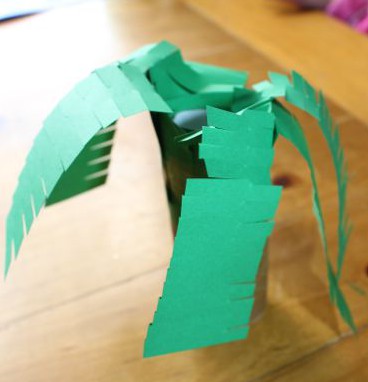
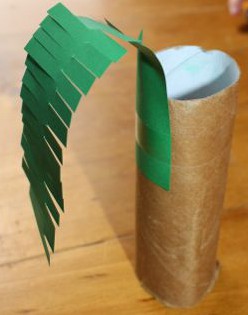
The next tree has foliage made from sheets of green paper. We cut the paper into strips, and then placed small cuts into both sides of these strips to create leaves that A thought look like palm leaves. The key is not to cut right through the strip, though A had a little trouble with this and we ended up with a few short leaves! We left a section at one end of each leaf uncut, where we could attach each leaf to a cardboard roll. A taped the leaves to the outside of the roll, and then let the leaves flop outwards and down. This was her favourite tree.

IMG_1663

Putting the tissue paper into the cardboard roll.

Putting the tissue paper into the cardboard roll.

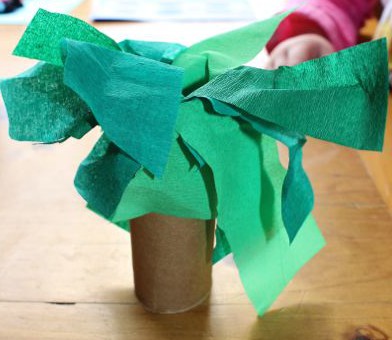
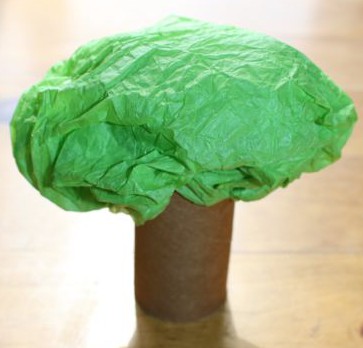
The last tree was the simplest of all. A loosely rolled one end of a sheet of tissue paper and inserted it into a cardboard roll. She used a piece of tape to secure it, and then scrunched and shaped the tissue paper into a ball shape to create the tree’s leaves. She added a few pieces of tape to keep the tissue paper attached to the cardboard roll.

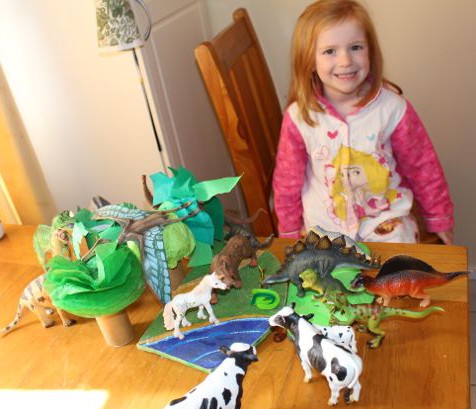
A was very happy with her cardboard roll trees, and used them to create fun play scenes with her animal and dinosaur figurines.

A very happy girl with her new trees and her animals.

A very happy girl with her new trees and her animals.

Paper Weaving

Standard

IMG_1683Paper weaving is a simple activity that kids love. It can be done with just two contrasting pieces of paper. A chose a sheet of purple paper for her base, and then some green, light blue and dark blue paper for her weaving strips.

The cut base, with the edge forming the frame.

The cut base, with the edge forming the frame.

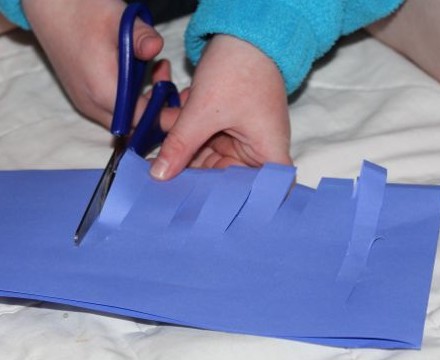
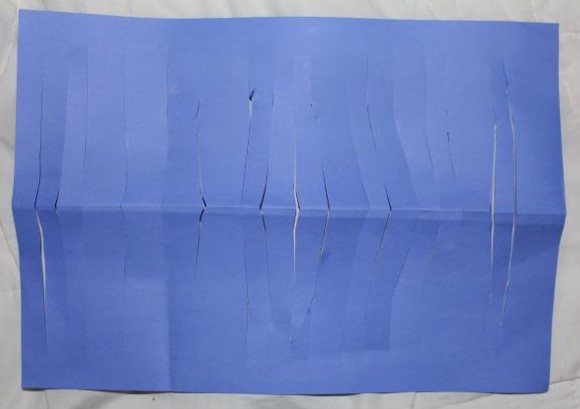
I folded the sheet of purple paper in half (short ends together), and then cut in from the folded side, leaving a couple of centimetres at the end and edges to form a frame around the edge. Each cut was about two centimetres apart, but there’s no need to be exact.

Cutting a strip of paper.

Cutting a strip of paper.

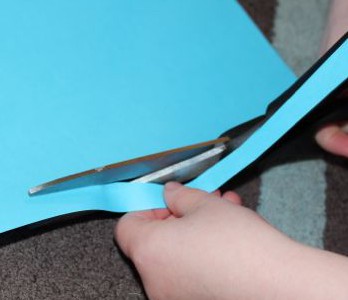
A cut some strips of coloured paper to weave through the base sheet. She made some thin and some fat. I think having uneven strips makes the finished artwork more interesting than even strips.

A started weaving strips through the cuts of the base sheet. She practiced over, under, over, under… until her strip was all the way across the base. Once she had a strip weaved through, she pushed it up against the edge of the last one, and did another one. It was a little difficult to get the last strip in, as there wasn’t much space left, so I helped her finish it off.

Weaving paper strips.

Weaving paper strips.

A added a dab of glue under the end of each strip to hold it in place. The Clag glue made the colour in the paper run a little, so we could see where the glue was even once it had dried, so next time we will use a glue stick!

Putting on some glue.

Putting on some glue.

Button Photo Frame

Standard

IMG_1507

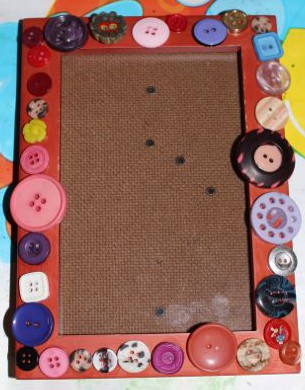
The photo frame.

The photo frame.

Last week I picked up a cheap wooden photo frame from the local second hand shop. It was very plain, but in good condition. A jazzed it up for me using a selection of buttons from our button jar.

A spread all the buttons out on the table so that she could select the ones she wanted to use. In order to stick to the frame, the buttons needed to have a flat back. Then she added some glue and started sticking buttons all around the frame.

Gluing on buttons.

Gluing on buttons.

Once it was dry we put a photo of the kids with their great grandmother into the frame, and it is sitting on our dining table.

Letter Writing Organisation

Standard

The kids are getting into writing letters, the old fashioned snail mail way. They love to write letters and draw pictures to send to their friends and family members. A also really likes sticking the stamps onto the envelope. They are always so excited when a letter arrives for them too!

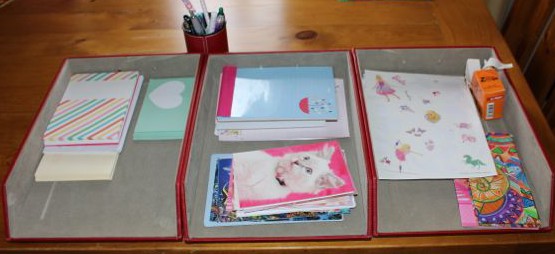
Paperwork trays with matching pen holder.

Paperwork trays with matching pen holder.

I bought each of them some letter writing packs, with envelopes, paper and stickers. Over time though, we have ended up with some odd envelopes and paper, stored in various places about the house. I thought it was time to bring all of our letter writing supplies together and store them in a more organised and neat fashion. I was trying to devise a way that I could make a holder for our stationery, when I came across some paperwork trays at a friend’s garage sale. I knew these would be just perfect for our writing supplies.

With the kids’ help, we located as much of the writing supplies that we could and brought them together on the dining table. I took everything out of its packaging, to reduce the clutter. Some packets had a single envelope in them! We tried out all of the pens that had been stored with the writing paper, and threw out the ones that didn’t work.

Mix and match stationery supplies.

Mix and match stationery supplies.

As we had three trays to work with, we divided the supplies into three piles. We used one tray for envelopes, one for paper, greeting cards and note pads, and in the third we placed sticker sheets, address books and stamps. We stacked them on top of each other, and added the pen holder with some pens and pencils to the top tray. It is a lot neater, and far easier to find what we’re after.

IMG_1530

The trays.

Our new organised letter writing station.

Our new organised letter writing station.

Yellow Sensory Tub

Standard

IMG_1314I gathered lots of yellow things from about our house and popped them into one of our sensory tubs yesterday. I was surprised by the amount of yellow things we just had lying about. There was a plate, bowl, spoon and fork, as well as some yellow lids, a silicone chocolate mould, felt shapes, plastic frogs, wooden pegs, a pom pom and pipe cleaner. And of course, the yellow sensory tub wouldn’t have been complete without a banana and a lemon.

Putting yellow things into the bowl.

Putting yellow things into the bowl.

Baby T went straight for the banana (he loves them) and tried to take a bite right through the skin. He was very happy when L peeled it for him, it quickly disappeared and he wasn’t interested in the skin. Then he took everything else out of the tub to look at it carefully. He put everything into the bowl and gave it a mix with the spoon. He tried to spear the pom pom with the fork, and he enjoyed banging the pegs against the plasticware.

Trying to pick up the lemon with the tweezers.

Trying to pick up the lemon with the tweezers.

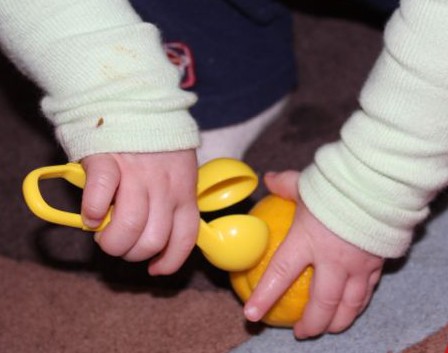
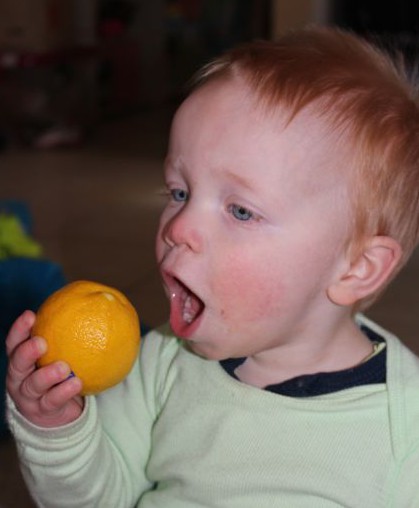
We spoke a lot about the colour yellow, and the textures and shapes of the different items as Baby T explored the tub. L and A tickled him with the pipe cleaner, and pretended to make the frogs jump onto his head. Baby T really liked the lemon and the big plastic tweezer scoop, and spent a lot of time playing with these items. He tried to pick the lemon up with the tweezers many times, but it was far to big. He also took a bite out of the lemon… He wasn’t impressed with the taste, but he still wouldn’t let the lemon go.

Going for a big bite.

Going for a big bite.

Scratch Art

Standard

IMG_0845Scratch art seems to be very popular with the kids at the moment, and I’ve been asked on numerous occasions to buy some of the scratch art card. I remember making our own scratch art paper when I was in primary school, so I thought the kids might like to try this at home.
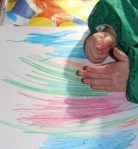
A colouring in her paper.
A colouring in her paper.

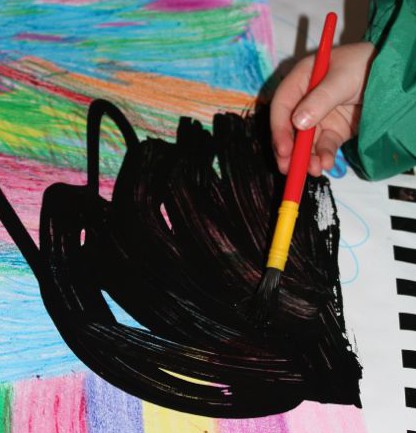
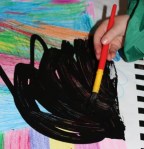
A adding black paint.

A adding black paint.

We coloured in some sheets of paper using crayons, so that the whole page was covered in crayon. We used a rainbow of colours in no particular pattern. A just scribbled all over her piece of paper until it was mostly covered, and then I helped her fill in the edges. Once the colouring in was done, we used thick black paint to cover the paper, covering up the crayon rainbows. We left it to dry.

There was a shaft of sun coming in our lounge room window, so we positioned the paper on the floor in the sun to help them dry a little more quickly. There were still a few wet patches, when ,unfortunately, our cat came inside. I didn’t expect him to decide, not only to walk through the wet paint, but to lay down for a snooze in the sun, right on top of one the black pieces of paper! I have never been so pleased to own a mostly black cat before. When I shooed him off, he trod a bit of paint along the floor, which I had to clean up, but he took care of the rest himself (no need for a bath, luckily!) And what have I learnt from this? Well, for starters, I’ll make sure I shut the cat outside next time we decide to paint on the floor 🙂
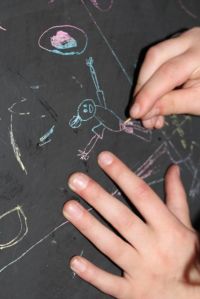
L using a toothpick to scratch out her picture.

L using a toothpick to scratch out her picture.

So eventually, the paint was completely dry, and L and A were able to set about scratching the black paint off to reveal the crayon beneath. They tried a few different items to scratch the paint with, including the end of a spoon, a matchstick, and some toothpicks. They both agreed that the toothpicks worked the best.

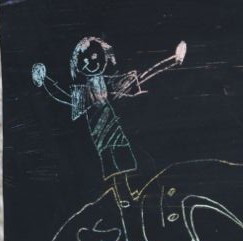
A made a lot of squiggles all over her piece of paper. After all the scribbling, A did draw herself in the corner, which I thought was quite nice.

A drew herself.

A drew herself.

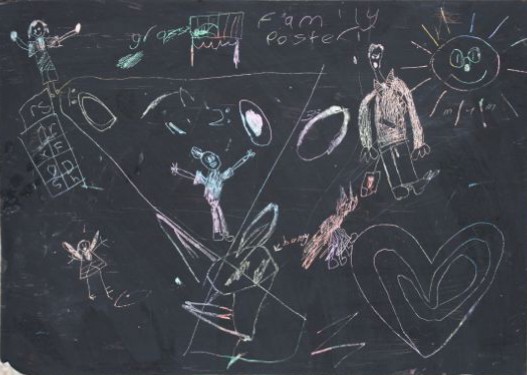
L drew all of the members in our family, and called her picture “Family Poster”. She drew A wearing fairy wings, and Big L wearing a tie. A has fairy wings on a couple of times a week, but I can’t remember the last time Big L wore a tie! She put glasses on the sun, and Baby T is in his cot.

The brightness of the crayons were a bit dulled when the paint was scratched off, so we might need to put the crayon on thicker next time. We could also try using  oil pastels instead of crayons to see if that works.

L drew herself too.

L drew herself too.

I really like these pictures. The kids had fun making the scratch art paper, and then using it to scratch out their pictures. This is something that was fun, and we will do again (though hopefully without the help of our cat).


IMG_0847

Paper Lanterns

Standard

IMG_0727Paper lanterns are a quick and easy craft activity, great for rainy days!

A cutting her paper.

A cutting her paper.

The kids each picked out a sheet of coloured paper and folded it in half lengthways. They cut into the paper from the folded edge, parallel to the short side of the paper, until about 1cm from the non-folded edge. The cuts continued at roughly 1-2cm intervals down the length of the paper. Though A’s cuts were a little wobbly, she was very careful not to cut all the way through.

The cut paper.

The cut paper.

Once the cutting was finished, they unfolded their sheets, and with the folded edge facing out, they curled one short edge around to join the opposite edge in a circle. We used sticky tape to secure the two edges together, but staples or glue would have also worked. The kids used some strips of paper in other colours as handles for their lanterns, attaching them with tape to the top.

A's big lantern.

A’s big lantern.

We had a packet of coloured squares too, which we used to make some mini-lanterns. L thought these little lanterns were very cute, and has hung some of them in her room.

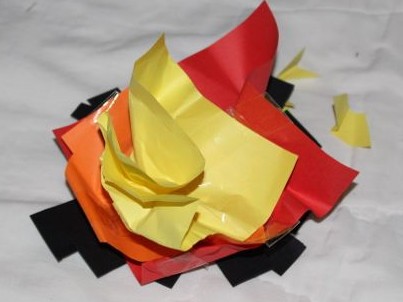
Having the packet of little squares out led A to ask about making a flame for inside her lantern. She picked out some orange and yellow squares, and scrunched them together to form a flame. I helped her tape her flame into the base of her big lantern.

A's lantern flame.

A’s lantern flame.

The flame inside the lantern.

The flame inside the lantern.


Talk of flames led to talk of campfires, and next thing I know, L has made a fire from red, orange and yellow paper squares, and A has cut up a piece of black paper to form the sticks of a camp fire. A carefully arranged her sticks, and then placed the fire on top of them. She put her little puppy toys next to the campfire and pretended that they were having a little rest next to the warm fire. I love it when the kids have some spontaneous pretend play.

The campfire.

The campfire.

The puppies enjoying the warmth of the campfire.

The puppies enjoying the warmth of the campfire.

Button Flower Art

Standard

IMG_0260

Placing buttons.

Placing buttons.

These old buttons have been made into flowers by A. She chose a centre for each flower, and then surrounded it with other buttons for the petals. Once the buttons were placed just right, I helped her to glue them down.

Drawing flower stems.

Drawing flower stems.

A used crayons to draw flower stems and leaves and grass. She wanted lots and lots of wild grass, and ended up drawing so much the flower stems were lost a bit, but she was happy. The top of the page looked a bit bare then, so I suggested some clouds. A decided that if there were to be clouds there should also be rain, and a sun. She told me that it needed a sun to be happy, but she also wanted it to be a rainy picture.

Button flowers stuck down.

Button flowers stuck down.