Tag Archives: craft

Pom Pom Rainbow

Standard

A is into rainbows at the moment.IMG_9867

Sorting pom poms.

Sorting pom poms.

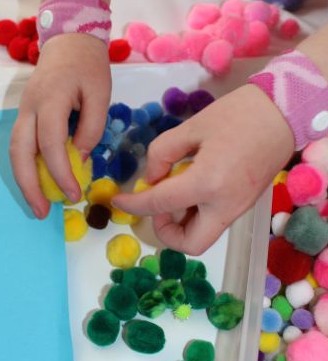
I got out our tray of pom poms, which contains many pom poms in various sizes and colours. A first sorted through them to find the pom poms she wanted to use, placing them in piles of like colours. She chose to use six colours in her rainbow, and to place it on clouds. The clouds are made of cotton balls as A thought they were fluffier, and more cloud-like than the white pom poms we had.

Placing a line of pom poms.

Placing a line of pom poms.

A asked me to place a line of craft glue on her paper in the shape of a rainbow. She carefully placed the pom poms onto the line of glue, one at a time, making an arch in one colour. Then she worked on the next colour, and the next until she had her rainbow complete. Placing the pom poms using her pincer grip was good for her fine motor skills.

Sticking on the clouds.

Sticking on the clouds.

Once all the pom poms were placed onto the paper, A put some glue at the bottom on each side of the rainbow. This is where she placed the cotton ball clouds. I thought it looked very good like this, but A decided that it needed some birds (some birds turned into a lot of birds!).

We have put this one up on our wall. It looks a little lonely at the moment, but we are planning to make some more rainbow pictures to go alongside it.

Rainbow picture with birds.

Rainbow picture with birds.

Cardboard Roll Bunnies

Standard

IMG_9557These cute little bunnies are made from toilet rolls, but any cardboard tubes could be used. We covered the rolls with white paper first. We glued the paper to the tubes, and folded the ends inside the tube for neatness.

Making bunny ears.

Making bunny ears.

Drawing on details.

Drawing on details.

Adding a tail.

Adding a tail.


I cut out some pink cardboard for the inner sections of the white paper ears, and L glued the cardboard to the paper. The kids glued two ears into the top of their cardboard roll. Then they got busy gluing on googly eyes and using markers to add the facial features and arms. L also drew a little carrot in the hands of her bunny, which A promptly copied onto her bunny too. L drew her bunny’s feet on, but A wanted to use a white pipe cleaner as feet for her bunny. I cut two small lengths of pipe cleaner, and bent them around to form little feet, then A glued the end of them into the base of her roll.

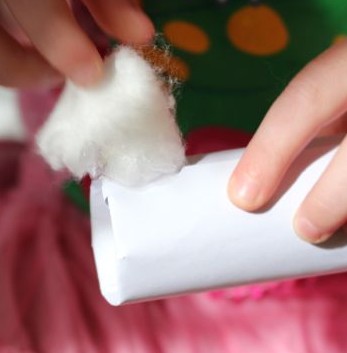
To finish the bunnies off, the kids glued a cotton ball onto the back of the cardboard roll as a tail. While we had the cotton balls out, L had an idea for making baby bunnies. She made some ears out of paper and markers, and glued them to a cotton ball. Then she added some tiny googly eyes. She gave this baby bunny to A to play with. They called this one Baby Hopsity, and the bigger bunnies were Father and Mother Hopsity.

Baby Hopsity.

Baby Hopsity.

Cardboard Roll Chicks

Standard

IMG_9564

Gluing on the yellow paper.

Gluing on the yellow paper.

The roll covered in paper. The edges have been folded into the roll.

The roll covered in paper. The edges have been folded into the roll.

We used toilet paper rolls for these chicks, but rolls from paper towel or similar could have been cut in half to use instead. We covered the cardboard rolls in yellow paper so that the paper extended beyond the ends of the roll. We cut these sections just to the edge of the cardboard to create a fringe of paper at the ends of the roll.  Then we folded the excess paper fringe into the centre of the roll to make a neatly covered cardboard roll.


Adding feet.

Adding feet.

Adding eyes.

Adding eyes.

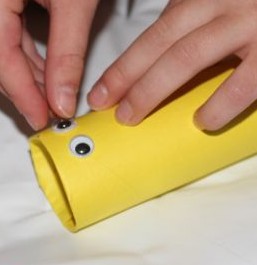
I cut out some feet shapes from orange cardboard and the kids added them to the base of their rolls. Each foot had a little tab of cardboard folded up and glued on the inside of the roll. L and A added googly eyes and the beaks were made from a small piece of pipe cleaner folded into a little triangle and glued onto the roll.

L cut down some yellow feathers to the size she wanted, and placed them on the sides of her chick for wings. She also glued a small piece of feather to the back as a tail. A cut up feathers to use on her chick too. She added wings, a tail, and some hair to her chick. Both chicks are really cute.

The back of L's chick.

The back of L’s chick.

Showing the placement of feathers on A's chick.

Showing the placement of feathers on A’s chick.


Sand in a Bottle

Standard

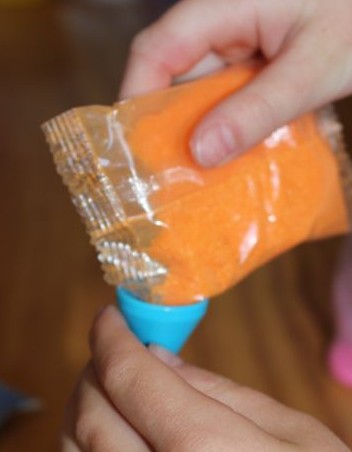
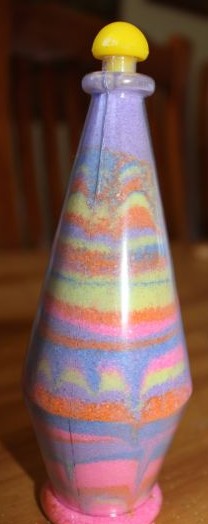
IMG_9460I had been sourcing supplies to try layering coloured sand in bottles, when I saw this kit advertised in the Scholastic Book Club (Australia). It was a good opportunity for the kids to try this craft activity on a small scale. The kit came with small bags of coloured sand, plastic bottles and stoppers, a little funnel and a styling stick. The sand was purple, orange, blue, pink and yellow.

Some of the bags of sand.

Some of the bags of sand.

Pouring sand.

Pouring sand.

Each of the kids picked a bottle and got started. Surprisingly we had very few spills of sand, and the kids were very careful pouring it into the funnel. They even took turns using the funnel to pour sand into their bottles. It was nice to see them sharing.

L's bottle.

L’s bottle.

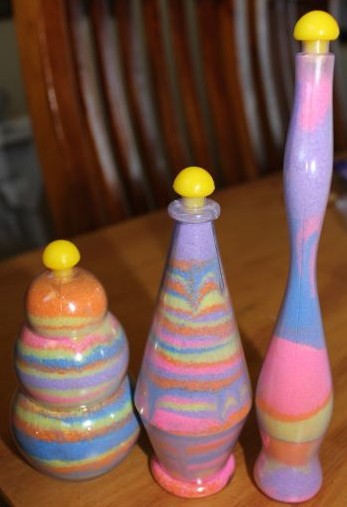
A’s first bottle was very tall and skinny, so it didn’t take much sand to make thick layers. L made her layers reasonably flat, while A liked her layers to be angled. They were unable to use the styling stick on these bottles, as the shape of them prevented the stick getting to the edge to push the sand down.

Using the styling stick.

Using the styling stick.

A's second bottle.

A’s second bottle.

A filled another bottle and we were able to use the styling stick in this one as the sides were straight and flat. A would pour a few layers, and then scrape the stick down the inside to push some of the sand down through the layers, forming unique variations in the layers. This looked really good.

Once the bottles were filled, we placed a stopper in the top to prevent the sand escaping. The sand settled a little too. Then they were ready to be displayed.

This was a fun activity, and the kids really liked it. The only disappointing thing was that the plastic of the bottles wasn’t as clear as glass would have been. As we poured the sand into the bottle some coloured dust stuck to the inside of the bottles dulling the colours a bit. This was a fairly minor issue though, and it didn’t detract from the fun of filling the bottles with sand.

I would like to try this activity again using glass bottles and other colours of sand. The layers of sand in the bottles look fantastic displayed on our shelf.

IMG_9454


Simple Easter Basket

Standard

IMG_9366

Adding the pipe cleaner handle.

Adding the pipe cleaner handle.

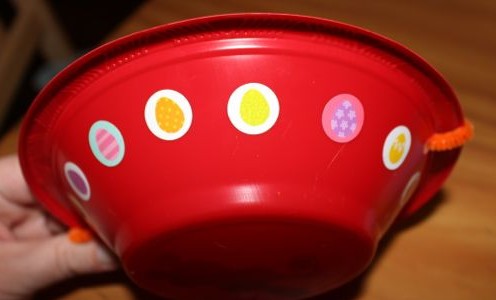
We made very simple Easter baskets this year out of plastic bowls. L and A each chose a coloured bowl, and I used a single hole punch to make a hole on either side of it. Through the holes we threaded a pipe cleaner, twisting it around on itself at each side to secure it to the bowl. The pipe cleaner was the handle of the basket.

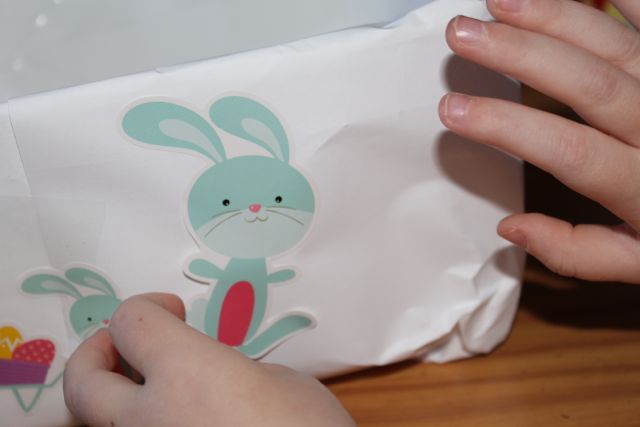
A adding stickers to the inside of her basket.

A adding stickers to the inside of her basket.

A chose to decorate her basket on the inside, adding lots of small Easter stickers around the inside, as well as some stickers on the base. L decided to put most of her stickers on the outside of her basket, with just a single bunny on the inside base. Then they were ready for the egg hunt.

The outside of L's basket.

The outside of L’s basket.

The kids ran around finding the little eggs hidden by the Easter Bunny and adding them to their baskets. The single moveable handle meant that the baskets could become unbalanced easily if the eggs were on one side of the bowl, so they had to be careful not to tip the baskets up and spill the eggs. L collected more eggs than A, so Big L helped the kids to count all of the eggs and divide them equally between them. Baby T only found two eggs, but we thought that was plenty for such a little boy. He did enjoy eating one of them very much, once I took the foil off for him.

After a successful egg hunt.

After a successful egg hunt.

Dyeing Easter Eggs

Standard

IMG_9169

L blowing out an egg.

L blowing out an egg.

A blowing out an egg.

A blowing out an egg.

Before we started this activity, I washed the eggs to remove any dirt or chicken poop from the shells. We had to blow the egg out of its shell before we could dye them, which meant making a small hole in the top of the egg, and a slightly larger hole in the other end. I was going to use a metal skewer to puncture the eggs, but I couldn’t find one, so an old-fashioned can opener did the trick. To break up the egg to make it easier to blow out, I inserted a meat thermometer and swirled it around inside for a few moments. A toothpick or wooden skewer would have also worked. Each of the kids had a go at blowing out the eggs by placing their mouth over the small opening and blowing through the egg so that the egg white and yolk was forced out the other hole into a bowl. Once all the egg came out, we ran some water into the shell and swished it about to remove any remaining traces of egg, and then blew that out too.

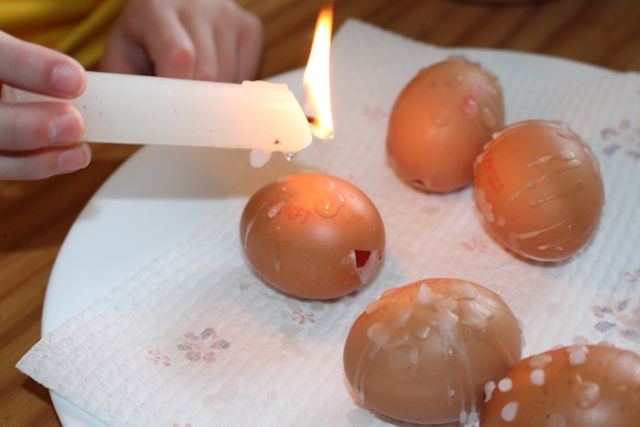
L dripping wax onto the eggshells.
L dripping wax onto the eggshells.

Adding wax to the shells.

Adding wax to the shells.

The eggshells needed to be dry before we added wax to them, so we dried them in a tea towel, being careful not to break them. I lit a candle with a match and let some of the wax melt. Then we dropped the wax onto each shell, making spots and lines. Melted wax is hot and can burn, so it was particularly important to do this part carefully and with adult supervision. L had a go at placing wax on the shells, but A did not, as I felt she was a bit young to do this without incidence.

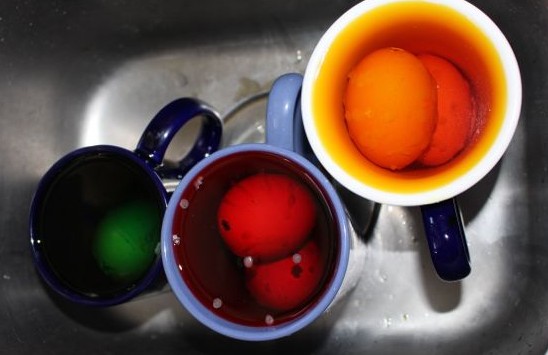
The wax dried quickly on the shells, and then they were ready for dyeing. We used food colouring in cold water for this part. We placed blue colouring into a saucepan to do multiple eggshells, while other shells were placed in cups each containing red, yellow and green coloured water. Egg shells float, so to keep them down, I filled them with the water, making them sink. We left the shells to colour for about an hour.
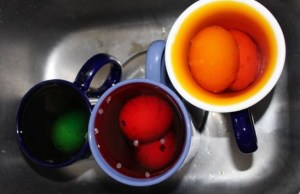
Dyeing eggshells in cups.

Dyeing eggshells in cups.

After dyeing.
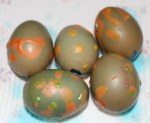
After dyeing.

Prior to removing the wax.

Prior to removing the wax.

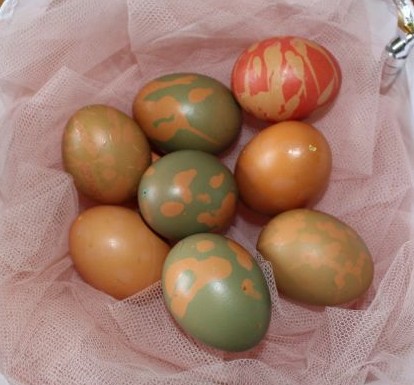
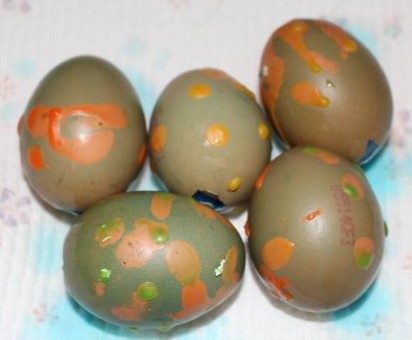
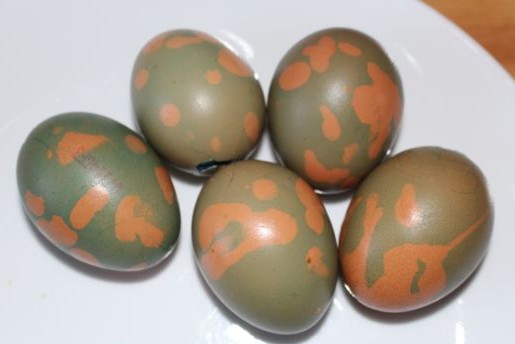
When I removed the shells from the coloured water, we shook out as much water as we could, blew out the rest, and placed them on paper towel to help absorb any excess water. Most of the wax scraped off easily with my fingernails, and the loose wax wiped off with a tea towel. The wax protected the shell from the food colouring, creating patterns of colour and natural egg shell. Blue and red were the strongest colours, and green was light, but still good. The yellow was hardly visible at all, though looking closely, it was possible to see the pattern. The colours may have been more vivid if I had had lighter coloured eggs to work with.
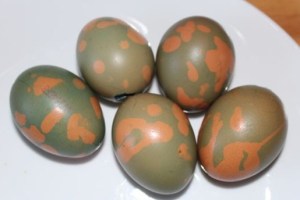
The blue eggs after the wax is removed.

The blue eggs after the wax is removed.

A adding stickers to the egg basket.

A adding stickers to the egg basket.

The kids decorated a plastic ice cream container that I had covered in white paper. They added Easter stickers and some curly ribbon to make it pretty on the outside. Inside, we placed some bunched up pink tulle to make a cushion for the egg shells to lay in. This has been placed on the table as a centre-piece.

A did drop a couple of the eggshells on the floor after we were finished, and they broke open, so she learnt to be more careful handling the shells as they are only fragile.
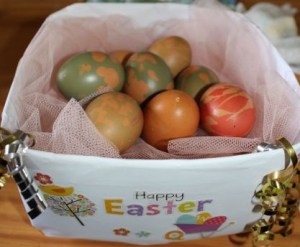
IMG_9173

Paper Plate Hot Air Balloon

Standard

IMG_8949There was recently a Hot Air Balloon Festival held near us, so we have been talking about hot air balloons a lot lately. This led to some hot air balloon craft using a paper plate and some cardboard.

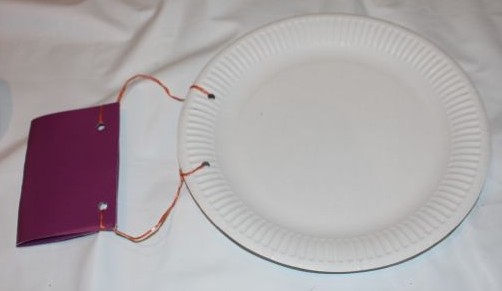
The basket attached to the balloon.

The basket attached to the balloon.

The pegs attached to the passengers.

The pegs attached to the passengers.

We used a rectangle of cardboard to make the balloon’s basket, and we attached this to the paper plate using string. A drew a picture of herself and one of her friends to be the passengers. I carefully cut around them, and we glued tiny pegs to the backs of these pictures, and left them to dry.

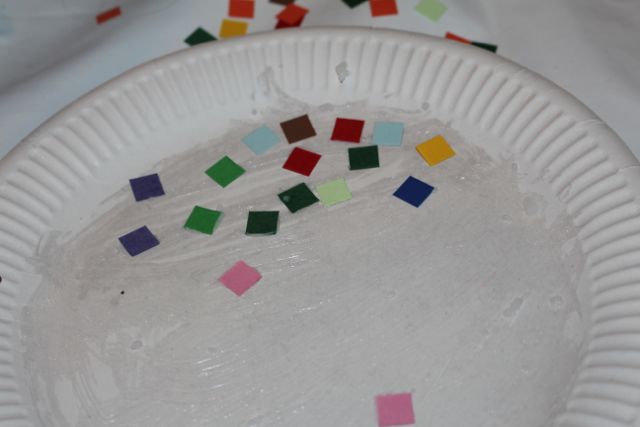
Placing the cardboard mosaics.

Placing the cardboard mosaics.

Adding more mosaics.

Adding more mosaics.

I had a bag of cardboard mosaics, which are little squares of coloured cardboard, great for decorating art and craft projects, or making pictures with. A brushed Clag glue all over the inside of the paper plate, and then she stuck the mosaics squares on randomly. We had to leave this to dry for a while.
A used the little pegs on the back of her passengers to attach them to the basket. We hung the balloon in her room and her passengers can go for a ride in the breeze from the window.


Wooden Beads

Standard
The pile of wooden beads.

The pile of wooden beads.

A found a little box of wooden beads and laces while we were tidying up her room. She asked to do some beading with them today.

Sorting the beads.

Sorting the beads.

She tipped them out into a pile, and then sorted them by colour. There was also a few bigger beads with flowers on them, and A placed all of these ones together. Once she had them in separate piles, I gave her some little cardboard labels on which I had written the French words for the colours. She read each one, and then put the label next to the correct pile.

Sorted beads with French labels.

Sorted beads with French labels.

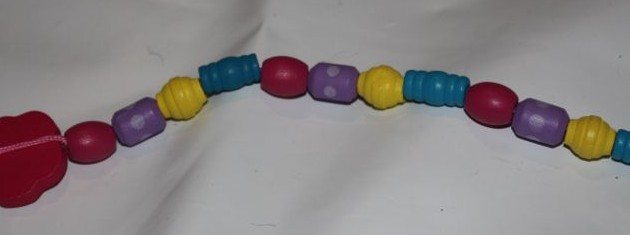
A placed the beads onto the laces, making patterns with the colours. Once she was happy with her string of beads, we hung them up in her room.

Bead pattern.

Bead pattern.

Paper Plate Rabbit

Standard

A made a paper plate rabbit today. It has paper ears, a button for a nose, googly eyes, a pipe cleaner mouth and little pom pom teeth.

IMG_8956

Adding a button nose.
Adding a button nose.
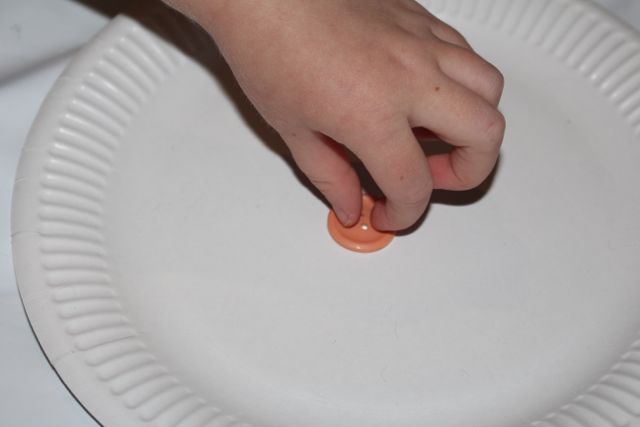
I cut out the ears for A, and she glued them together. Once she had glued the ears to the top of the paper plate, they were a bit floppy, so we added a couple of popsticks behind the ears to keep them upright. A glued down the nose, eyes, mouth and teeth, and then left it to dry.

Adding popsticks to keep the ears up.

Adding popsticks to keep the ears up.

We used the hole punch to put a hole in the plate between the ears and added some string so that it could be hung up in her room. This was pretty simple and quick, and A is very happy with her rabbit.

Backyard Teepee

Standard

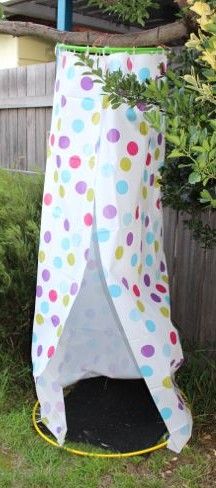
IMG_8907Our simple teepee is just the right size for one child. L has been using it for some quiet time by herself, where she can read and eat a snack in peace.

IMG_8900We used a small plastic hoop (I think it was 50cm in diameter) at the top of the teepee. To this we attached a plastic shower curtain using plastic shower curtain rings. Last time I actually had a shower curtain the rings clipped together once they went through the curtain and around the curtain rod. These curtain rings didn’t clip, and the shower curtain kept popping off them. To solve this we taped the opening of the ring shut. I overlapped the shower curtain, placing the last ring through the first and last holes to  stop it from moving around the hoop so much.

At the base, we used a larger plastic hoop (this one was 75cm in diameter). L helped me to punch holes around the bottom edge of the shower curtain with the hole punch. Then we used the rest of the shower curtain rings to attach the bottom of the curtain to the bigger hoop, and taped up the gaps.

Placing the curtain rings.

Placing the curtain rings.

Punching holes in the shower curtain.

Punching holes in the shower curtain.

I tied the small hoop onto the branch of one of our trees, to hang at about the right height for the big hoop to rest on the ground, but without the curtain billowing out too much. We didn’t have enough rope, so I used some poly string as a temporary tie until I can get some more. We added a soft-fall mat under the teepee so that the kids didn’t have to sit on the ground while they were using the teepee.

The kids are very happy with this little teepee, and they have both been playing in it. A took some toys out and had a little tea party, while L has mostly been using it as a reading spot.