Category Archives: Themes

Cardboard Roll Bunnies

Standard

IMG_9557These cute little bunnies are made from toilet rolls, but any cardboard tubes could be used. We covered the rolls with white paper first. We glued the paper to the tubes, and folded the ends inside the tube for neatness.

Making bunny ears.

Making bunny ears.

Drawing on details.

Drawing on details.

Adding a tail.

Adding a tail.


I cut out some pink cardboard for the inner sections of the white paper ears, and L glued the cardboard to the paper. The kids glued two ears into the top of their cardboard roll. Then they got busy gluing on googly eyes and using markers to add the facial features and arms. L also drew a little carrot in the hands of her bunny, which A promptly copied onto her bunny too. L drew her bunny’s feet on, but A wanted to use a white pipe cleaner as feet for her bunny. I cut two small lengths of pipe cleaner, and bent them around to form little feet, then A glued the end of them into the base of her roll.

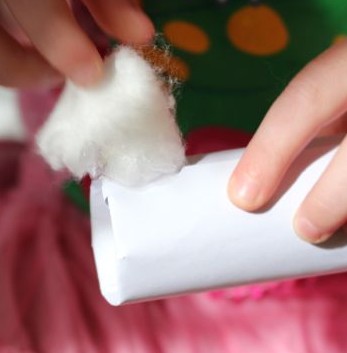
To finish the bunnies off, the kids glued a cotton ball onto the back of the cardboard roll as a tail. While we had the cotton balls out, L had an idea for making baby bunnies. She made some ears out of paper and markers, and glued them to a cotton ball. Then she added some tiny googly eyes. She gave this baby bunny to A to play with. They called this one Baby Hopsity, and the bigger bunnies were Father and Mother Hopsity.

Baby Hopsity.

Baby Hopsity.

Clay Monsters

Standard

IMG_8261L had previously used some clay at school for modelling, but this was the first time for A. We used white air drying clay, which I bought at Bunnings.

Our dry monsters.

Our dry monsters.

The clay was easy to work with, and the kids treated it much like they would have play dough. They enjoyed the sensation of squishing it in their fingers, and rolling it into balls and sausages. Once they got down to the serious business of shaping their monsters we added a little water to the clay to make it sticky enough to create features. Working with wet clay can get pretty messy too, so we worked on a muck mat, and had damp tea towels for hand (and face) wiping as necessary.

Using a paint brush to add detail.

Using a paint brush to add detail.

I let the kids decide what kind of monsters they would model, yet both of them decided to make serpent monsters. Neither of the kids are particularly keen on snakes, so perhaps they thought snake-shaped monsters would make very scary clay monsters.

Making the clay smooth with water.

Making the clay smooth with water.

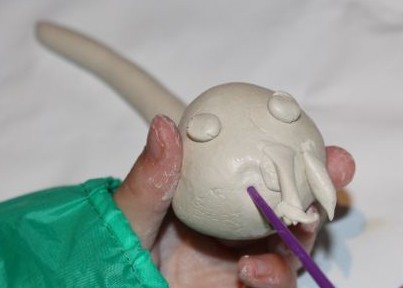
A made her clay into a long body with a little head, while L made her snakey monster with a huge head and fangs. L used a paintbrush to add some details to her serpent, such as a mouth. A painted water along the body of her snake until it was very smooth. Her monster really looked like a snake, but she assured me that it was a really terrifying monster. A also made a funny little spotty blob monster, which she said was like a germ.

My monster with umbrella.

My monster with umbrella.

I also made a clay monster of my own, because playing with clay is just fun. My monster was a bit of a blob with four feet, and numerous eyes made by poking the clay with a toothpick. It is also holding a clay umbrella with a toothpick handle. The umbrella was L’s idea, and I love it, it made my monster very quirky, especially since it doesn’t have hands or even arms for that matter, so I think it is holding the umbrella with its side! It has a tail that looks a bit like the opening of a trumpet, and three spikes on its head, but no nose.

The germ monster.

The germ monster.

We placed the monsters onto plastic wrap so they wouldn’t stick to anything, and then left the monsters to dry completely, which took a few days. This was not helped by a bout of rain at the time, keeping the air moist. While they were drying we were careful not to move them or bump them.

L thought she might like to paint her monster once it was dry, but in the end we left them as is. I quite like all of the clay monsters that we made, and we have placed them onto a shelf for display.


Rainy Day Pictures

Standard

IMG_9777While I was walking down one of the hallways at L’s school I spotted some wonderful rainy day art on the wall done by one of the classes. I liked them so much we tried them at home. At school they had used oil pastels and edicol dye, but we substituted watercolour paints, as we didn’t have the dye.

L drawing her picture.

L drawing her picture.

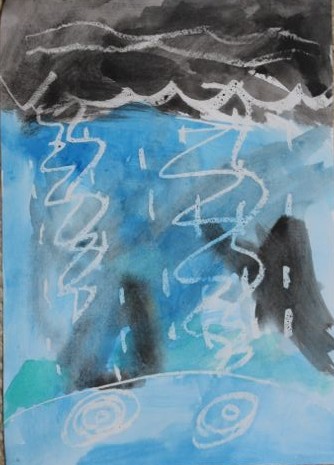
First we drew a picture using the oil pastels. Most of the picture was drawn in white, including the clouds and raindrops. L put big bolts of lightning on her first one too. I also drew a picture and added a rainbow to it as an example for A of what we could do. A copied this picture, adding rainbows to her art.

Adding watercolours paint.

Adding watercolours paint.

Once we finished drawing with the oil pastels, we used watercolour paint to cover the paper. The oil pastels resist the paint, so that only the blank paper is coloured, and the picture emerges clearly. I used black and blue for my clouds, light blue for the sky and light green for the hills. L made her first picture very blue with deep black clouds at the top. She also added some black in the background, giving her picture a cityscape look. She told me that the swirls at the bottom are from the drops of rain, but I think they look like scorch marks from her lightning. A had one picture copied from mine with black clouds, blue sky and green hills, but her other one was almost all blue. For this one she added some purple across the bottom, mixing it with the blue, and told me it was a river with lots of fish.

A's second picture.

A’s second picture.

My rainy day painting.

My rainy day painting.

L's thunder storm.

L’s thunder storm.


A has a tendency to use a lot of paint in her art, and this left her paper quite wet and a bit soggy in places. Mine and L’s paintings dried quickly, but we had to wait a while for A’s. We have our rainy day pictures displayed on our living room wall.

Tie Dye

Standard
Mirrored fold.

Mirrored fold.

IMG_9696We just had to try tie dyeing, it is so much fun, and it produces some beautifully unique and bright clothes. We used basic white cotton t-shirts and singlets for our tie dyeing, but it suits lots of other garments and cloth items too. I bought the tie dye kit from Educational Experience, as I wanted an all inclusive starter pack to help us get this fabulous activity right. This kit even came with a very handy DVD showing how to make some of the popular folds for tie dying.

L creating a swirl fold.

L creating a swirl fold.

All tied up.

All tied up.

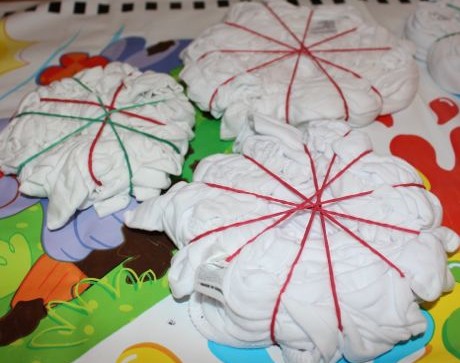
We washed our shirts, and then folded and tied them up in various ways while they were still damp. L was quite good at getting her shirts folded, A needed a little help, especially when placing the rubber bands around the fabric. They tried swirls, scrunches and concertina folds. I also helped A place one of her singlets into lots of little puffs of fabric each secured tightly by a rubber band. I also tied up some shirts. My favourite to do was making the swirl.

Soaking in the soda ash solution.

Soaking in the soda ash solution.

The shirts had to soak in soda ash solution for at least twenty minutes. We did this in one of our large nappy buckets (a clean one!). While they were soaking we got our dyeing area set up. We did it outside to minimise the potential for getting dye on anything that it wouldn’t come out of, like the carpet. I laid down a muck mat on the grass, and the kids wore old clothes and art smocks, as well as gloves to protect their hands. The kit came with dye applicator bottles that required the addition of water and vigourous shaking to make the dye usable, so I did this, and then we could start. There were three dyes, red, blue and yellow, but these were easy to mix to make sections of purple, green or orange.

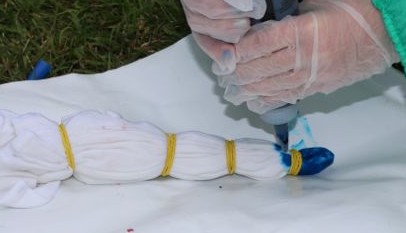
L dyeing the end of her bull's eye short blue.

L dyeing the end of her bull’s eye shirt blue.

Excess soda ash solution was squeezed out of each shirt as we removed it from the soaking bucket. Then it was ready for the dye to be applied. The kids enjoyed putting the dye onto their shirts in various colour combinations. It was very messy though, and even with the protective clothing, both kids had splashes of dye on their skin. A kept touching her face, resulting in numerous dye splotches on her forehead and cheeks, and L splattered some blue dye onto her legs. It didn’t wash off our skin with the first wash, but it was mostly gone by the following day.

Dyeing a swirly shirt.

Dyeing a swirly shirt.

Some dye ran off onto the plastic muck mat, so we opted to place our shirts onto cake cooling racks to help reduce the run-off dye from getting on the fabric where we didn’t want it. We also wiped down the mat with paper towel and washed dye off our hands in between shirts. When each shirt was finished receiving dye, it was placed into a plastic zip-lock bag to rest for about 24 hours.

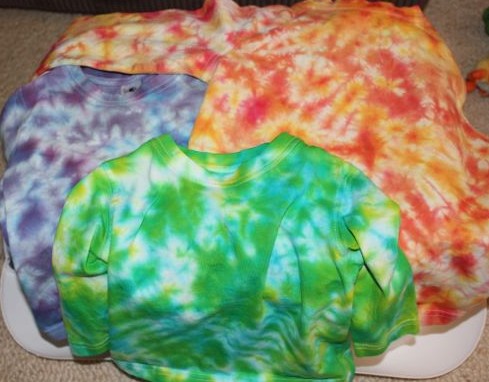
After waiting a whole day, I rinsed the shirts out, removing excess dye. I removed all the rubber bands, and rinsed them some more, and then washed all of them in a regular wash. The first round of rinse water from the machine was still pretty blue, but it ran clear after that. I hung all the shirts up to dry. It was a spectacular row of colour hanging on my line. All the patterns came out wonderfully and the kids are so happy with them.

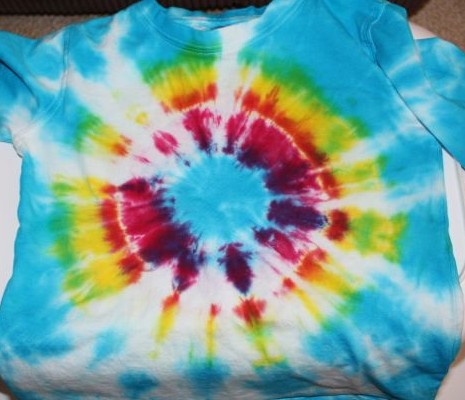
Spirals.

Spirals.

Scrunch pattern shirts.

Scrunch pattern shirts.

L's bull's eye.

L’s bull’s eye.

This is A's singlet that had all the little tufts of fabric caught in rubber bands. The whitish circles is where the rubber bands were.

This is A’s singlet that had all the little tufts of fabric caught in rubber bands. The whitish circles are where the rubber bands were.

The left singlet was folded in quarters and the right was vertically concertina folded.

The left singlet was folded in quarters and the right was vertically concertina folded.


The Worst Witch by Jill Murphy

Standard

IMG_9756The Worst Witch by Jill Murphy, paperback novel, 107 pages, first published by Allison and Busby in 1974, this edition was published by Puffin Books in 1978.

Mildred Hubble is in her first year at Miss Cackle’s Academy, a school for young witches. Disaster and trouble seem to travel in her wake as she navigates broomstick riding, basic spellcraft and potions, along with her best friend, Maud. While the school is headed by a jovial Miss Cackle, the girls are under the ever watchful eye of the severe Miss Hardbroom, their form teacher. Unfortunately for Mildred, she has found herself on the bad side of Ethel, another student. Not only is Ethel a better witch than Mildred, she is also the teacher’s pet, and she has a mean streak.

Witches are often portrayed as old, ugly and mean, but The Worst Witch shows a different side to witches. In this fantasy story, children are learning to become witches, and while some of them are mean, most of them are fairly normal kids just trying to get along in their schooling. Children can relate to Mildred’s dilemmas, even if they are of a more magical nature than their own. It is a fairly short and easy novel with some black and white illustrations scattered throughout. It is good for younger readers who are moving on from chapter books, suiting lower to middle primary school children. I read this book as a child, and it was nice to be able to share it with my own children. I found that I still enjoyed the story as an adult, and my second grader has already read it through a number of times. She is looking forward to finding the other books in this series.

Cardboard Roll Chicks

Standard

IMG_9564

Gluing on the yellow paper.

Gluing on the yellow paper.

The roll covered in paper. The edges have been folded into the roll.

The roll covered in paper. The edges have been folded into the roll.

We used toilet paper rolls for these chicks, but rolls from paper towel or similar could have been cut in half to use instead. We covered the cardboard rolls in yellow paper so that the paper extended beyond the ends of the roll. We cut these sections just to the edge of the cardboard to create a fringe of paper at the ends of the roll.  Then we folded the excess paper fringe into the centre of the roll to make a neatly covered cardboard roll.


Adding feet.

Adding feet.

Adding eyes.

Adding eyes.

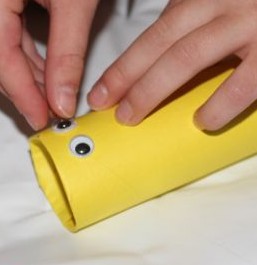
I cut out some feet shapes from orange cardboard and the kids added them to the base of their rolls. Each foot had a little tab of cardboard folded up and glued on the inside of the roll. L and A added googly eyes and the beaks were made from a small piece of pipe cleaner folded into a little triangle and glued onto the roll.

L cut down some yellow feathers to the size she wanted, and placed them on the sides of her chick for wings. She also glued a small piece of feather to the back as a tail. A cut up feathers to use on her chick too. She added wings, a tail, and some hair to her chick. Both chicks are really cute.

The back of L's chick.

The back of L’s chick.

Showing the placement of feathers on A's chick.

Showing the placement of feathers on A’s chick.


Egg Nests

Standard

IMG_9440I’ve made these little egg nests a few times in the last couple of years, but I can’t remember where the idea came from originally. They are a big hit with the kids, and really easy to make.

Mixing.

Mixing.

I’m not great at measuring things when I cook, and if I’m not following a recipe I’m even worse, so I just estimated the amounts. I used about three cups of Kelloggs rice bubbles, and about two-thirds of a packet (250g) of Cadbury white chocolate melts.

The kids put the patty pan cases into the muffin tray, and then got ready to mix the chocolate and rice bubbles. I melted the chocolate in the microwave in a ceramic bowl in thirty second bursts, stirring regularly until the chocolate was smooth. I poured it into the mixing bowl and the girls got mixing. Their wooden spoons clashed a few times, and some of the mix went flying, but they had fun, and they got the job done. It’s best to mix quickly before the chocolate cools too much.

Filling the cases.

Filling the cases.

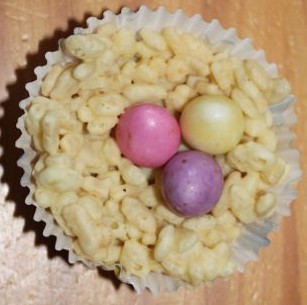
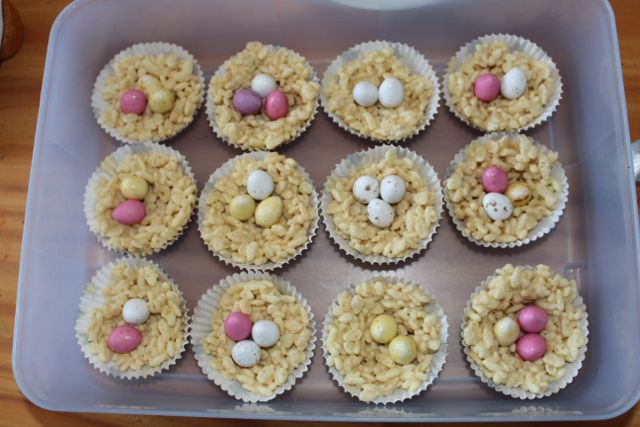
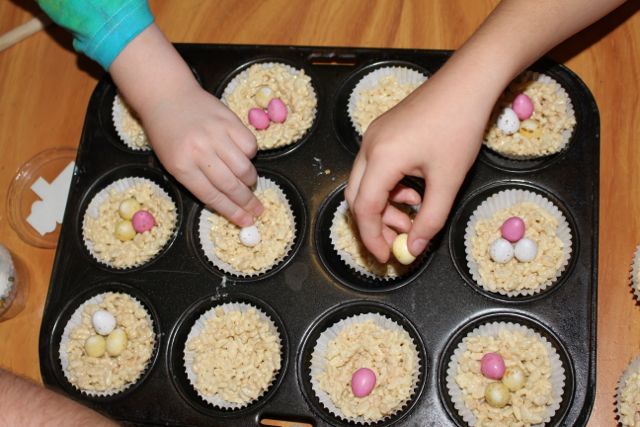
Once mixed, we used a desert spoon and a teaspoon to place some of the mixture into each of the patty pan cases. We pushed the mixture down, and then formed a well in the centre using the teaspoon (this is where the eggs sit). Once we’d filled the muffin tray, we still had some mixture left over, so I carefully spooned it into some loose patty pan cases in the same way. All up this mixture made sixteen egg nests.

Adding the eggs.

Adding the eggs.

Then it was time to add the little eggs to the nests. These eggs are Cadbury mini-eggs which are milk chocolate on the inside with a candy coating. I like these mini-eggs because they have speckled shells, and nice colours, but I only seem to be able to get them at Easter. We have used other mini-eggs at other times of the year which were bright colours, and a little smaller than these, I think. They still worked nicely. The kids placed two or three eggs into each nest (and possibly a couple into their mouths!). The tray and the extra patty pan cases went into the fridge to set.

Once the chocolate was set these egg nest treats didn’t last long!

Ready to eat.

Ready to eat.


Simple Easter Basket

Standard

IMG_9366

Adding the pipe cleaner handle.

Adding the pipe cleaner handle.

We made very simple Easter baskets this year out of plastic bowls. L and A each chose a coloured bowl, and I used a single hole punch to make a hole on either side of it. Through the holes we threaded a pipe cleaner, twisting it around on itself at each side to secure it to the bowl. The pipe cleaner was the handle of the basket.

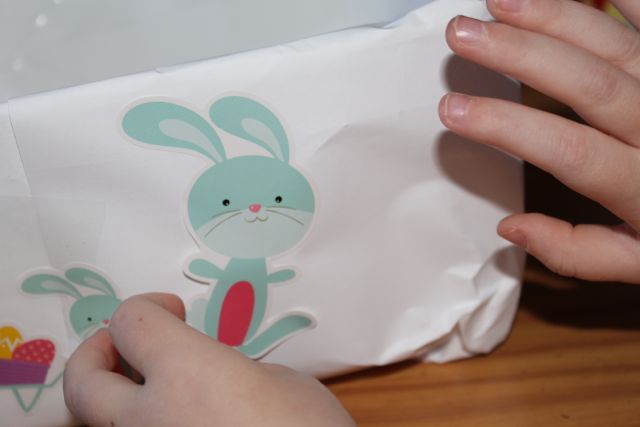
A adding stickers to the inside of her basket.

A adding stickers to the inside of her basket.

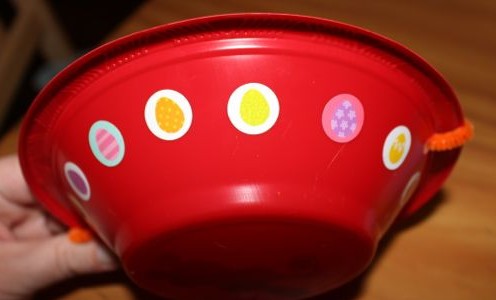
A chose to decorate her basket on the inside, adding lots of small Easter stickers around the inside, as well as some stickers on the base. L decided to put most of her stickers on the outside of her basket, with just a single bunny on the inside base. Then they were ready for the egg hunt.

The outside of L's basket.

The outside of L’s basket.

The kids ran around finding the little eggs hidden by the Easter Bunny and adding them to their baskets. The single moveable handle meant that the baskets could become unbalanced easily if the eggs were on one side of the bowl, so they had to be careful not to tip the baskets up and spill the eggs. L collected more eggs than A, so Big L helped the kids to count all of the eggs and divide them equally between them. Baby T only found two eggs, but we thought that was plenty for such a little boy. He did enjoy eating one of them very much, once I took the foil off for him.

After a successful egg hunt.

After a successful egg hunt.

Dyeing Easter Eggs

Standard

IMG_9169

L blowing out an egg.

L blowing out an egg.

A blowing out an egg.

A blowing out an egg.

Before we started this activity, I washed the eggs to remove any dirt or chicken poop from the shells. We had to blow the egg out of its shell before we could dye them, which meant making a small hole in the top of the egg, and a slightly larger hole in the other end. I was going to use a metal skewer to puncture the eggs, but I couldn’t find one, so an old-fashioned can opener did the trick. To break up the egg to make it easier to blow out, I inserted a meat thermometer and swirled it around inside for a few moments. A toothpick or wooden skewer would have also worked. Each of the kids had a go at blowing out the eggs by placing their mouth over the small opening and blowing through the egg so that the egg white and yolk was forced out the other hole into a bowl. Once all the egg came out, we ran some water into the shell and swished it about to remove any remaining traces of egg, and then blew that out too.

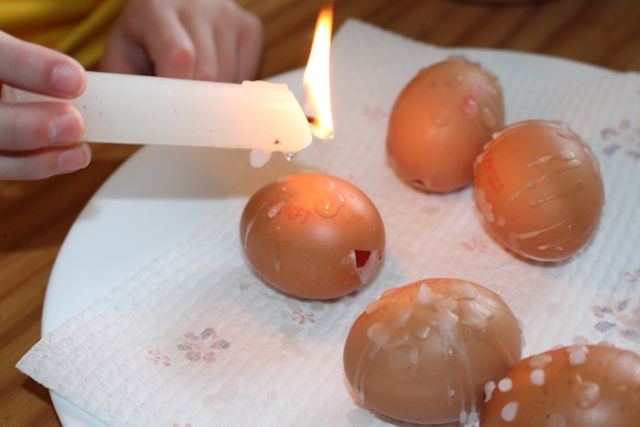
L dripping wax onto the eggshells.
L dripping wax onto the eggshells.

Adding wax to the shells.

Adding wax to the shells.

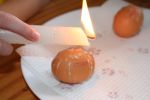
The eggshells needed to be dry before we added wax to them, so we dried them in a tea towel, being careful not to break them. I lit a candle with a match and let some of the wax melt. Then we dropped the wax onto each shell, making spots and lines. Melted wax is hot and can burn, so it was particularly important to do this part carefully and with adult supervision. L had a go at placing wax on the shells, but A did not, as I felt she was a bit young to do this without incidence.

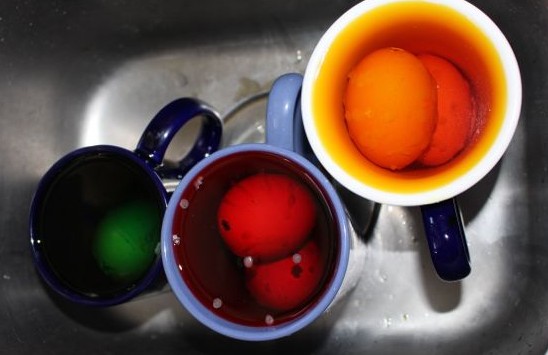
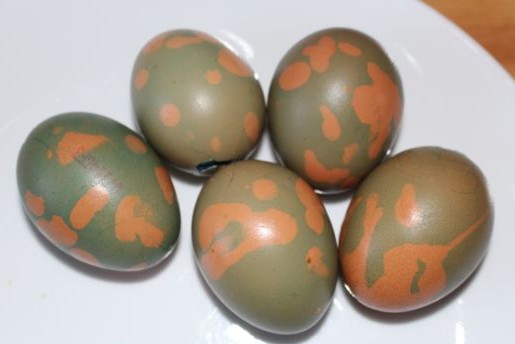
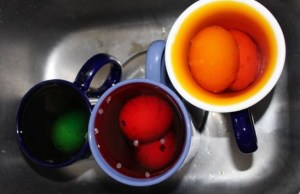
The wax dried quickly on the shells, and then they were ready for dyeing. We used food colouring in cold water for this part. We placed blue colouring into a saucepan to do multiple eggshells, while other shells were placed in cups each containing red, yellow and green coloured water. Egg shells float, so to keep them down, I filled them with the water, making them sink. We left the shells to colour for about an hour.
Dyeing eggshells in cups.

Dyeing eggshells in cups.

After dyeing.
After dyeing.

Prior to removing the wax.

Prior to removing the wax.

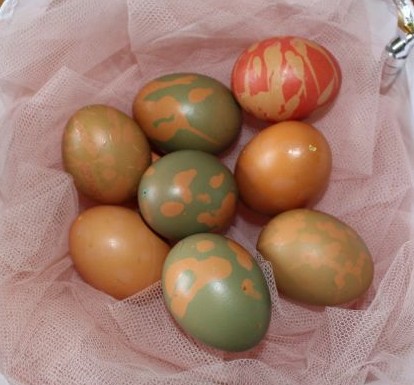
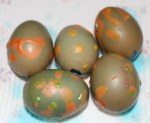
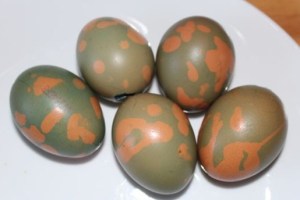
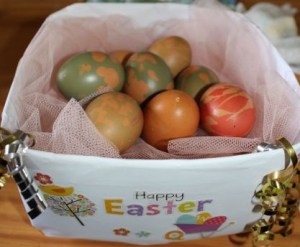
When I removed the shells from the coloured water, we shook out as much water as we could, blew out the rest, and placed them on paper towel to help absorb any excess water. Most of the wax scraped off easily with my fingernails, and the loose wax wiped off with a tea towel. The wax protected the shell from the food colouring, creating patterns of colour and natural egg shell. Blue and red were the strongest colours, and green was light, but still good. The yellow was hardly visible at all, though looking closely, it was possible to see the pattern. The colours may have been more vivid if I had had lighter coloured eggs to work with.
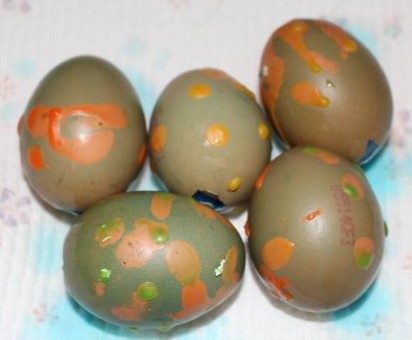
The blue eggs after the wax is removed.

The blue eggs after the wax is removed.

A adding stickers to the egg basket.

A adding stickers to the egg basket.

The kids decorated a plastic ice cream container that I had covered in white paper. They added Easter stickers and some curly ribbon to make it pretty on the outside. Inside, we placed some bunched up pink tulle to make a cushion for the egg shells to lay in. This has been placed on the table as a centre-piece.

A did drop a couple of the eggshells on the floor after we were finished, and they broke open, so she learnt to be more careful handling the shells as they are only fragile.
IMG_9173

Easter Chocolates

Standard

I wanted to try making some Easter shaped chocolates this year with the kids, as I thought it would be fun. We were given a number of plastic chocolate moulds by a good friend, and my mother also gave us a silicone chocolate mould to try. We started with the silicone mould.

IMG_9124We didn’t make our own chocolate, we used choc melts, in milk chocolate and white chocolate. I melted small batches of the melts in a ceramic bowl in the microwave for about 30 seconds at a time. Each time the microwave dinged, I mixed the chocolate with a spoon to make sure that it was melting evenly and not burning on the bottom of the bowl. It’s very important to remove the spoon from the bowl before it is placed in the microwave!

Chocolate mould.

Chocolate mould.

I did not let the kids handle the bowl with the melted chocolate, as it can be very hot. I used an oven mitt to prevent burning myself on the bowl when removing it from the microwave. After a minute or two it was normally cool enough to touch, but we still had to be very careful.

Mixing the hot chocolate.

Mixing the hot chocolate.

Ready for the fridge.

Ready for the fridge.

As silicone is floppy, we used a plastic cutting board underneath the mould to prevent it from drooping and spilling the chocolate. We transferred the melted chocolate into the mould one spoonful at a time, carefully filling each hole to the top and smoothing it out. Inevitably, we dripped chocolate onto the cutting board, mould and even on the bench. The kids didn’t mind swiping it up on a finger and popping it in their mouths. Once all the holes on the mould were filled, we placed it in the fridge to set.
Placing the chocolates onto the cellophane.

Placing the chocolates onto the cellophane.

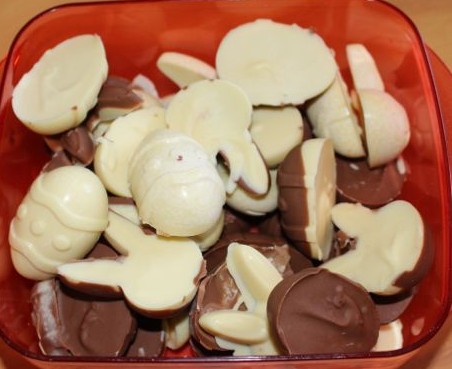
We made some plain milk chocolate, some white chocolate, and some we mixed together to marble the chocolate. I also had a go at layering the chocolate. I found it was best to let the first layer set in the fridge for about fifteen minutes before adding the second layer.

Forming a bundle.

Forming a bundle.

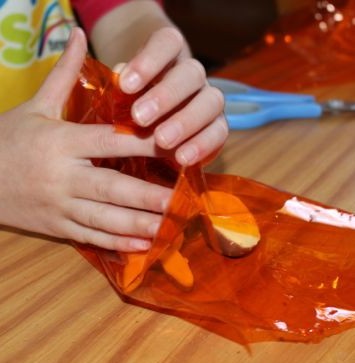
The kids cut some cellophane into squares and placed about four chocolates onto each square, then brought the cellophane up around the chocolates creating a little bundle. We added some curling ribbon to tie it up, and I curled it with scissors. L tried to curl her own ribbon, but she didn’t quite manage it. They want to give their little parcels of Easter chocolates to relatives.

Little parcels of Easter chocolates.

Little parcels of Easter chocolates.